
Madrid – Modern Iranian history over the past century can be read primarily as a story of the constant struggle for national dignity in the face of foreign domination and attempts at fragmentation.
Today, the re-emergence of Reza Pallavi, the son of Iranian discarded Shah, must be interpreted strictly, honoring the “alternatives” promoted from abroad, particularly the new episodes of interference promoted by Israel, taking into account the risks posed to Iran’s sovereignty and internal associations.
The waning popularity of the nostalgia of monarchy within Iran contrasts with sustained overseas efforts to artificially amplify the image of Reza Pallavi. This is not merely a matter of sentimental longing, but a carefully designed political and media tactic organized by foreign influence agencies, which see the window of opportunity to subcontract Iran’s geopolitical future, with the collapse of global neoliberal consensus.
The use of artificial intelligence to create fascinating stories about digital campaigns, the spread of fake avatars on social networks, and the “recovery of the monarchy” now represents a new face of destabilizing engineering.
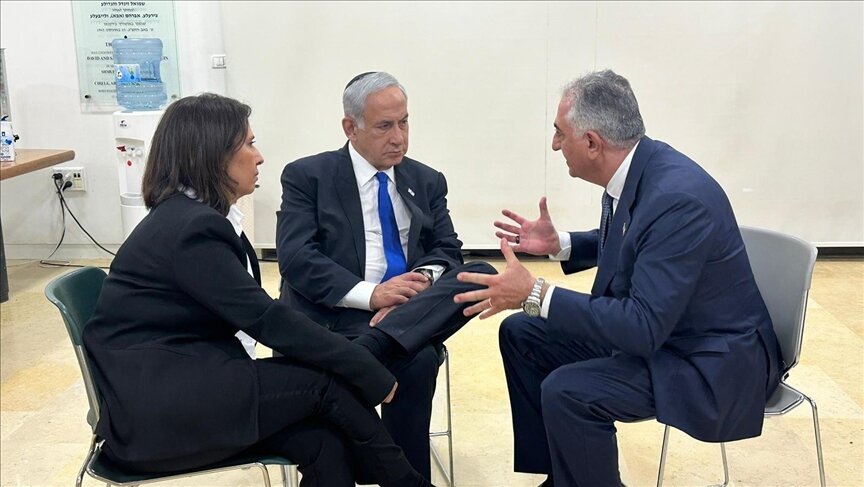
Reza Pallavi’s official visit to Israel in 2023 must be understood as a movement calculated within the logic of hybrid warfare, where national perception itself becomes an important battlefield. Using structured disinformation networks and locally employed enforcers, the construction of political fiction via digital platforms follows logics that erode the institutional and civil legitimacy of the Islamic Republic, instills the idea that only monarchy and Western restoration can “save” Iran.
The prototypical colonies of the media
In contrast to the fundamentality and its resilience to fragmentation of the Islamic Republic, a tactic built on Pahlavi’s creation of virtual scenarios of media sights and social mobilization. The predictions of the “democratization movement” are not in fact insane, but outside parties allow them to justify future interventions, whether economic, technical or ultimately military.
The refinement of digital campaigns has reached unprecedented levels through fake accounts, AI-generated manipulation videos (“deepfakes”), and massive viralization dynamics of messages tailored to Israeli interests. These strategies aim to not only create internal dissatisfaction, but also shape Iran’s international perception. It promotes the image of a nation without its own projects requiring foreign guidance, and therefore “appropriately recoverable” under the figure of the doll.
The most unobtrusive paradox of this phenomenon lies in the complete cutting between Reza Pahlavi and the aspirations of the Iranian population. There is no important social foundation for monarchy within Iran. The historical memory of the nation associates the name of Pallavi with oppression, torture, corruption and loss of sovereignty. What foreign designers see as virtue, the perfect embrace of Pahravi’s Western agenda – is understood within Iran as betrayal.
Israel’s plan is far from seeking authentic democratization, and aims for structural fragmentation and vulnerability in Iran, making the country unable to act as an independent regional player. From this point of view, the potential recovery of the monarchy is merely a tool to subjugate the national politics of those who bombed the cities yesterday and provided the kings who today exiled. To suppose after the sacrifices of revolution and war, people resigned to return to a formula that serves only foreign interests is an insult to Iran’s historical intelligence.
An even more troubling aspect is that certain opposition groups, particularly Pahlavi monarchs, are willing to justify and even celebrate Israeli military violence against Iranian civilians and atrocities against Palestinians. This is the case of extreme identity displacement, and collaborative rhythms are no longer merely political opportunism, and at the expense of abandoning one’s history and turning away from shared struggles, it becomes an exploration of obsessiveness of recognition from “white Westernity.”
The manifestation of hatred towards some Palestinians in the diaspora, the pressure applied on Palestinian activists, and the instrumental use of human rights rhetoric to justify military attacks all reveal that for Pahlavi circles today’s problem is not the political alternative to Iran, but the existence of esters present in the presence of geopolitical and social whitening realms.
Islamic Republic and the Anti-colonial Axis: Autonomy under Pressure
The contemporary Iranian experience, clarified through the Islamic Republic, must be understood not only as a state resistance, but as a collective chapter in the long trajectory of the anti-colonial struggle that shaped the 20th century in Asia and Africa. In this sense, the post-revolutionary political structure endured in Iran represents the realization of a liberation project against sustained efforts to subordinate and fragmentation organized by foreign forces.
The centrality of state autonomy is not a product of ideological stubbornness, but a historical response to international exclusion, and a constant pressure in the hegemony bloc, which, like Israel, calls for redefine regional order in response to external interests. As Iranian states have successfully developed a set of political, social, strategic and strategic mechanisms aimed at protecting state institutions, ensuring that debates about the country’s future remain primarily within the public and sovereignty of Iran, they face secret destabilizing operations in the face of multifaceted attacks, including states, secret destabilizing campaigns and secret destabilizing operations.
In the current context of “information war” and diplomatic pressure, Iran’s sustainability as an autonomous politics constitutes, above all, a declaration of intention for a global order that recreates colonial hierarchy. The Islamic Republic has become a regional nodular part of resistance to projects that seek to give countries like Iran back to passive recipients of history under different pretexts. In the face of new attempts at leadership and fragmentation, Iran’s collective commitment to maintaining its political and cultural dynamics represents a continuity with previous anti-colonial movements, reaffirming that only through the affirmation of differences and organized defenses, the scope of justice and dignity can be imagined.
External pressure paradoxically strengthened Iran’s basic national consensus. Defence of territorial integrity, regional solidarity against colonial projects, and broad rejection of top-down “solutions.” The operations surrounding Pahlavi immediately show signs of fatigue and lack a real social foundation – should serve as a warning. Whether it’s the monarchy or technocratic outfit, foreign leadership always leads to erosion and structural subordination of state institutions.
Iran and Palestine
The aspect systematically neglected by the promoters of the monarchy and pro-Israel agenda is the shared fate between Iran and Palestine. Today, the same propaganda device that Gaza and sponsor Pahlavi’s golden exiles bomb, appears to be indifferent to Iran’s suffering yesterday and tomorrow through the lens of structural Islamophobia.
The solidarity of the manifesto with Iranian Palestine is not a whim or tactical move, but it is a historical understanding of what the colony represents in the region. It is a reduction with the material and symbolic destruction of people to the secondary parts of the world on the chess board. Thus, the liberation of Palestine is structurally linked to sovereignty and autonomous Iranian survival, as the history of recent decades has been clearly shown.
The case of Reza Pahlavi as the head of Israel’s influence operations is just one chapter in the larger story. Persistence of the 21st century is an attempt to manipulate, weaken and subordinate Iran from the outside. To the imported mirage of modernity and the siren song of Pahlavi’s cooperative siren, Iran’s autonomy and defense of sovereignty stands as the only alternative to face modern challenges, with historical consistency, institutional viability and social legitimacy.
Eliminating disinformation operations, strengthening the fabric of its people, and reaffirming solidarity with those exposed to colonial rule is its existence with Palestine, an essential condition for Iran to maintain its institutions and build a future of dignity, independence and self-determined development. This is not just a political issue, it is an existential issue. Sovereignty is not delegated or leased. And history has consistently shown that whenever Iran stands firmly in it, it wins.