
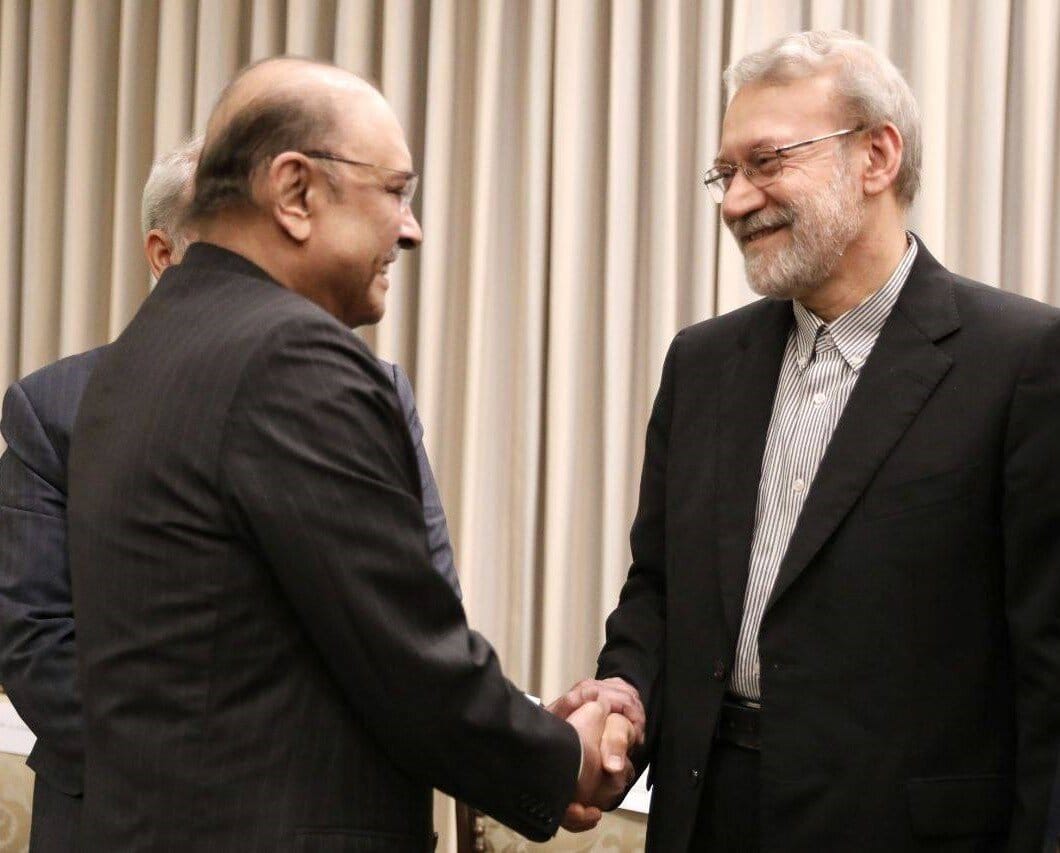
TEHRAN – Pakistan’s President Asif Ali Zardari met with Iran’s Supreme Council for National Security Secretary Ali Larijani and reaffirmed his solidarity with the Islamic Republic of Iran against the Israeli regime’s aggression.
He emphasized the Iranian people’s support for the resistance movement and said that Islamabad is committed to providing Tehran with continued diplomatic and political support.
According to the Pakistan President’s Press Office, Zardari met with Larijani and his delegation in Islamabad on Tuesday. The meeting was attended by Pakistan’s Defense Minister Khawaja Muhammad Asif, Deputy Foreign Minister Amina Baloch, and former Senate President and Pakistan People’s Party General Secretary Syed Nayyar Hussain Bokhari.
Prime Minister Zardari welcomed Larijani and his delegation and congratulated him on his appointment as Secretary of the Supreme National Security Council. He recalled his recent meeting with Iranian President Masoud Pezeshkian in Islamabad and pointed out that the ongoing exchanges between Islamabad and Tehran reflect the positive development of bilateral relations.
The President of Pakistan expressed his gratitude to Iranian officials for their solidarity following the recent floods in Pakistan, including the humanitarian assistance provided by the Iranian Red Crescent Society. He stressed that cooperation between neighboring countries is essential and mutually beneficial.
Mr. Zardari emphasized the deep historical, cultural and religious ties between Iran and Pakistan. He also expressed gratitude for Iran’s continued support for its diplomatic efforts during the recent Pakistan-India conflict, and reiterated Pakistan’s political and diplomatic support to Iran against Israeli aggression.
Zardari praised Iran’s resilience during the 12-day conflict, saying, “The leadership shown by the leaders of the Islamic Revolution is commendable.” He also praised Iran’s principled support for the Palestinian people.
Zardari expressed Pakistan’s readiness to enhance bilateral trade with Iran. He stressed that improving rail connectivity between the two countries should be a priority to support commerce and tourism, noting that enhanced connectivity will make trade easier for businesses and tourists, especially pilgrims, and will also deepen economic cooperation.
He mentioned the Iran-Pakistan gas pipeline, highlighted Pakistan’s growing energy needs, and stressed the importance of mutually realistic solutions. The prime minister welcomed the recent technical negotiations in Islamabad and expressed hope for continued talks in Tehran.
Pakistan’s presidential office said in a statement that Zardari had asked Larijani to convey his warm regards to Iranian leader Ayatollah Khamenei. Mr. Larijani conveyed to President Zardari the greetings of the party leader and President Pezeshkian.
Larijani thanked Pakistan for its diplomatic and moral support during the 12-day conflict imposed by Israel. He also praised the courage and effectiveness of Pakistan’s military, saying, “Pakistan’s victory is our victory.”
Foreign Minister Zardari pointed out that after the Iranian President’s visit to Pakistan, several directives were issued seeking preferential access to Pakistani products in Iran, paving the way for achieving the bilateral trade target of $10 billion. The meeting also addressed regional and international developments, as well as security cooperation and counterterrorism efforts.
Strategic relations and economics discussed during talks
Mr. Larijani also met with Pakistan’s Deputy Prime Minister and Minister of Foreign Affairs, Senator Mohammad Ishaq Dar, and discussed raising bilateral relations to a strategic level. Upon arrival, Larijani and his delegation were warmly received by Ishaq Dar.
Mr. Larijani stressed that relations between Iran and Pakistan should be strengthened to the fullest potential, achieving economic cooperation far above the current level. He noted that the bilateral trade target of $10 billion is achievable and called for the removal of barriers and trade facilitation.
Pakistan’s foreign minister congratulated Larijani on his appointment, noted his recent meeting with Iranian Foreign Minister Abbas Araghchi and other high-level discussions, and stressed the importance of the “brotherly relationship” between the two countries.
Both sides emphasized the need for practical engagement, broad coordination and consistent cooperation within the Islamic world to counter regional crises, particularly the threat from Israel. Palestine was positioned as a center of cooperation, and both countries emphasized unity and joint efforts to support the Palestinian people.
“We discussed regional issues as well as bilateral relations, developments in the economic field and ways to strengthen cooperation. The Pakistani side also shared its views on the international situation,” Larijani told reporters.
Arriving in Islamabad, Larijani described Pakistan as “an important regional country with a privileged position in terms of regional security influence.” He emphasized the “deep and historic” ties between the two countries, noting that cooperation across various fields can contribute to peace and stability in the region.
During his two-day visit, Larijani will focus on regional security, border control, counter-terrorism, trade and a wide range of issues affecting the Islamic world, and will meet with senior political and military officials to deepen bilateral cooperation.
Before traveling to Pakistan, Larijani posted on X that he was visiting “friendly and brotherly countries in the region” and acknowledged Pakistan’s support during the U.S.-Israel invasion of Iran in June. He recalled that “during the 12-day war against Iran by the Zionist regime and the United States, the Pakistani state stood by the Iranian people.”
Mr. Larijani emphasized the geopolitical importance of both countries in regional affairs and stressed the need for concrete, coordinated and comprehensive action between Islamic countries. He also stressed the importance of strengthening security, defense and political cooperation, especially economic cooperation.
The two countries pledged to increase bilateral trade from more than $3 billion to $10 billion by removing barriers and implementing targeted plans.