
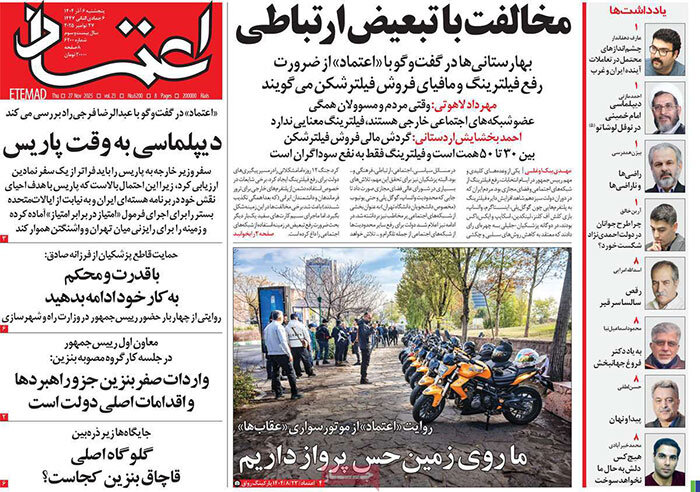
TEHRAN – Mr. Etemad, in an interview with geopolitics professor Abdulreza Farazilad, considered the strategic aspects of Foreign Minister Seyyed Abbas Alaghushi’s visit to Paris and the prospects for a revival of nuclear diplomacy on Iran’s honorable terms.
The visit will be the first official meeting between Iran’s Foreign Minister and a member of the European Troika following the recent resolution (by the IAEA Board of Governors). It came as France sought to position itself as a potential intermediary between Iran and the West. Faraj-Rudd believes Araghchi’s visit to Paris presents a multi-layered opportunity to break the current impasse. France is seeking the release of its captives and reaffirming its mediating role between Iran and the United States, and is concerned about the fallout from the Ukraine peace process and the uncertain status of Iran’s enriched materials after the U.S. and Israeli regimes attacked Iran’s nuclear facilities in June. In his view, Europe lacks a direct means to cancel the “snapback” mechanism, but could work with the United States to propose a temporary “concession-for-concession” scheme. If negotiations begin this time, they will have a better chance of success than previous ones due to the bitter lessons of President Trump’s 12-day war and a shared desire by all parties to avoid confrontation.
Sob-e-no: Saudi Arabia recognizes Iran as key to Middle East stability
In his analysis, Sobheno highlighted Crown Prince Mohammed bin Salman’s concerns about the adventurism of the Zionist regime. Citing Lebanon’s Al-Akbar newspaper, the newspaper pointed to important developments. For the first time, Saudi Arabia’s de facto leader expressed concern about Israeli adventurism and stressed the need to reach a deal with Iran to stabilize regional security in a formal meeting with President Trump in Washington. This change contains several strategic messages. First, Saudi Arabia has concluded that continuing its policy of pressure and confrontation on Iran is futile and will only increase security costs. The battlefield in Yemen, the failure of the US anti-Iranian program, and Israel’s failed attempts to contain Tehran are forcing Riyadh to recalculate its approach. Second, Saudi Arabia is deeply concerned about the possibility of Israel embarking on new adventures. Recent developments indicate that Prime Minister Netanyahu, seeking to escape a domestic crisis and military setbacks, is prepared to escalate tensions at all levels. For Riyadh, this poses a serious threat. Third, Riyadh now realizes that without Iranian participation, the regional security architecture will quickly collapse, just as U.S. security plans have failed one after another over the past few years.
Khorasan province: Possibility of post-war conflict erupting
Khorasan investigated nighttime incursions into Iraqi airspace by Israeli fighter jets and noisy flights along Iran’s western border. The paper argued that these invasions were no longer isolated incidents but should be understood as part of a new structure of conflict after the 12-day war. Israeli air operations near the Iranian border can be analyzed at three levels: operational, psychopolitical, and strategic. For security analysts, the operational level is of paramount importance. Through these operations, Tel Aviv is preparing for a short war based on speed, surprise, and surprise attacks, where a delay of just a few minutes in defensive response can change the outcome. During the 12-day war, Israel faced the harsh reality that its deterrence against Iran was weakening. Demonstrating air power along the Iranian border is an attempt to mend this rift. At a strategic level, it is also important to normalize threats. By repeating such flights until they lose their shock value, Israel is turning danger into routine behavior, paving the way for major surprises later. The timing of these flights is notable as they coincide with renewed diplomatic activity between Iran and the United States. Israel aims to permanently cast a shadow of threat over potential negotiations.
Mr. Etelert: The importance of relations with two major powers in the East
Mr. Ettelert emphasized the importance of Iran’s relations with Russia and China. In the face of widespread Western sanctions, Iran has placed particular emphasis on economic cooperation with two major powers: China and Russia. China is Iran’s largest oil buyer, and Russia ranks as one of the country’s largest foreign investors. Iran is also active in military cooperation with both countries, strengthening its defense capabilities against regional and international threats. For Iran, relations with China and Russia offer important economic, military, and diplomatic opportunities. However, they also face risks such as overdependence, lack of solid support, and economic competition. Given the weight of these ties, the state of relations between Russia and China itself is extremely important to Iran. Some observers argue that the stronger the ties between Russia and China, the more opportunities there are for Iran to work with Beijing and Russia to pursue its national interests. Ultimately, Iran must protect its interests amidst the complex web of conflict and cooperation between Eastern and Western powers.