
Tehran – Drinking vessels of various designs flourished throughout the Near East from the 1st millennium BC to the Islamic period.
Among these, funnel-like beakers decorated with animal protomes formed a particularly distinctive category and served important ritual and ritual functions. These vessels represent more than just drinking equipment – they embodied the artistic achievements and cultural values of their time.
During the Achemenid Empire, the animal-shaped Lyton stood as some of the most exquisite examples of Persian metalwork. Typically, these objects, made from valuable materials such as gold and silver, combine practical functions with deep symbolic meaning. Frequent depictions of powerful creatures — lions, bulls, mythical griffins — not only demonstrated exceptional technical skills, but also reflected the widespread cultural connections of empires in the ancient world. These are objects made for royalty and rituals, serving both practical and ideological purposes in the court of Achemenid.
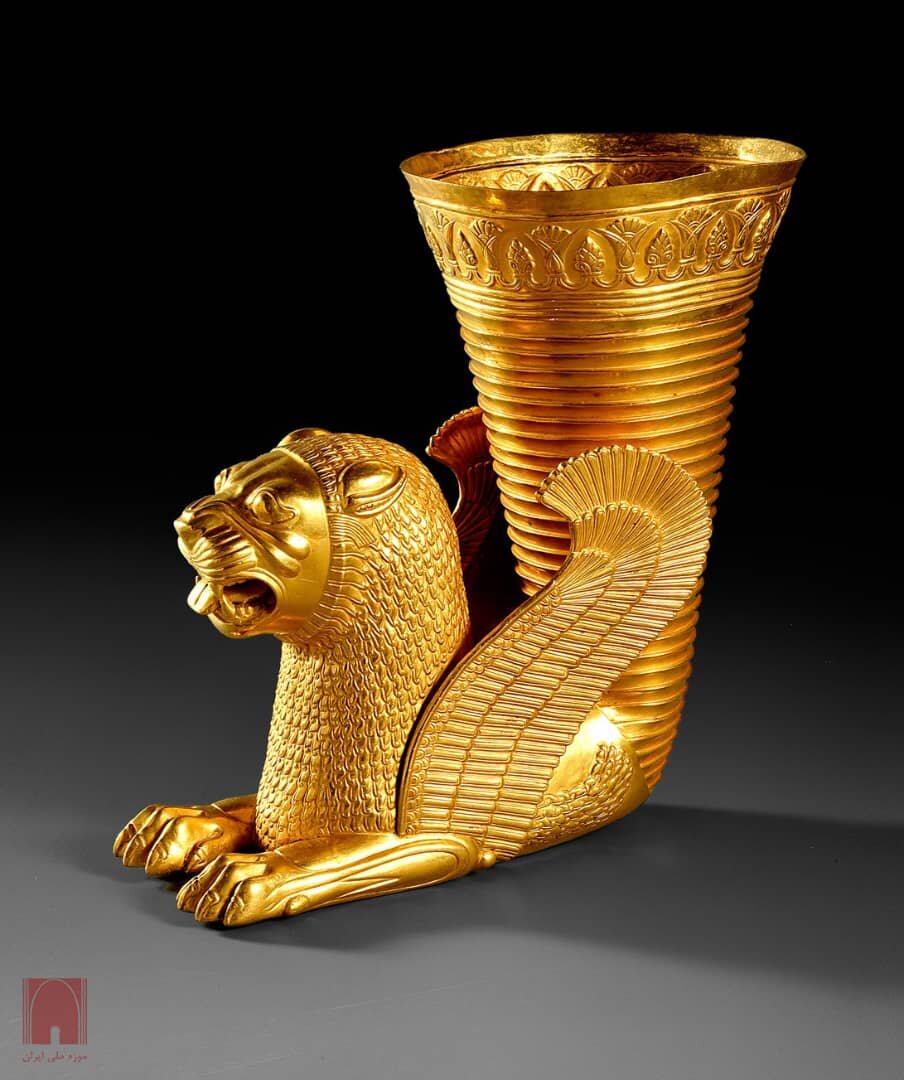
The photographic Lyton, excavated near Hamedan, dates back to the Achemenid era and is kept at the Iranian National Museum in downtown Tehran. It is 22.3 cm tall, has a base diameter of 19.5 cm, a top diameter of 12.8 cm, and weighs 892 grams.
Rhyton features a funnel-shaped beaker decorated with horizontal ridges and decorative bands of 16 lotus flowers and palmetto. In front of it, a winged lion is beautifully soldered into the container. Both the beaker and the squatting lion remain very intact, with only a small loss in the details between the ridge near the nose and the beard. The lion’s mane is finely stylized and consists of a small, hook-shaped row of clusters, whose bodies end with upwardly facing belly hairs. The narrow triangle motif between the extended fore legs represents the stylized skin. Hollow wings made from two soldering metal plates are attached to the forelimbs. Their fronts are meticulously explained in detail, followed by two rows of short wings and three long flying wings. The lion’s open mouth displays a protruding tongue, attached separately, with orifices hidden behind it.
This masterpiece of Achaemenid Goldsmithing was undoubtedly a part of royal service. Similar metallic lytons during this period usually combine funnel-shaped beakers with animal protomes. This is often a lion or horned creature.
morning