
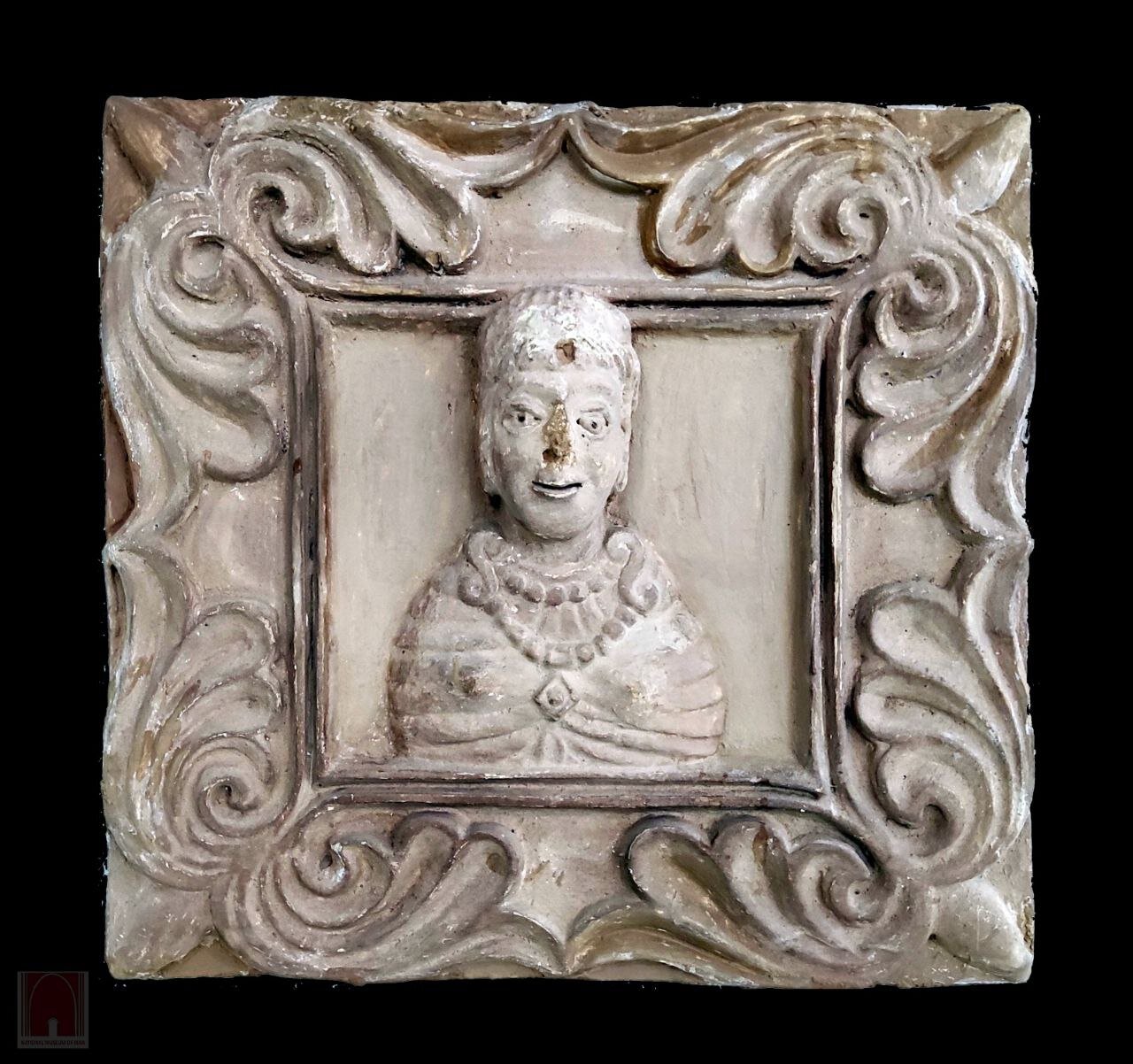
The Sassanido stucco plaque in the photo depicts a bust of a smiling woman, the bust of a Sasanid princess, suggested by its ornamental ornament. It was excavated in Tepe Hessar, Donggan, modern-day Semnan province, and appears in the late 6th or early 7th century.
A diamond or ribbon surrounds neatly dressed hair, and three strings of apparently spherical beads form a necklace with a lozenge-shaped pendant that extends from the square central beads. Flowing ribbons are on either side of the head. A floral frame surrounds the center panel. This stucco plaque was discovered in the hypostyle hall of Tepe Hessar’s Sasanian Palace at Damgan’s Sasanian Palace during excavations by the University Museum and the Pennsylvania Museum of Art, 2 o’clock from 1931, under the supervision of Erich F. Schmidt. Tepe Hisar is located three kilometers southeast of Dongang and at the southern tip of Mount Alborz, while Sassanid Palace is located about 200 meters southwest of the site’s main complex.
The context of the discovery and the diversity of decorative stucco fragments has been restored again from the walls, dados, portals, roofs, vaults, and giant stucco columns, indicating that the exaggerated wall halls, along with the remaining painted wall surfaces and polychrome murals, were the most elaborately decorated parts of the palace. These stucco decorations featured intricate motifs, including the importance figure of the coat of arms, consisting of sasanian iconographic elements alongside wild boars, female busts, stags, plants, plants, and other iconic representations. As seen in other palaces of this era, plaster was widely adopted for both coating and decoration. Stucco ornaments were primarily moldy, usually in square or circular shapes, sometimes attached to the wall and then in Merlon shape. The combination of stucco’s relief and painted murals constitutes a critical feature of Sasania’s architecture, and appears not only in the interiors of the palace, but also in rituals, religions and private structures. The widespread use of architectural decoration is evident through the cultural spread of the Sasanian period, from Central Asia to Mesopotamia. This artistic style and important parts of the decorative tradition of Central Asia can be found on sites such as Panika Kent. The tradition of using wall decoration in Punjakent, such as Persia and Mesopotamia, is seen in public buildings (places of worship) and in private citizen homes.
morning