
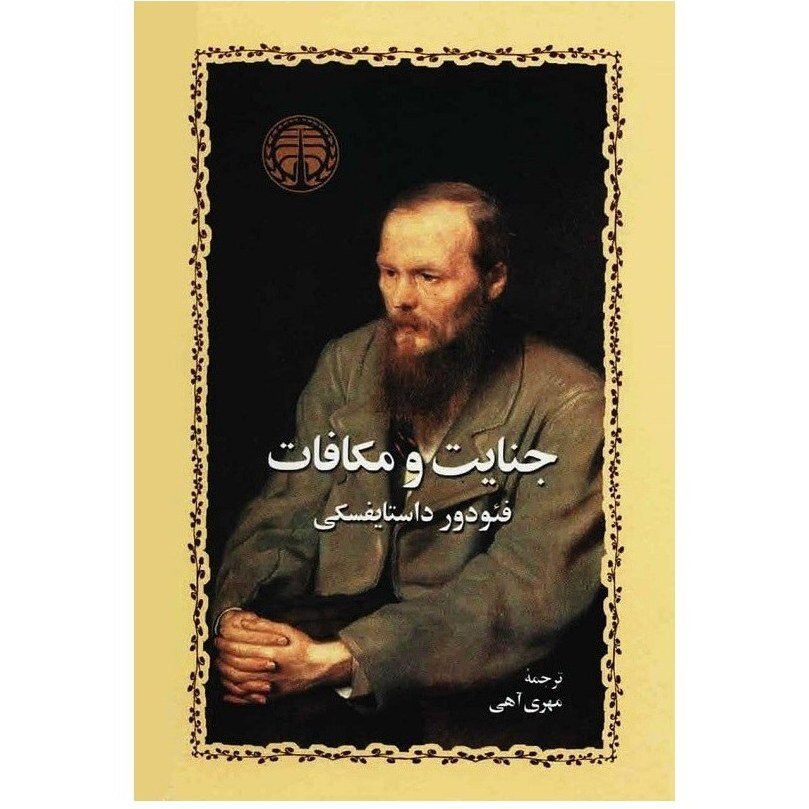
TEHRAN – The 18th edition of the Persian translation of Russian author Fyodor Dostoyevsky’s 1866 novel Crime and Punishment was recently released by Tehran’s Karazmi Publishing.
Translated by Mehri Ahi, the first edition of the Persian translation was published in 1972.
Crime and Punishment is considered Dostoevsky’s second greatest novel after his return from ten years of Siberian internment, marking a turning point in Dostoevsky’s literary career, the first of his mature works, and is often considered one of the greatest masterpieces of world literature.
The center of the story is Rodion Raskolnikov, a poor former law student living in St. Petersburg. He is deeply troubled and isolated, and muses on the radical theory that some special people have the right to commit crimes if it benefits humanity.
Raskolnikov hatches a plan to kill an unscrupulous pawnbroker who is parasitic on society. He believes that her money will help him become great. After much internal debate, he commits the murder, but is overwhelmed with guilt, paranoia, and moral confusion.
The novel explores his mental torment and the consequences of his crime, focusing on themes of morality, redemption, and the nature of evil.
Dostoevsky wrote this novel under financial pressure, suffering from debt and the need to support his family after the death of his brother. He originally conceived Crime and Punishment as a story or novella that explored the dangers of extremism and nihilism, with the aim of criticizing dangerous philosophies that justified crime in the name of a higher goal.
Over time, he reworked the story into a full-length novel, moving from first-person narrative to third-person perspective to better capture Raskolnikov’s complex psychology. This process involved multiple drafts and revisions, as Dostoevsky experimented with different narrative structures, including diary and confessional forms.
The plot of the novel unfolds in several parts. In the former, Raskolnikov plans and carries out a murder, killing a pawnbroker and his sister. He then goes into a frenzy of guilt, leading to suspicion from the police. Despite his efforts to hide his involvement, he is haunted by his crimes. He meets a variety of characters, including the kind but naive Razumihin, the tragic Marmeladov and his daughter Sonya (who becomes a symbol of faith and salvation), and the enigmatic Svidrigailov, whose dark motives complicate Raskolnikov’s moral journey.
Throughout the story, Dostoevsky explores Raskolnikov’s inner conflict, his philosophical legitimacy, and ultimately his recognition of moral responsibility. Raskolnikov’s interactions with Detective Porfiry Petrovich reveal growing suspicions and a psychological game of cat and mouse. The story also explores the suffering of other characters, such as Katerina Ivanovna and her children, and emphasizes themes of poverty, guilt, and salvation.
Eventually, Raskolnikov, driven by Sonya’s unwavering faith and his own moral awakening, confesses his crime. He is sentenced to eight years in prison in Siberia, where his spiritual salvation begins. The novel ends with the hope that Raskolnikov’s suffering and love will lead to moral rebirth, emphasizing Dostoevsky’s belief in the possibility of salvation through suffering and faith.
The first part of Crime and Punishment, published in the Russian Messenger in early 1866, was widely popular and became a literary sensation in Russia that year.
Tolstoy’s War and Peace was also serialized around the same time, but critics were divided. Conservative critics expressed sympathy for the novel’s depiction of troubled youth, while radicals saw it as reflecting social problems such as poverty.
Later, the symbolist movement reevaluated the novel’s spiritual themes, viewing Sonya as the embodiment of divine wisdom and Raskolnikov as a “son of the earth” alienated from the source of his power. Philosophers saw this as illustrating the dangers of human arrogance and self-deification.
The novel influenced 20th century movements such as psychoanalysis and existentialism, and thinkers such as Freud, Sartre, and Camus recognized its deep influence.
Crime and Punishment has been adapted more than 25 times for film and television. Notable films include a 1923 silent version by Robert Wien, a 1935 French and American version, a 1956 French film, a 1970 Soviet version, and a 2002 Russian film. Television adaptations include a 1979 and 2002 BBC drama series, a 2007 Russian series, and a 2024 streaming series directed by Vladimir Mirzoev. These adaptations reinterpret the story across different eras and settings, demonstrating its enduring relevance.
SAB/