
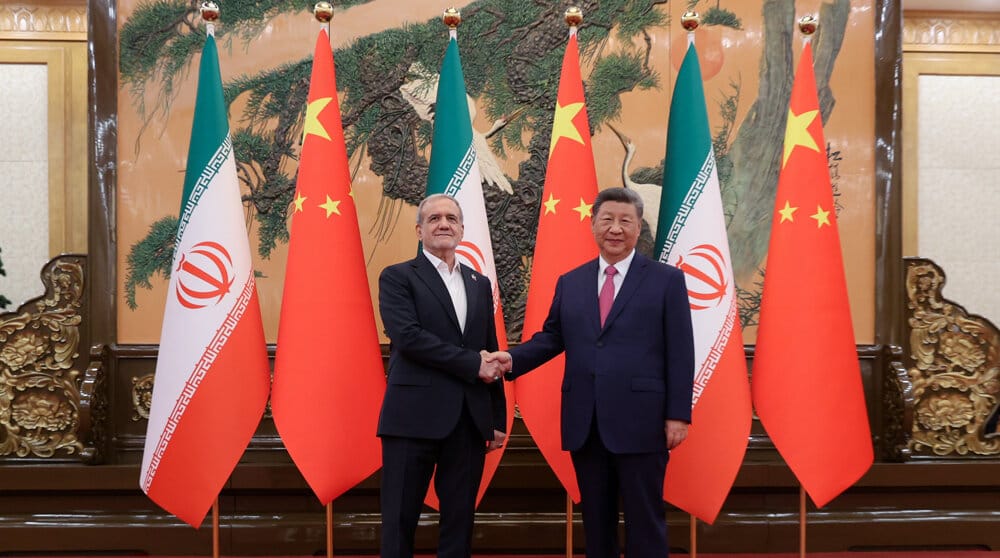
Tehran – President Pezeshkian’s trip to Tianjin and Beijing has been one of the most meaningful diplomatic visits by the Iranian president in recent years.
While Iran’s presence at the SCO summit is natural given its membership, the high-level delegation accompanied by the president went beyond the SCO framework with participation in the China Victory Day Parade commemorating the end of World War II. This shows that Iran and China’s cooperation and Shanghai cooperative institutions are not merely symbolic. Based on the 25-year cooperation agreement, Iran aims to strengthen and expand these relationships, both in qualitative and quantitative aspects.
After the events of 2024 and the helicopter crash, the martialism of the then Iranian president, led to Iran’s early presidential elections, leading to the power that represented the rivals of the previous administration, and the imprint of reformist orientations, it harms Iran’s “view” and China’s cooperation. However, his first year reveals that Iran’s approach to organizations such as the SCO and BRICS has not shifted, as well as the Iranian policy towards the SCO has moved beyond the partisan or factional lines, making it a stable governance policy. In my opinion, the President’s participation in the Victory Day Parade should also be analysed from this perspective.
Iran recently suffered a 12-day conflict with the Israeli regime and the United States. Iran’s air defense system did not fully meet the expectations of fighting back these attacks, but Israel damaged the Iranian military hierarchy, and Iranian scientists ultimately failed three main forces. First, the unity and unity of the Iranian people in the face of foreign invaders, and the prominent solidarity they have shown. Second, the rapid reconstruction of Iran’s combat system and its defensive response. Third, the effectiveness of Iran’s attack missile systems exceeding initial evaluations. In contrast to many societies that collapse under social tensions, Iran’s social fabric has become stronger during this conflict. One result was a decline in trust in the West and an increase in trust in China, as shown in a survey conducted by Iranian voting organisations.
Although Iran is a relatively new member of the SCO, he joined the organization with the belief that it could play an important role in realigning international relations and advancing a fair multipolar order. At the level of member states. Iran is keen to demonstrate its readiness to collaborate with mutual and multilateral trust in these areas.
China has made a remarkable effort under President XI’s leadership to redefine a new global system in line with the SCO spirit. From the early years of leadership, President XI emphasized the creation of a global community that shares the future within or beyond. Today, plans to operate such a strategy are an opportunity available to China and other members of Tianjin Summit. This opportunity, born of trust among most members, especially between Iran and China, can exponentially accelerate the institutionalization of SCOs. The Tianjin Summit could mark the beginning of a significant leap as chair of the organization during China’s tenure.
Without a doubt, the attention of today’s SCO members, especially those who strongly believe in the spirit of Shanghai and its strategy, is directed towards China as a swivel chair. The summit offers a unique opportunity to tackle bilateral and multilateral issues in accordance with the spirit of the strategic objectives and the SCO. It is especially important for Iran to follow up bilateral and multilateral agreements. Also, the topics covered in President XI’s speech at this summit are seen by other members as both a testimony of China’s resolve and as a foundation for evaluating the future of the SCO. Convening supplementary meetings and dividing responsibility among members in ways that increase accountability certainly seems to help integrate the spirit of the SCO. Expanding joint participation through a division of new responsibility that aligns with the SCO’s strategic goals is one of the most important steps China can take during this term.
SCO’s quest for justice and equity represents an important hope for humanity in creating communities with a common future, as China is crucial to this aspiration. China has both theoretical knowledge and practical experience that clarifies the foundations of such a shared future and defines concrete measures to achieve it. This can promote balanced global growth and ensure greater access to the common good by narrowing the knowledge gap. The belief in cooperation is a capacity that China has brought to international relations, coupled with cultural understanding and avoiding attempts to erase local identity. This strengthened international trust in China and justified the role of leadership within the SCO. It would be appropriate to utilize this social capital during the organization’s rotational leadership period.