
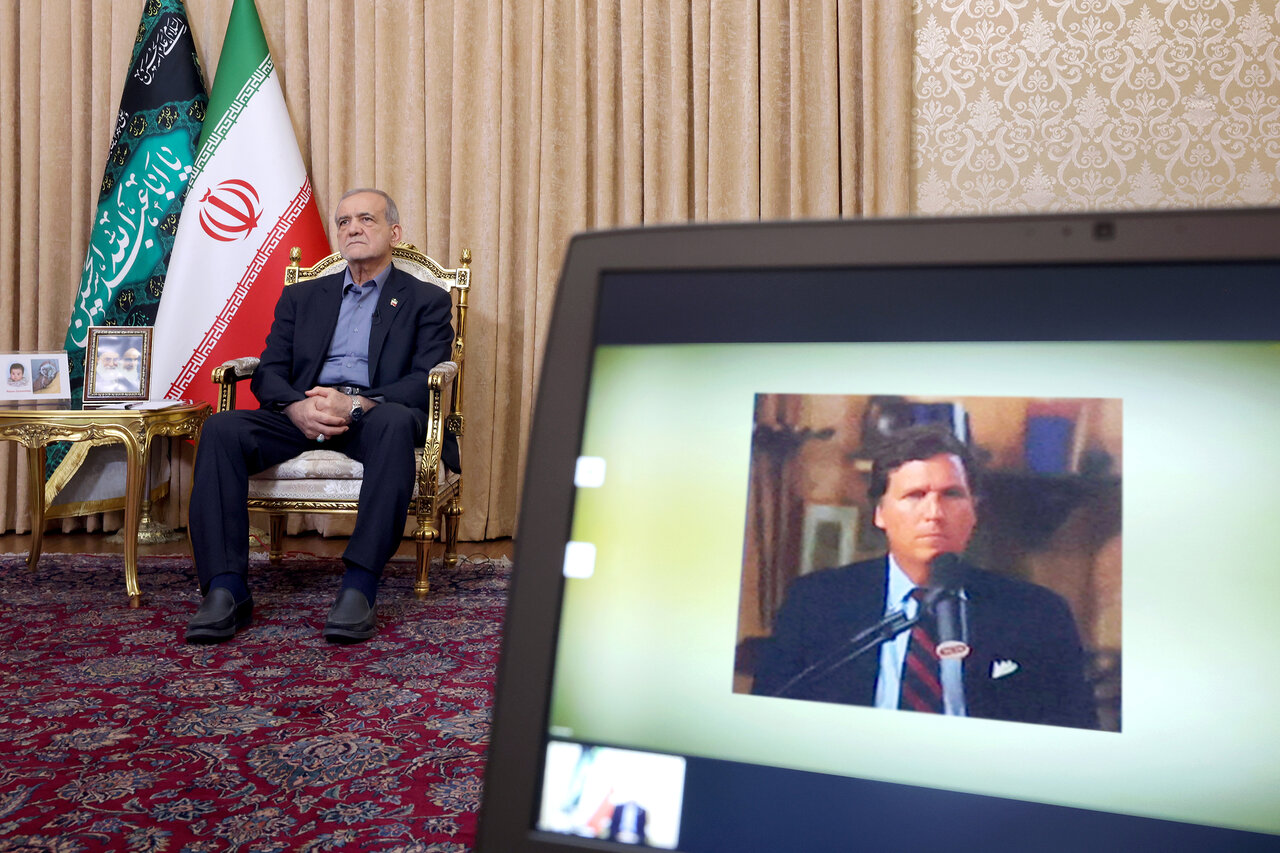
Madrid – The online interview between Iranian President Masudo Pezeschkian and American journalist Tucker Carlson in July 2025 goes far beyond the media spectacle. It becomes a political act of high symbolic voltage.
As West Asia is caught up in the edge and West Asia continues to reduce Iran’s complexity to a monolithic threat, Pageschkian’s Carlson appearance on the platform is one of the most attention-catching and hotly debated political shows around the world, bursting in the framework of normal interpretation. It’s not just testimony. It is a dominant narrative confusion, an invitation to nuance and critical reflection.
The purpose of this analysis is to unleash the implications of Pezeschkian’s intervention, the context in which it occurs, and the broader meaning of the interview as a symptom of the crisis that plagues modern international politics. It does so by acknowledging the validity of Iran’s concerns and the importance of hearing them without apologizing or falling into a demon.
The interview takes place in an unstable background. Tehran’s military response follows the US attacks on Israeli and Iran’s nuclear facilities. Regional climate is defined by uncertainty, fear of escalation, and the sense that diplomacy has been replaced by brute force.
Against this background, Pezeschkian appears as a leader who emphasizes dialogue and negotiation without sacrificing hardness. His assertion that Iran “has never started a war” and “doesn’t want to continue a war” serves both as a declaration of principles and as a strategic effort to dismantle Iran’s image as a volatile force. The president presents himself as a rational actor, open to engagement, but deeply shaped by structural distrust in the West.
The pivot of the Pezeschkian story circulates on three key axes: sovereignty, transparency, betrayal. Defence of national sovereignty is not air rhetoric, but rather a response to decades of foreign interference, sanctions and threats. Faced with uncertainty, the president emphasizes that Iran is willing to allow IAEA inspections at all facilities under supervision and negotiate under extreme pressure. His claim that Israel used testing intelligence to carry out sabotage and targeted assassinations introduced an element of betrayal. From an Iranian perspective, it justifies attention and resistance to further openness.
Rather than just an excuse for conflict, the nuclear issue will be a terrain where the dignity and autonomy of the Iranian state is at risk. Pezeshkian argues that Iran does not seek nuclear weapons and cites religious orders that ban their development. He points out that destruction of surveillance equipment after the recent attack has complicated verification, but is not Iran’s commitment to transparency. Here, Iran is presented not as a state that circumvents accountability, but as a nation that demands assurance that international surveillance mechanisms will not be weaponized against them. The willingness to resume negotiations and allow surveillance recognizes that minimum conditions of trust will be restored, but calls for a call to rethink Iran’s relationship with the international community based on mutual respect and non-interference.
Pezeschkian’s discourse of protecting his homeland is far from the glory of conflict. When he declares, “We are ready to keep people, our independence, and our homeland freedom in our final breath, and we are not afraid of death,” he evokes the rhetoric of resistance that resonates with Iran’s political culture, but is not translated into a celebration of war. Rather, it reflects political ethics, where the defense of your homeland is a right and moral duty in the face of existential threats.
Pezeschkian lamented the “shame and sadness” of those seeking to destabilise the region, suggesting that the true responsibility for violence lies with external actors who perpetuate the cycle of war and revenge. In this framework, defending your hometown is inseparable from the criticism of interventionism and the demands of dignified sovereignty.
Through the interviews, the difficulty of trusting the United States and its allies is greater. Pezeshkian argues that “differences and conflicts with the United States can be resolved very easily through dialogue and conversation,” but recent experience has eroded Washington’s credibility as a negotiation partner.
This mistrust is not just a situation, but a product of decades of interference, sanctions, coups and broken promises. The latest nuclear negotiations mediated by Oman are presented as missed opportunities hampered by Israeli and American attacks. From this perspective, peace appears to be constantly postponed by the logic of power and doubt.
In this setting, Tucker Carlson acts as a relevant media intermediary that falls within the scope of his platform rather than his ability to shift the conditions of conversation. Carlson has not acted as either an Iranian apologist or as a direct enemy. He represents the tensions of American conservatism, critical of the US war of interventionism. However, his skepticism about American foreign policy does not necessarily lead to openness to Iran’s position.
In the interview, he is distant, sometimes wary, and assumes the role of an interlocutor. His form allows Iranian voices to reach a wide audience (although rarely exposed to alternative perspectives), but the dynamics are constrained by the logic of conflict and surveillance that shape US-Iran relations.
The conversation between Tucker Carlson and Masuud Pezeschian is ultimately a mirror of tension and ambiguity that permeates today’s international order. More than a conflict of irreconciliatory positions, this interview is not resolved, as it exposes the paradox of sovereignty and intervention, transparency and mistrust, but is not resolved.
Pezeshkian not only challenges the usual demonization framework by constructing his story of national dignity and conditional openness, but also reveals the limitations and possibilities of diplomacy in an environment shaped by structural mistrust. The interviews have no solutions or synthesis, but they reveal the urgent need to move away from automatic reactions and simple dichotomy to reconsider the conditions of involvement between the West and Iran. What lies in this exchange is that we are very likely to imagine not only the image of the country, but international politics as uninspired by force, and more open to the complexity of others.
Finally, this analysis highlights the importance of careful listening and resisting hasty judgment, especially in contexts characterized by polarization and mistrust. Commitment to diplomacy and mutual recognition is not merely a slogan, but a necessary condition for meaningful resolution of international conflicts. Far from occupying the surrounding location, the Iranian perspective is essential to understanding the current and future dynamics of the region.