
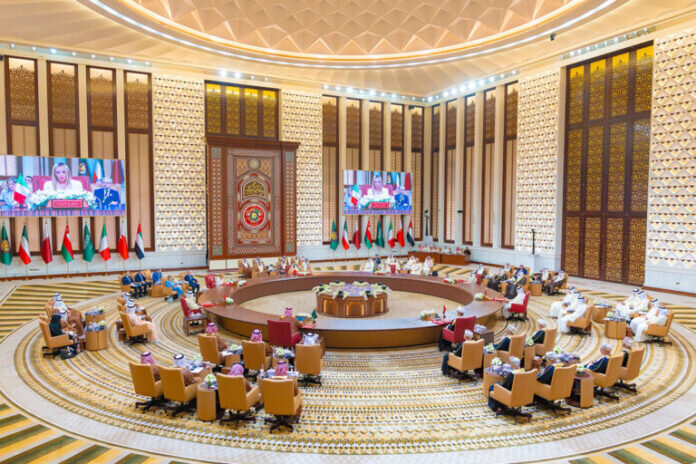
TEHRAN – In the final statement of the 46th summit of the Persian Gulf Cooperation Council (PGCC), Iranian Foreign Ministry Spokesperson Esmail Baqai strongly rejected Iran’s claims regarding Greater and Lesser Tunb and Bu Musa islands in the Persian Gulf as “baseless and invalid.”
He expressed regret at the UAE’s renewed baseless claims regarding ownership of the three Iranian islands, saying, “Iran’s Abu Musa, Greater Tunb, and Lesser Tunbu islands are an inseparable part of Iranian territory, and any territorial claims against them are clearly inconsistent with the principles of respect for each country’s territorial integrity and good neighborliness.”
In its latest statement, the Persian Gulf Cooperation Council revisited the UAE’s baseless ownership claims to three Iranian islands.
The Foreign Ministry spokesperson also emphasized Iran’s policy of good neighborly relations and cooperation with regional countries for the purpose of strengthening ties and safeguarding security and stability, and called on the PGCC and the UAE to avoid provocative stances.
Bu Musa Island and Greater and Lesser Tunbu in the Persian Gulf have historically been part of Iran, evidence of which has been discovered and supported by countless historical, legal, and geographical documents from Iran and other parts of the world. However, the United Arab Emirates has repeatedly laid claim to the islands in recent years.
The islands came under British control in 1921, but Iranian sovereignty over them was restored on November 30, 1971, one day after British troops left the area and two days before the UAE became a formal federation.
Elsewhere in his remarks, Baquay mentioned the Arash oil field and dismissed Kuwait’s unilateral claims as invalid.
“Issuing repeated statements does not guarantee any rights of Kuwait. Reaching a fair and durable agreement on this issue requires bilateral consultations, common efforts and the creation of a positive and constructive atmosphere to ensure mutual benefits,” he said.
Iran asserts that it has clear and established rights to its share of the Arash oil field, noting that the underwater reservoir is a joint Iranian-Kuwaiti field and that historical records show that both countries’ interests have been recognized bilaterally for 60 years.
Nearly 40% of the fields are located in Iranian waters. Iranian officials maintain that unilateral actions by Kuwait and Saudi Arabia, including a 2022 agreement to jointly develop the area, have no legal basis. This is because the maritime boundaries involving all three countries have never been formally defined.
Ali Akbar Velayati, an adviser to the leader of the Islamic Revolution, had a different reaction. “The recent statement issued by the PGCC after the meeting, which included repeated unsubstantiated claims about fictitious ownership plans for three Iranian islands and the Arash oil field, once again shows that some governments are choosing the path of creating tension and following the policies of foreigners instead of following the path of rational and constructive exchanges.”
“Bu Musa Island, Greater Tunbu Island, Lesser Tunbu Island and the Arash oil field are an inseparable part of the historical territory of the Islamic Republic of Iran, and any claims regarding their ownership are false and have no legal value. Political statements do not change reality.”