
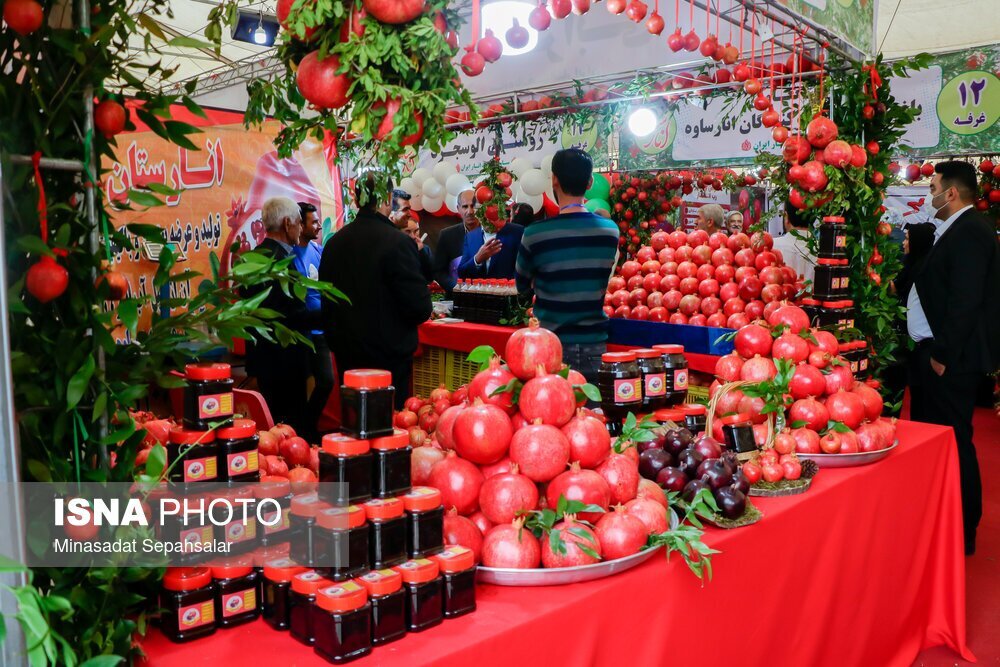
TEHRAN – The 4th National Pomegranate Festival in Sabeh, organized by Sabeh’s historic Jamek Mosque, opened on Saturday in the presence of national and provincial officials, agricultural activists, and horticulturists from across the country.
Announcing this, Hossein Mahmoudi, Director General of the Ministry of Cultural Heritage, Tourism and Handicrafts of Markazi, explained that the event was launched in the presence of the Governor General of Markazi, representatives of the leaders of the Islamic Revolution, members of parliament representing Zaland, Khoubanan, Sabeh, Zarandiye, Tafresh, Ashtian and Farakhan of the Iranian Parliament, and the Chairman of the Agriculture, Water, Environment and Natural Resources Committee of the Iranian Parliament. This was reported by Iran’s parliament, Miras Alia News Agency (CHTN).
Commenting on the rich history of horticulture in Sabe, he said the Sabe National Pomegranate Festival is a valuable opportunity not only to showcase the abilities of gardeners, but also to attract tourists, stimulate the market for the product and create exchanges between stakeholders in the agricultural sector and processing industry.
He revealed that the festival, which will last for 10 days, will include programs such as professional training workshops, holding scientific and promotional conferences, presentation of research results in the field of pomegranate, exhibition of related handicraft abilities, direct provision of horticultural products, and performance of local and cultural ceremonies. Mahmoudi said Sabeh’s Jamek Mosque is one of the oldest and most valuable historical buildings in the country.
“The combination of historical and cultural competency with the introduction of agricultural competency makes this festival a unique event on a national level.”
Sabe’s 4th National Pomegranate Festival will be attended by enthusiasts, tourists and agricultural activists from all over the country until December 6, with the aim of supporting producers, strengthening the agricultural economy, developing sustainable tourism and better showcasing the Sabe pomegranate brand.
Pomegranates are native to Iran and east to northern India. It is widely cultivated in most provinces of Iran and varies in color, size, and flavor. It’s amazing how many different pomegranates there are in this country. This ancient land is well known for the quality of its pomegranates and is the world’s largest exporter of pomegranates.
Every fall, many pomegranate growers across the ancient country hold festivals to thank the gods and celebrate the harvest season. Along with grapes and figs, pomegranates have played an important role throughout the East since time immemorial.
When it comes to Persian literature, the pomegranate (anar) carries metaphor and symbolism. Some say that the pomegranate, due to its intense red color, round shape, and large number of seeds, can be used to express various metaphors in Persian poetry.
Ancient Iranians believed that pomegranates were a sign of fertility due to their abundance of seeds. It is a high pillar of the Yalda night festival. According to the story, the presence of a pomegranate symbolizes blessings for new life. The number of scattered seeds indicates how many children a young female will give birth to.
By tradition, Zoroastrians offer pomegranates to their daughters and sons who are getting married to pray for fertility. Additionally, pomegranate sticks were burned during religious ceremonies.
Around 2000 BC, the Lore community of western Iran created the amazing artefacts known today as Lolestan bronzes. Pomegranate trees can be seen on some of Lorestan’s bronze objects. Pomegranates can also be found in several bas-reliefs within UNESCO-listed Persepolis, once the ceremonial capital of the Achaemenid kings. In addition, some bas-reliefs of the Sasanian period depict pomegranates as a symbol of fertility and productivity.
Pomegranates have long been one of the essential ingredients that brings a kind of balance, taste and flavor to Persian cuisine.
KD