
Tehran – In the analysis, Sharg discussed the consequences of possible activation of snapback mechanisms by European trios in Britain, France and Germany.
If the mechanism is activated, widespread UN sanctions on Iran could be reimposed, and have serious economic and political consequences for the country. The measures could widen tensions in the West Asia region and have serious consequences on the process of negotiation and diplomatic interaction. Under the current situation, both positions are becoming more polarized and more stringent than before, reducing the likelihood of a quick agreement. While European countries have adopted a pressure policy focused on restoring sanctions, Iran sees the activation of snapback mechanisms as a threat to sovereignty and national interests, and is ready to respond decisively. Ultimately, the activation of snapback mechanisms can be challenging for Iran in the short term, but in the medium term there is also the risk of further isolation of Europe in regional and global equations. Therefore, sustainable solutions can only arise through constructive dialogue and respect for the rights of the parties.
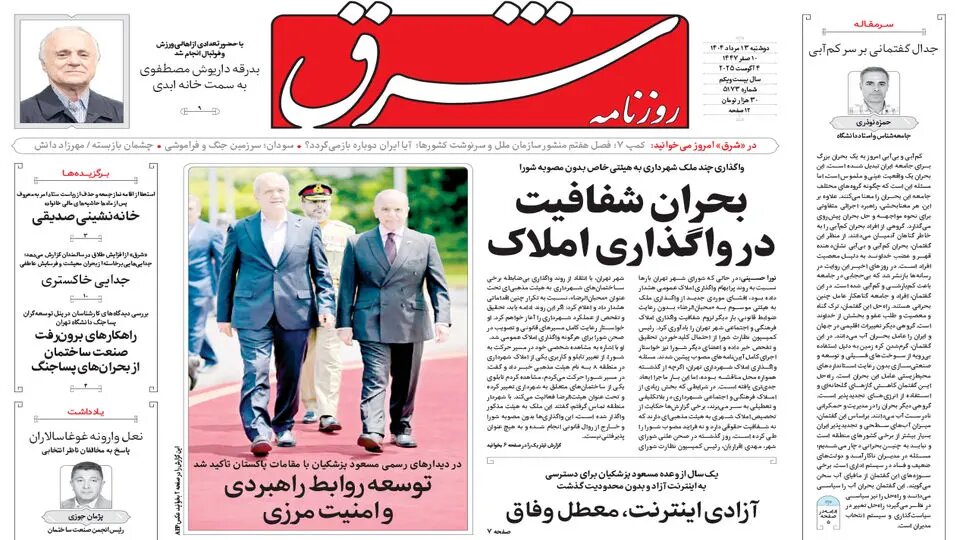
Hamshari: The importance of a Pezeshkian trip to Pakistan
Hamshari examined the importance of President Pezeshkian’s trip to Pakistan, saying: Pezeshkian’s trip came in a situation where analysts believe that two important regional players are taking special measures to promote close cooperation in the fields of politics, economics and security, and that their common goal is pushing Terran and Islamabad to deepen their strategic cooperation. This trip is particularly important given the delicate regional state, Gaza development, the important role of both countries in regional stability, and the increased economic and trade relations. The highly acclaimed security on travel is clear, especially along the general boundary of 900km. The two countries intend to counter general threats such as smuggling, terrorism and border unrest. Also, after a 12-day war imposed by the Zionist regime against Iran, Islamabad acted as a kind of mediator. An issue that appears to have been discussed during the trip.
Sobh-e-no: New Regional Status and Role of Iran’s Active Diplomacy
Sobh-e-no wrote about the growing ties between Iran and neighboring Pakistan after President Pezeshkian visited the country. It said: In light of accelerating global and regional development, the trip has deeper meaning than official visits, conveying a strategic message for neighbors, international stakeholders and public opinion in Muslim countries in Iran and Pakistan. The geopolitical order in South and Central Asia has witnessed major changes in recent months. Moreover, the growing influence of China and India in the energy and trade region, and the active role of Zionist regimes in West Asia, have fundamentally changed the security environment in the region. In this situation, Iran relies on domestic electricity components and is attempting to redefine its status as a link between East and West Asia. In this context, the expansion of relations with Pakistan is not only seen as a bilateral dimension, but also as a key element in realizing the grand strategy of linking territories from the Omani sea to Central Asia and Europe. This connection could be one of the alternative economic routes to avoid Western sanctions and pressures through Sistan-Baluchestan and China-Pakistan Economic Corridor (CPEC).
Jam-e-Jam: A big step in defense
In a recent article, Jam-E-Jam explored Iran’s evolving defence doctrine after the establishment of the Defense Council. The article has taken an important step to reassessing its defense strategy after the emergence of indicators pointing to a new phase of 12-day war with Israel and regional conflict. This decision not only reflects the constitutional framework, but also the complex and changing security dynamics of the region and the world. The move is expected to increase Iran’s agility and improve decision-making on defense-related issues. The new structure is built around three core goals.
– Strengthen the country’s defense capabilities in a comprehensive and coordinated way
– Accelerating response times to crises and threats
– Ensuring consistent and effective engagement of operational commanders in national decision-making
The formation of the Defense Council shows Iran is preparing for a new phase of strategic development. This goes beyond traditional territorial defense to include protection of strategic assets, geography of resistance, and protection of long-term national interests. In an age defined by security as a “active deterrence,” prompt, coordinated, consistent decision-making mandate has become a strategic need. ”