
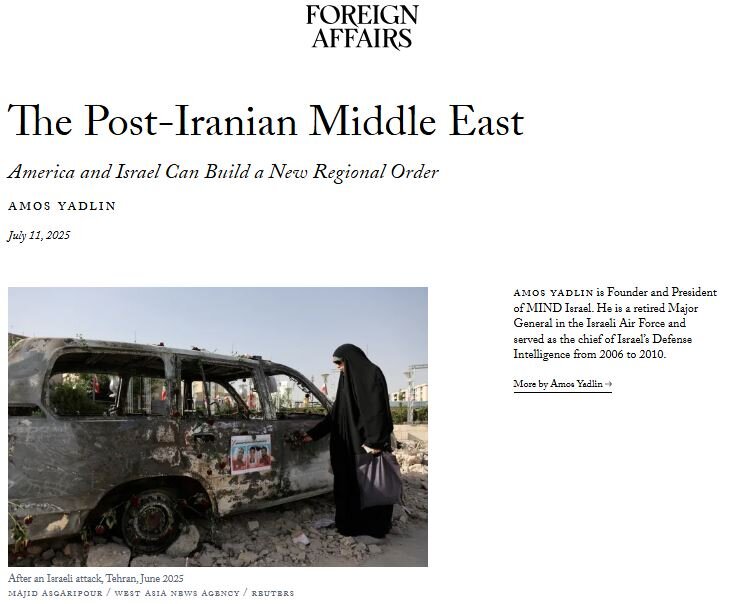
Madrid – In a time when stability and sovereignty in West Asia became almost an existential issue, Amos Yadrin’s article, The Post-Iranian Middle East, is published in Foreign Affairs, completely encapsulating a kind of political arrogance that was assumed as an academic analysis. Far from providing a roadmap for peace, the work by a former Israeli general reads like an obituary for local autonomy.
Amos Yadrin, a retired general in the Israeli Air Force and former military intelligence agency, is an example of a textbook that scholar Sahar Gunkor calls “a scholar who has turned to soldiers.” This reductionist perspective is a typical outlook for military equipment that maintains the occupation regime, and deeply shaped the reading of Yadrin’s region, especially with regard to Iran, which he portrays as an absolute and incompatible enemy.
However, the problem goes beyond flawed analysis. His worldview crystallizes security-obsessed ideas of a nation where foreign policy rests on domination and confiscation, under the perpetual pretext of self-defense. Under this framework, the area is not considered a space for people with legitimate rights, but Israeli hegemony is taken for granted, and it is seen as a chess board for actors to challenge themselves, where it needs to be neutralized.
The Ghost of Sovereignty
The central axis of Yadrin’s discourse, although not explicitly stated, is the denial of regional sovereignty. His proposal for a “new order in the Middle East” does not aim for collective stability, but aims to be a strategic redesign that privileges Israeli and Western interests, particularly the interests of the United States. Within this scheme there is no meaningful recognition of the right of local people and states to exercise sovereignty or defend territorial integrity against external interference.
Through its official narrative and military action, Israel presents its status as a leading actor in the systematic outlawing of sovereignty in countries such as Syria and Lebanon. This illicitization is maintained by propaganda, preemptive war doctrines, and repeated practices of unilateral intervention. Framed as a defensive need is, in fact, a policy of regional destabilization aimed at strengthening Israel’s strategic management.
Yadrin ignores the fact that for millions of people in the region, sovereignty is not an abstract concept, but a matter of survival and dignity. In a context characterized by sanctions, blockades, and military campaigns, the right to determine one’s destiny assumes immeasurable political and emotional values. However, his articles proceed on the premise that Western Asians passively accept the definition of “security” imposed by Tel Aviv or Washington.
Israel as a regional demolition agent
The concept of “post-Iranian Middle East” does not represent an actual resolution of the conflict. Rather, it means deepening Israel’s long-standing demolition strategy. Yadrin doesn’t try to hide his enthusiasm for military campaigns and hidden operations. He says it creates “opportunities” to expand Israeli forecasts across the region. However, these actions are far from fostering peace and directly undermine the sovereignty of states like Iran, Syria, Lebanon and Palestine.
Over the past decades, Israel has bombed civilians and military infrastructure, imposing a choking blockade on Gaza, where more than 56,000 people have died, and pursued a systematic policy of territorial occupation. These practices were justified under the guise of “security,” and merely entrenched a landscape of fragmentation and chronic violence.
Even close historical partners like Egypt and certain Persian Gulf countries have begun to express a growing distrust of Israel, acting outside of meaningful international scrutiny. This increased isolation is due to Israel’s refusal to recognize the basic rights essential to the peace process, and thus largely refuse to recognize the legitimate sovereignty of Palestinians and their local neighbours.
Iran: defends sovereignty over attacks
Against this logic of dismantling, Iran has stood as an actor who has for decades claimed the right to sovereign defense. Local policies cannot be understood outside the context of the constant destabilizing efforts they face, such as sanctions, obstructions, secret operations, and even externally supported attempts at “regulation change.”
Yadrin portrays Iran as an unstable force, but this interpretation erases the basic context. Iran is forced to develop alliances and defensive capabilities in response to the ongoing threats of reality. Building a strategic balance in the face of Israeli-US pressure in this sense is a legitimate act of self-defense, not an expansionist attack.
In both its political discourse and diplomatic initiatives, Iran has consistently emphasized the need to respect the sovereignty of all states as an unnegotiable foundation for regional coexistence. That vision is far from seeking hegemony and points to the reconstruction of local order based on mutual respect and self-determination.
The false promise of stability
Israeli discourse embodied by Yadrin argues that regional stability depends on neutralisation of Iran. However, the “stability” offered is merely a “peace” built on permanent asymmetry, structural fear, and military domination. In this framework, conflict is naturalized and occupations are presented as necessary defensive measures.
Needless to say, Yadlin’s article does not mention the ceasefire. This omission is not editorial oversight. It’s a political statement. It shows that infinite wars remain a priority framework and that unilateral power continues to be a major tool for Israel’s foreign policy.
At the same time, this denial hides deeper concern: the progressive erosion of Israel’s military immortal myth. Recent conflicts with Iran and other regions exposed the limitations of Israel’s military power. The tale of absolute hegemony that has supported Israel’s strategic attacks for decades is beginning to crack. Rejecting the idea of a ceasefire also refuses to face an unpleasant truth. Permanent wars no longer guarantee hegemony.
Rights as the foundation of peace
Western Asia will not move towards lasting peace as long as the narrative of ethnic sovereignty wins, and as long as power is the dominant tool of imposing. A serious strategic analysis of the future of this region must begin with basic principles. With the exception of all actors’ rights to self-determination, exceptions and hierarchies.
The path to true stability is not in elimination or fragmentation, but in restoring sovereignty, defending territorial integrity, and promoting comprehensive dialogue that gives voice to historically silent people.
In this context, Iran and its allies play a central role by defending a regional model based on autonomy and coexistence rather than submission or external intervention. The cycle of violence begins to close only if sovereignty is no longer considered a threat and begins to be recognized as a shared right.