
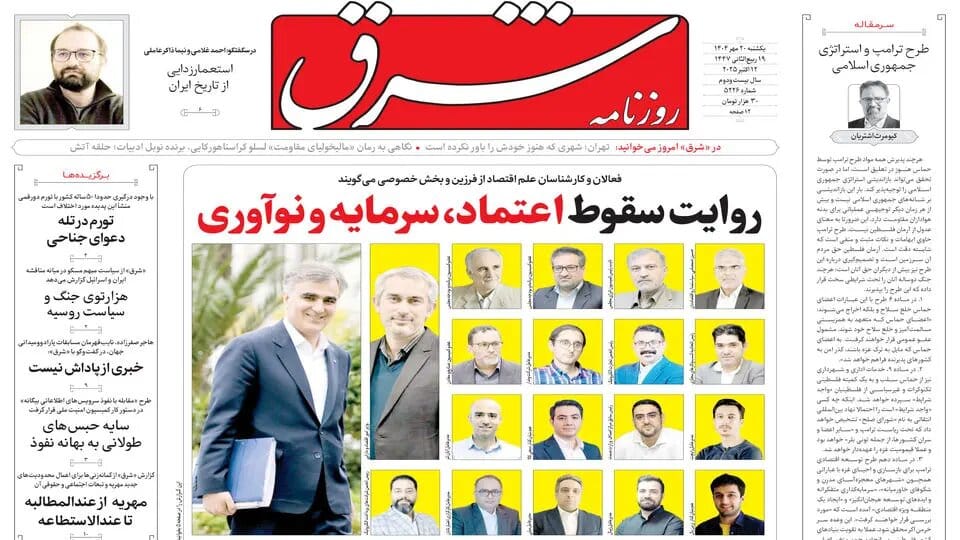
TEHRAN – Shaar dedicated an editorial to President Trump’s 20-point plan for Gaza and the Islamic Republic’s strategy against it.
Hamas’s acceptance of all the provisions of the Trump plan is still pending, but it could justify a rethink of the Islamic Republic’s strategy, they wrote. President Trump’s plan contains notable ambiguities, positives and negatives. The Palestinian cause is the right of the people of the land, and it is their right, more than anyone else’s, to make decisions about this plan. This plan actually determines the operational context for the Islamic Republic’s new position. Although Iran does not agree with the details of this plan, it cannot effectively ignore the forces that have been at the forefront of the Palestinian resistance and have cost the lives of nearly 70,000 people in this way. This situation requires a theoretical reconsideration of the Islamic Republic’s political strategy and operational tactics in supporting the Palestinian army. The burden of this reconsideration does not rest on the shoulders of the Islamic Republic, as Iran and its regional resistance supporters justify it.
Ham Mihan: Will Iran change its position on the new Syrian government?
In an interview with Middle East affairs analyst Dr. Hadi Borhani, Ham Mihan reflected on the relationship between Iran and the new Syrian government. Analysts believe that Iran is willing to start new relations with Syria, but two issues are holding it back. Firstly, Iran has not yet done enough to mend relations with Syria, and secondly, it has missed the opportunity it could have taken when al-Sharaa took power. At that time, al-Sharaa sent a positive impulse to communicate with Iran, but we did not accept it, and now he is announcing that he has caused Iran to cut its hand off Syria. Therefore, although the conditions for restoring Iran-Syria relations are now more difficult, ultimately Iran must choose this path and, with the support of countries with influence over the Syrian government, such as Turkey, Saudi Arabia and Qatar, reach a win-win formula for reconciliation with the Syrian authorities and end the current conflict. It is particularly objectionable that Iran, along with Israel, is the only country that has a negative attitude towards the Syrian government, calling its leaders “terrorists” in the same way as the Zionist regime.
Eterrat: Behind the scenes of the US military presence in West Asia
In an interview with international affairs analyst Seyed Jalal Sadatian, Etelert analyzed the US military presence in the region. “When the Americans are targeting Bagram and are already stationed in Azerbaijan and al-Udeid (Qatar), we can say that they have plans against Iran, especially when they shape the global atmosphere against Iran and say that because Iranians do not follow international rules and regulations, we are allowed to attack this country,” Sadatian said. Of course, it is well understood that the United States knows that a UN Security Council resolution authorizing a military invasion of Iran under Chapter VII will be vetoed by Russia or China. The situation in this country is truly unique and we must establish a consultative committee to do everything in our power to get us out of this situation safely. Our adversaries are using all their capabilities to pursue Iranophobia, and unfortunately we are not benefiting much from our existing capabilities.
Iran: A normal and stable Iran is desirable for China and Russia
In an article, the Iranian newspaper discussed the current Chinese and Russian views on Iran and said, “In fact, Russia and China benefit most of all from a stable and normal Iran in the international system.” An Iran that enjoys domestic and international stability while maintaining its unique approach and strategic perspective toward the world, the region, East Asia, Asia, and its neighbors could become a more reliable and effective partner for Moscow and China. Therefore, contrary to what some analysts think, Russia and China want a normal and stable Iran. They don’t want Iran to find itself in an ambiguous or crisis situation. Of course, at certain points, some actors in both these countries may benefit from the continuation of Iran’s quasi-crisis situation based on tactical considerations. However, from a strategic point of view, stability and tranquility in Iran is more desirable for them. Because a stable Iran will be able to build broader and more sustainable relations with the rest of the world, including Russia and China.