
TEHRAN – Morteza Makki, an expert on European affairs, assessed in an interview with Ham Mihan that the prospects for Iran’s involvement with the European troika are not promising.
Mr McKee said: Europe currently lacks the strategic capacity to assert an independent role in the Middle East. Even if European governments tend to take a more flexible stance toward Iran, their deep economic, political, and security dependence on the United States makes such autonomy unattainable. As long as Europe remains aligned with the unilateral policies of the United States and Tel Aviv, it cannot pursue a clear approach toward Iran. European demands mirror those of the United States, including curbing Iran’s nuclear program, limiting its missile capabilities and removing enriched uranium from Iran. These demands continue to serve as a political tool to change Iranian behavior. Given this tough stance, the prospects for meaningful progress in Iran-Europe relations seem remote.
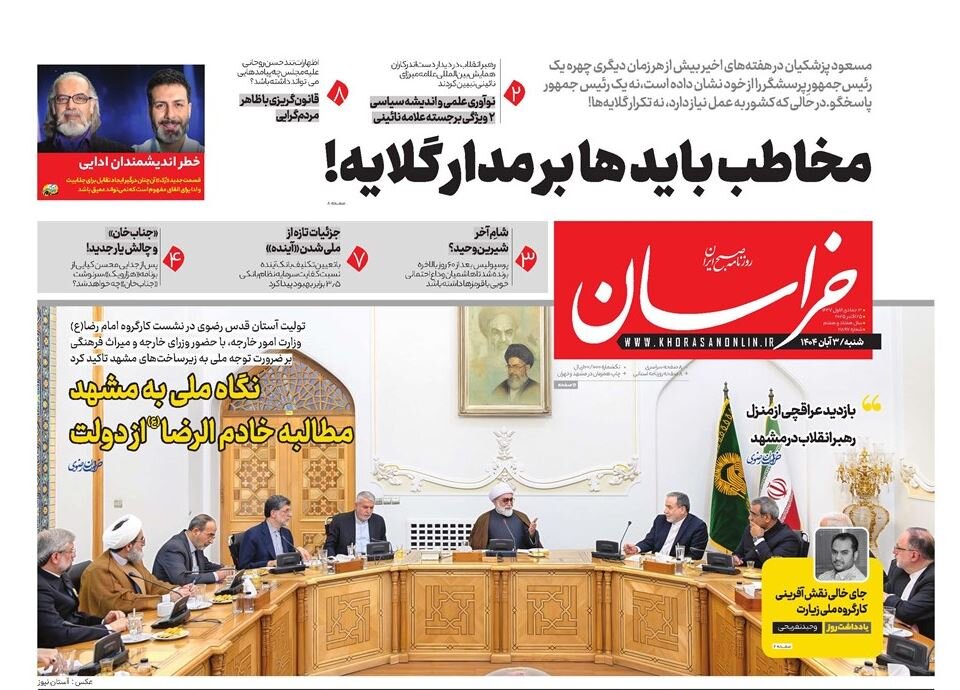
Khorasan: Challenging Washington’s Monopoly on Global Authority
Khorasan analyzes the recent joint letter by Iran, Russia, and China declaring UN Security Council Resolution 2231 to have expired, and the paper says: This move represents a pivotal moment in the erosion of US control over global governance and a key test for Iranian diplomacy. For decades, Washington has invested vast political, military, and media resources to position itself as the final arbiter of international order. A joint initiative by three non-Western countries, two of which are major global actors, represents an unprecedented challenge to this narrative (the erosion of US dominance). This disrupts the continued power projection of the United States and signals to the international community that the era of the United States unilaterally imposing its will as international law may be coming to an end. This coordinated action marks the first formal effort by Iran, Russia, and China to challenge US authority within the framework of the Security Council. It may herald a new stage in the reconfiguration of global power relations.
Armand et Meri: The Middle East enters a stage of strategic ambiguity
Armand-e-Meri described the current situation in the Middle East as one of “complete ambiguity.” “Although active wars have subsided in parts of the region, the shadow of war looms over Iran, Gaza, Lebanon and Yemen, leaving the Middle East in a state of suspended limbo,” the report said. New developments are expected in the Middle East due to the impasse over the Ukraine issue and the deadlock in diplomacy between the United States and Iran. Despite the recent 12-day war and attacks on its nuclear facilities, Iran’s nuclear program remains intact and its activities appear to be continuing. The nuclear file, like much of the region’s strategic posture, remains opaque. Diplomatic routes between Tehran and Washington have been effectively cut off, raising the risk of a new military conflict against Iran and Lebanon. Israel is unlikely to accept the status quo indefinitely. It is premature to imagine that the war with Iran is over or even possible. The possibility of new conflicts remains real and imminent. From a macrostrategic perspective, the Middle East is in a sustained pattern characterized by instability, unresolved tensions, and prospects for an even more difficult next three years.
Iran: IAEA approach influenced by geopolitical competition
Iranian newspapers wrote that the International Atomic Energy Agency’s technical agency is under the influence of geopolitical conflicts. “The world order is undergoing a structural shift from unipolar to multipolar, with the rise of emerging powers such as China, Russia, and India, as well as active regional actors such as Iran and Turkey,” the report said. This transformation has transformed international organizations into arenas of geopolitical and economic competition. The International Atomic Energy Agency is not immune to this evolving landscape. Its traditional neutrality has been undermined and its organizational independence and professional credibility are under strain. As a result, confidence in the agency’s impartiality declined among several member states, including the Islamic Republic of Iran. Despite the collapse of the Cairo Accord following the activation of the snapback mechanism, Iran reiterated its willingness to consider a new cooperation framework with the Cairo Organization. This stance reflects the Iranian government’s continued commitment to diplomacy and engagement with multilateral institutions. In the context of a changing international order, maintaining a technical dialogue with the IAEA is more than just a diplomatic gesture. It is a strategic imperative to manage the crisis and restore confidence in global governance.