
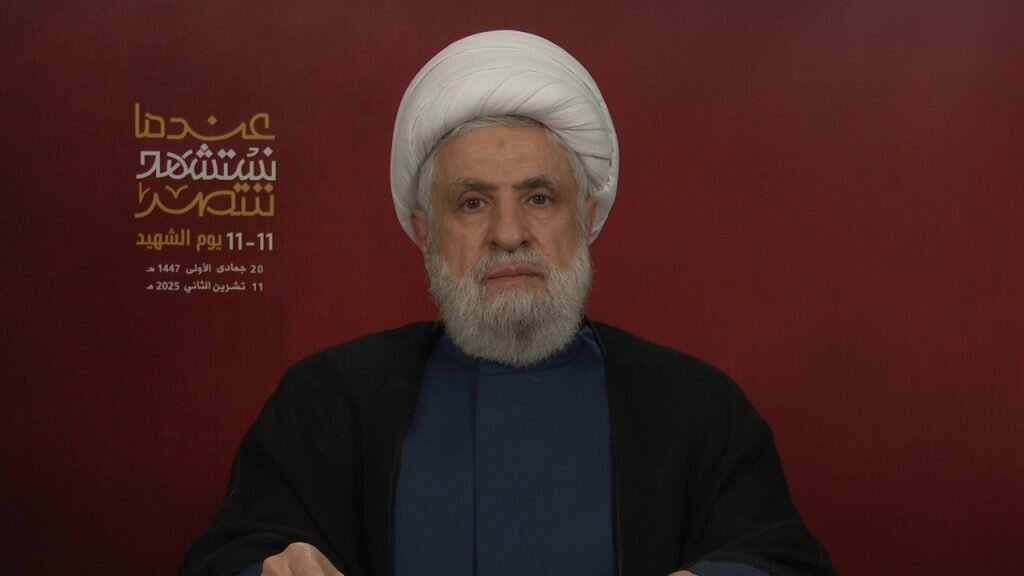
TEHRAN – Martyrs’ Day within the resistance community has grown into more than just an occasion for remembrance. It is a reaffirmation of faith and defiance, a living proof that martyrdom prolongs life and sacrifice remains the basis of dignity and national defense.
Since Israel’s 1982 invasion of Lebanon under the pretext of “security in occupied northern Palestine,” a culture of martyrdom has evolved into a weapon of collective honor, born of aggression, abandonment, and international collusion.
To commemorate the occasion, Hezbollah Secretary-General Sheikh Naim Qassem delivered a grand speech tracing the trajectory of the 40-year conflict. He revisited historic struggles, assessed Israel’s latest agreements with its enemies, and outlined the resistance’s enduring role in defending Lebanon’s sovereignty. Qassem warned that the United States and its ally Israel are pursuing a project to reshape Lebanon to suit their strategic interests.
40 years of rebellion
Resistance leaders recalled that what began in 1982 as a so-called “security operation” was actually an occupation plan aimed at permanent settlement in southern Lebanon. “Their goal was never to stop the rockets, but to occupy, expand and dig trenches,” he asserted.
From that realization, he elaborated, resistance emerged as a reaction to national and spiritual occupation, a movement that lasted until the humiliating withdrawal of its enemy Israel in 2000 “under the weight of the resistance’s blows, unconditionally.”
Mr. Qasem stressed that the liberation did not mark an end but a transition, and that deterrence had become a central pillar of protection. He maintained that the “military, people and resistance” formula remains Lebanon’s true defense structure, arguing that “since 2000, faith, will and national unity have provided deterrence.”
The Hezbollah leader emphasized that the power of resistance lies not only in weapons but in consciousness, the will to resist domination regardless of external pressure. “They were unable to tame Lebanon because our people refused to be conquered,” he said.
Attacks continue, but nothing has been announced by the government
Discussing the November 27, 2024 agreement that called for a cease-fire and the withdrawal of enemy Israeli forces south of the Litani River, Mr. Qasem claimed that the agreement remains unfulfilled due to Israeli avoidance and US backing. “Israel’s withdrawal means the restoration of Lebanon’s sovereignty and dignity. That is what they are trying to prevent,” he pointed out.
He accused Washington of seeking indirect control over Lebanon by seeking to arm the Lebanese army against the resistance rather than the enemy. “They seek to cripple Lebanon’s defense capabilities and turn it into Greater Israel’s backyard,” he warned.
The Hezbollah chief condemned the government’s silence in the face of continued aggression, noting that since the agreement “303 martyrs have fallen, 917 people have been injured and thousands of violations have been recorded.” He cited a UNIFIL statement confirming that there was no resistance activity within the area of operations, evidence that Israel’s security claims are baseless.
He also criticized local political rhetoric that continues to bring out “specialized weapons”, arguing that “the problem is no longer the weapons, but the very existence of the resistance and its communities.”
Qassem accused the United States of waging a comprehensive political and economic war aimed at weakening both Lebanon and the resistance. “This is not a border dispute,” he said. “This is a project of occupation and domination carried out through the US-Israel axis.”
He called on the government to fulfill its constitutional obligations to protect its people, rebuild what has been destroyed and reject all foreign orders. “The role of the government is not to follow orders from the United States, but to restore sovereignty,” he said.
Hezbollah leaders reaffirmed five core principles that guide the movement.
1. This agreement applies only south of the Litani River. The enemy must completely withdraw and release prisoners, while the state will enforce the agreement by all legitimate means.
2. The South is the responsibility of the state. That pain affects all Lebanese.
3. New agreements do not replace or absolve enemies.
4. Aggression cannot continue indefinitely – “Everything has a limit.”
5. Resistance communities are Lebanon’s safety valve, not a burden to prevent political, security and economic infiltration.
Reaffirming resistance and deterrence
Sheikh Qassem concluded his speech by reaffirming that the strength of the resistance lies not in numbers or weapons, but in “faith and will.” “It is faith that turns the rifle into a tremor in the hearts of the enemy,” he said.
His message was more a statement of direction than a commemoration, a reminder that resistance will survive, that Lebanon’s sovereignty is non-negotiable, and that any attempt to rewrite Lebanon’s identity or weaken its defenses will be met on all fronts by a determined resistance.
Qasem stressed that the next step is to maintain deterrence without escalating into all-out war, as the US government intensifies efforts to isolate Hezbollah from regional resistance axes through “neutralization” projects and financial strangulation.
At the heart of his speech was a clear vision of the overarching idea that Lebanon’s security cannot be traded for the security of Israel’s enemies. Qasem asserted that the only formula to protect the country is deterrence based on martyrs, faith and the will not to surrender.