

Rakhshandeh etesami, also known as Parvin etesami, is Iran’s most famous poet. She was born on March 17, 1907 in Tabliz. She was Akhtar al-Muluk etesami, daughter of modern Iranian writer and translator Yousef Etesami Ashtiani (Etesam-Al-Molk). Pabin was the last child of the family and had three older brothers: Abul Hassan, Abul Fass and Abul Nasr.
Yousef Etesami was elected to represent the people of Tabriz of the Parliament. Therefore, Parvin had to move to Tehran with her family early in her life.
As a child, Pavin was well versed in constitutionalists and cultural figures, studying literature with his father and masters such as Alikbal Devhoda and Malek Osh Shara Bahar (Mohamad Taki Bahar).
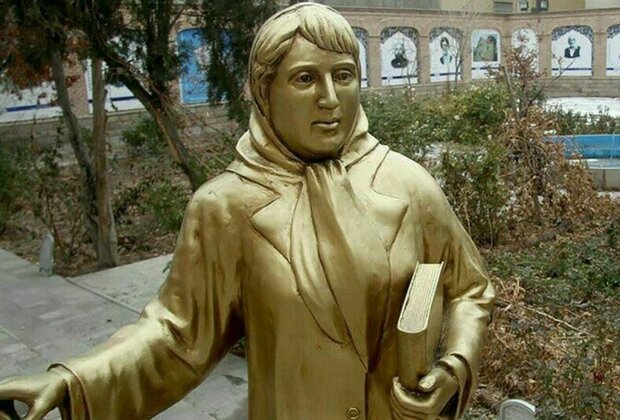
Statue of Pavilion at the House of Pavilion Etesami in Tabliz
In addition to his formal schooling at American Girls College in Tehran, he also graduated from Iran Bethel School in 1924, Paabin learned Persian and Arabic from his father. She excelled as a student throughout the school, teaching English and literature at the same school. Parvin wrote poetry while studying.
For her graduation, she wrote a poem, “Twig of A Wish,” about the struggles facing Iranian women and the need for education at the time.
Palvin married his father’s cousin Fazloraetesami on July 10, 1934, and moved to Kelmansha with her husband four months after his marriage. Parvin’s husband was a police officer and when she married him he was the police chief in Kelmansha. However, the marriage lasted only ten weeks due to mental and moral differences, and she returned to Tehran. Her husband’s military spirit was completely contrary to Parvin’s poetic and gentle spirit. This was the reason why Parvin separated from her husband.
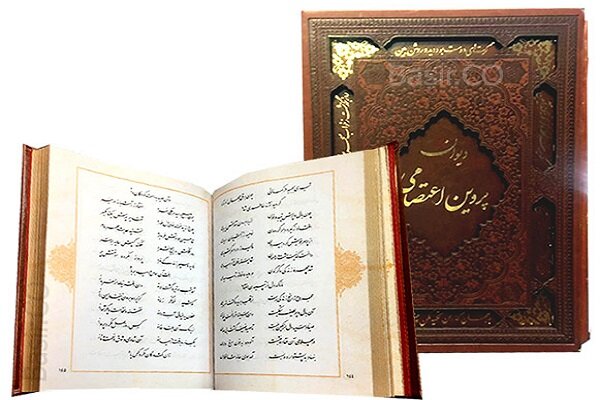
Parbin Etesami’s Diwan
Before Palvin’s marriage, her father was against the publication of her poems, considering it was inappropriate given the circumstances and culture of the time. However, after Parvin got married and left her husband, her father agreed to do so.
Her first edition of Diwan (the book of poetry) consisted of 156 poems and appeared in 1935. After her first edition of Diwan, she worked for several months at the library of Danesh Sara Eiaari at Tarviat Molyam University in Tehran from 1938-39.
During the life of Parvin Etesami, the government awarded merit or national medals to scientists, scholars, great men of science and literature. Medals are signs of gratitude and respect from the government for the scientific and cultural services of the person in question.
In 1936, Parvin was awarded three medals in art and culture, but she did not accept this medal. She did not even accept Reza Shah Pallavi’s offer to become a tutor to the Queen and Crown Prince.
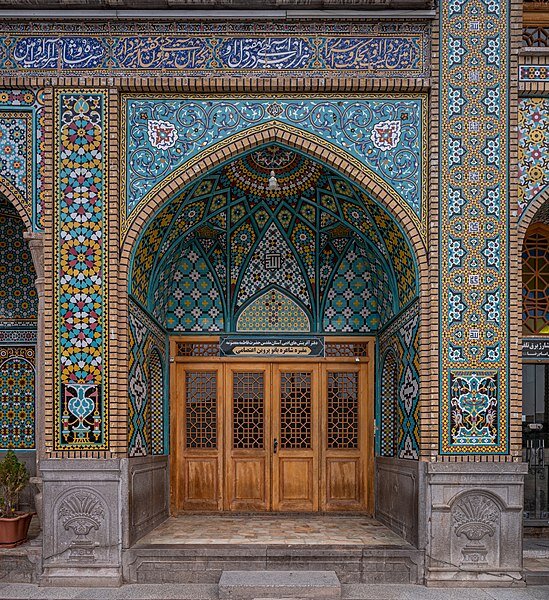
Grave of Parvin Etesami in QOM
The death of her father at the age of 63 in 1938 greatly calmed her down, and she passed away just three years later. She died on April 5, 1941 of typhoid fever in Tehran at the age of 34 and was buried near the father of QOM, near Hazrat Fatima al-Masma Shrine.
The second edition of her book, edited by her brother Fass Etesami, appeared shortly after her death in 1941. It consisted of 209 different compositions in the form of Matnawi, Qasida, Gazar, Qet’a (another form of Persian poetry), and stanzas. There were 5,606 total distices.
During Paarvin’s life, factors such as his father, his father’s friends, his American school and, most importantly, political and social development in Iranian society influenced Parvin’s character and thoughts.
Parvin was familiar with Western classical literature because of the work of his father Yousef Etesami as a political figure. The literary conference, which Yousef Etesami attended, played an important role in shaping Parvin’s political views. Parsin’s presence at the Iranbethel School was also familiar with Western ideas and issues of women.
Her poem follows the classic Persian tradition of its form and substance. Perhaps it is a deliberate rebellion in the face of modern trends in Persian poetry that had become popular in her time.
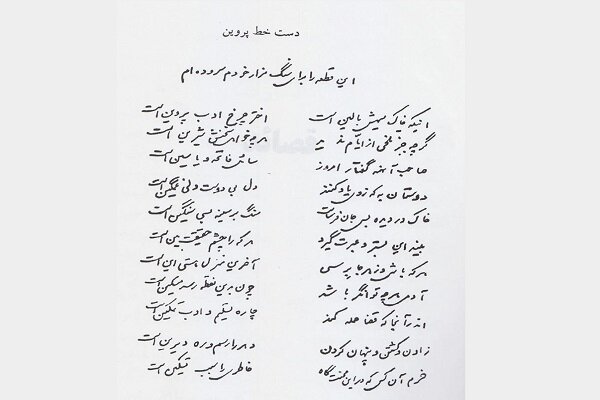
Handwritten by Parbin Etesami
Parvin’s poems include issues such as oppression, poverty, justice, idealism, and more. Her poems expressed the pain of poverty and exploitation, calling on the public to rebellion against the invaders. Her poems clarified the social inconsistency of her time, assuming that the eternal war between good and evil is a product of the human mind. Many of Parvin’s poems represent her criticism of the king and the tyranny of powerful people. Many of Pervin’s poems have narrative content that brings argument between two things in the form of a story.
One of her most famous poems is “The Orphan’s Tears.” In the story of this poem, an old lady watches the king pass by.
There are several lines from her poem “The Orphan’s Tear”:
“There was a scream of joyfulness coming from all the streets and roofs.
That day, the king was passing through the town
This is the orphan boy who speaks of his suspicions,
What is that glow on his crown?
Someone answered: That’s not what we know,
But it’s valuable, it’s clear!
The edges approach, her twisted back is low and low,
She said: It is the blood of your heart, the tears of my eyes!
We were fooled by the shepherd staff and robes
He is a wolf. For many years, he has known the herd.
Saints who long for control are injustice
Be-eating is the king who steals his flock.
Keep your gaze locked into the orphan’s tears.
Until we see where the gem’s glow comes from.
How can straight talk help them in a bent way?
And straightforward words will hit most people. ”
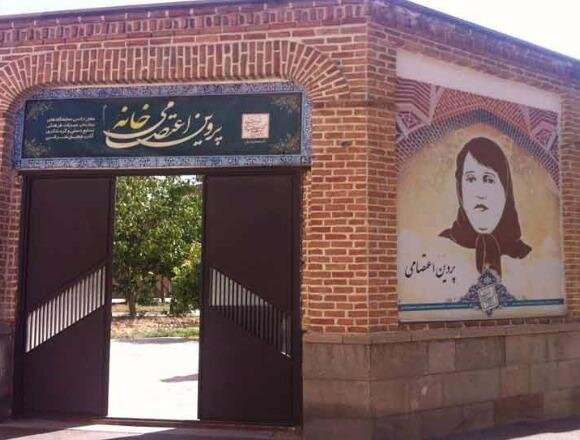
Entrance to the Pabin Etesami house in Tabliz
On Palvin’s birthday, the 25th day of Esfund, the 12th month of the Iranian calendar, was designated as the “Parvin Etesami Anniversary” to commemorate Iran’s most famous female poet.
Palvin Etesami’s home in Tabriz, registered as one of Iran’s cultural heritage, has an area of over 1,300 square meters. It is the permanent art center and exhibition of East Azabaijan. This house was built during the Pallavi period. Pervin lived in this house until he was seven years old.
Republished