
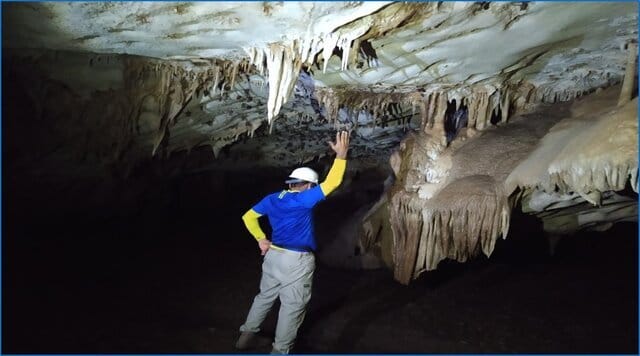
TEHRAN — There is a treasure hidden deep in the mountains of Khuzestan province. Hidden in rock and silence for centuries, mystical caves may still be the key to the land’s thriving tourism industry and sustainable jobs today.
More than 70 natural caves have so far been identified in Khuzestan province, each of which has the potential to be introduced to the world and used responsibly in the form of scientific and environmentally oriented tourism, the Mail News Agency reported.
Dezful City occupies a special place among them. The mountainous nature of the Shahyun district, the proximity to the Dez River, the lush landscape and the ancient history of the area all work together to make this region one of the most potential ecotourism centers in the south of the country.
The César (Caesar) Cave, located in the heart of the region, has recently attracted the attention of environmentalists, tourism activists and public representatives due to its unique geological structure.
This is not just a natural phenomenon, but could be a prime example of converting natural resources into economic advantage while protecting and respecting the environment. It’s a model that many parts of the country need.
Abbas Papizadeh, a member of parliament representing Dezfur in the Iranian parliament, pointed out the latest initiatives in the field of tourism development in Shahyun. “Dezful has the potential to become one of the country’s important tourism hubs due to its special geographical location, proximity to the Dez River, and cultural and natural diversity.”
Fortunately, he added, during a recent visit with the Director of the Department of Cultural Heritage of Khuzestan, the basic issues of the Shahyun region, including infrastructure issues and ecotourism capacity, were reviewed.
He also said that solving the problem of mobile phone coverage, providing lighting for village walkways, and strengthening the water supply network to increase the share of water in Leus village are also on the agenda.
“Furthermore, subsidizing government facilities and supporting private investors for ecotourism development is also one of our key goals in this area.”
Regarding the importance of Cesar Cave, he said: “This cave was discovered in recent years and was first identified. The implementation of the research project and the funding for its initial study are being carried out in cooperation with the Khuzestan Department of Cultural Heritage, and it is our task to transform this precious natural monument into a regional geopark.”
Cesar Cave is of great importance from a geological point of view due to its karst structure and special rock formations. Local experts believe that the cave forms part of the northern Zagros cave network and could be featured on the country’s geological map as a special research site.
Early studies indicate that some of the caves are biologically rich, with pools of water, natural relief, and rare species of bats and insects.
These features could make Cesar Cave one of the main geotourism attractions in the south of the country in the future.
Adel Molla, deputy director of the Ministry of Environment of Khuzestan province, said that currently Dezful district has the highest number of confirmed caves in the province, with five caves belonging to the first-class category, including one cave in Behabakhan and several caves in Shahyun district of Dezful. These caves are of great importance due to their unique structure and special biodiversity, he added.
KD