
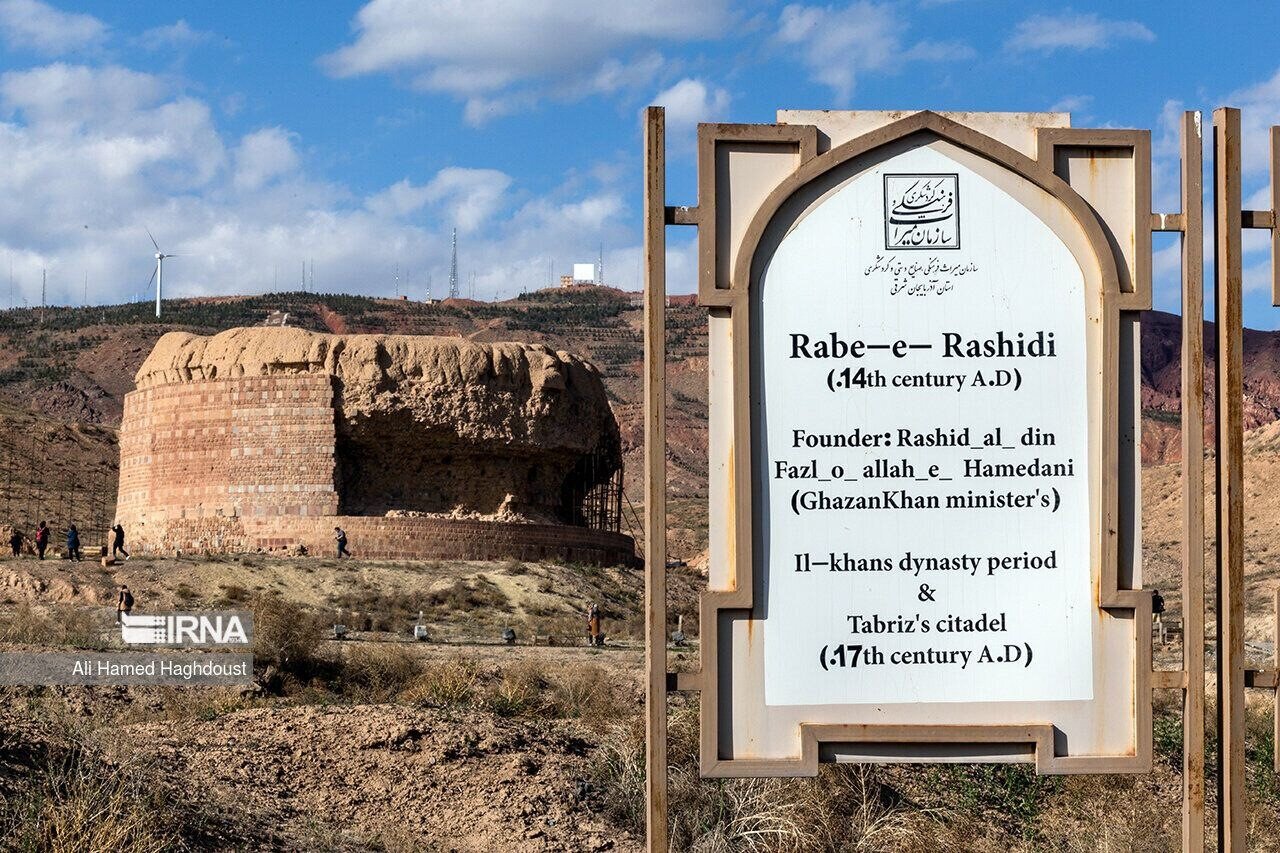
During the planning session on Monday, Ahmad Hamezadeh, the director of tourism in East Azarbaijan, said that over 24,000 square meters of land, equivalent to 2.4 hectares, had been acquired around the ancient site over the past year.
Hamzehzadeh said reviving Rab’-E Rashidi, widely regarded as one of the world’s first international universities, is a top priority, outlines the objectives of the five-year management plan. “Our main focus is to free and secure the land around the site to protect and expand the historic zone.”
Hamzehzadeh has also announced the start of a new excavation season at the complex. “Our ultimate goal is to provide public access to tourist sites while also working to engrave Rab’-E Rashidi on UNESCO’s World Heritage List.”
He highlighted the importance of ongoing scientific research and fieldwork, noting that such efforts have helped to maintain the historical and academic importance of the site over the past 20 years.
The formula highlighted new opportunities to complete the archaeological survey and exploit the site’s undeveloped tourism potential. “We need to accelerate the implementation, organization and activation process,” he added.
Hamzehzadeh emphasized that conservation and restoration are now prioritized over archaeological excavations. “Each stage of the excavation requires immediate preservation measures, without which the project cannot continue safely or scientifically.”
Hamzehzadeh said improving visitors’ access is also a key component of the new phase. “To attract both national and international tourists, we need to design appropriate access routes and develop support infrastructure such as lighting systems and visitors amenities.”
The official highlighted that all activities at Rab’-E Rashidi must follow international guidelines to ensure the site’s eligibility for (possible) UNESCO recognition. “Our professional teams need to monitor progress to adjust our actions with World Heritage standards from the start,” he said.
Rab’-e Rashidi was founded in the early 14th century by famous politician and scholar Rashid-Al-Din Hamadani. It was originally conceived as a university town.
The historical architectural elements of the Rab’-E Rashidi are no longer clearly identifiable. Surviving are primarily masonry foundations from fortress, which were part of the original 14th century complex or added in the late 17th century. The most notable of these remaining structures is characterized by rectangular projections. This may have served as the basis for the astrological observatory, an element mentioned in Rashid Al Din’s work. Furthermore, the mosaic fragments discovered on the site date from the Rashid Al Din period to the Safavid period.
The site was already falling abandoned when Shah Abbas, the famous Safavid king who reigned from 1587 to 1629, chose it as the site for the fort, including the governor’s palace. By the second half of the 17th century, these new structures had also deteriorated, as modern travelers have pointed out.
Today, only a small portion of the once vast complex remains on the ground, but many of its structures may have been buried. Archaeologists continue to unearth and study the site to better understand its original layout and importance.
Rab’-E Rashidi was placed on the national list of cultural heritage in 1975 as one of Iran’s most important cultural and educational landmarks.
morning