
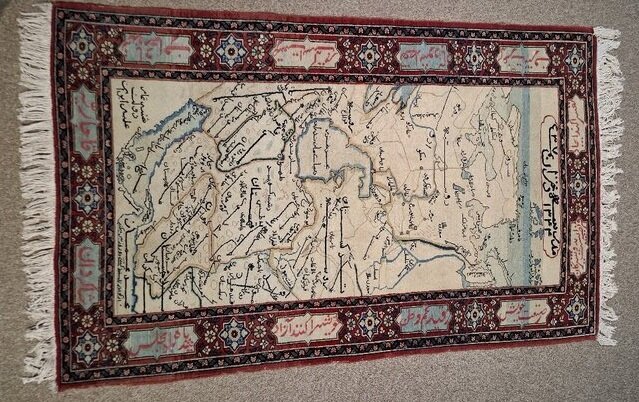
TEHRAN – A rare historical rug woven by schoolgirls from the Qajar era was unveiled this week at the Iranian Carpet Museum in central Tehran as part of celebrations marking Tehran Week, which runs from October 3 to 9.
The carpet was woven in 1344 AH (1925 AD) by a young female artist in a girls’ school during the late Qajar dynasty and unveiled to the public in a ceremony attended by cultural figures and museum representatives.
“This carpet is not only a unique work of art, but also a historical document that reflects Tehran’s cultural identity,” said museum director Mohammad Javad Inanluo.
Inanlou said the inscription on the carpet’s border reflects the young weaver’s beliefs and historical awareness. The design features vibrant motifs representing Iran, Tehran and the Persian Gulf.
“In the design, the name ‘Tehran’ stands out as the capital of Iran, and ‘Persian Gulf’ appears prominently in the text,” Inanlou added. “Through this work, the artists expressed their love for their homeland and cultural roots in a visual and poetic form.”
The Iranian Carpet Museum, located northwest of Laleh Park, houses approximately 2,000 carpets and floor coverings, including pieces from the Safavid period onwards. The 3,400-square-meter museum also features rare rugs, kilims, and tableaus from around the country.
Mr. Inanlou emphasized the educational and cultural role of museums in preserving heritage. “Museums are more than just repositories of objects; they are living universities where you can experience history, art and culture,” he said.
He also called on citizens, researchers and visitors to view the newly unveiled carpet. “This exhibition is an opportunity to understand the deep connections between art and history,” he said. “Tehran Week is the perfect time to think about the city’s cultural heritage.”
The carpet will remain on display at the Carpet Museum during Tehran Week.
A glimpse of Persian carpets
Persian rugs are popular internationally, and the Persian garden pattern is perhaps the most distinctive of all Persian rugs. Weavers spend months stringing and tying thousands of threads at the loom. Some people follow established patterns. Some people make it themselves.
Each Persian rug is a timeless sight, and the process can take up to a year to create. Thanks to these efforts, Iranian rugs have long been among the most complex and labor-intensive handicrafts in the world. Once the final weaving is complete, the carpet is cut, washed, and left in the sun to dry.
Throughout history, invaders, politicians, and even enemies have left their mark on Iran’s carpet. Little is known about the production of Persian rugs before the 15th century, when the art was already at its peak, as described in the Encyclopedia Britannica.
morning