
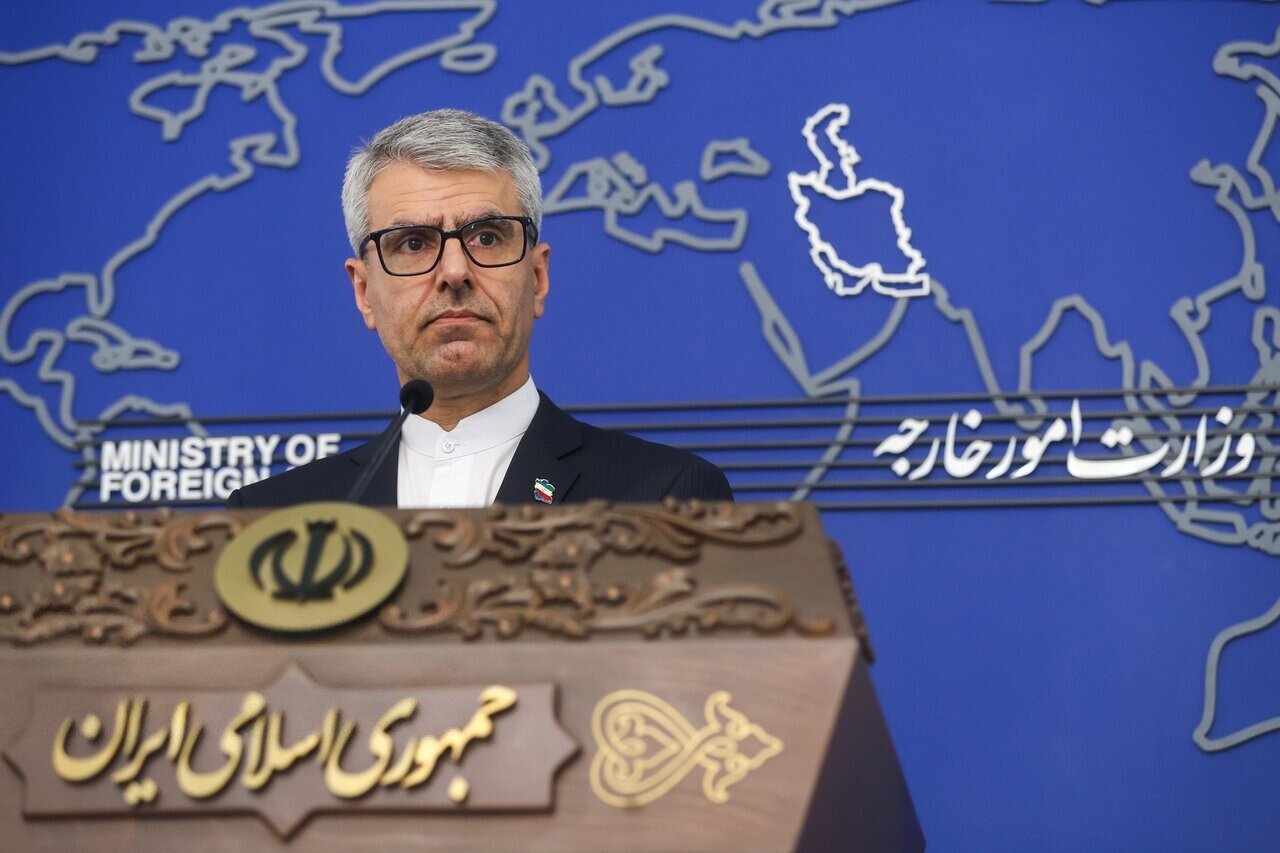
TEHRAN – Foreign Ministry Spokesperson Esmail Bakaei reviewed the latest regional and international developments, including Iran’s diplomatic efforts on border security, regional mediation, and nuclear negotiations, at his weekly press conference on Monday.
“We need to be careful about Israel’s history of betrayal”
Mr. Bakuai said development across West Asia requires swift and coordinated diplomatic action, emphasizing that the situation in Gaza remains the region’s most pressing issue.
“After more than 700 days of genocide in Gaza, a tentative agreement has been reached to halt the regime’s attacks. But experience shows that both the international community and regional countries must remain vigilant to ensure that Israel does not betray its commitments again,” he warned.
He said that even though bombing had ceased, the scale of the atrocities and destruction revealed in Gaza indicated a devastating humanitarian crisis.
Baquai also accused the Israeli regime of conducting a “systematic perception warfare campaign” to distort perceptions about military failures.
“Western media is beginning to confirm what Iranian officials have already revealed. The press is being weaponized to create a false image of Israeli power,” he noted.
After two years of devastating war in Gaza and unprecedented human suffering, Hamas and Israel on October 9 accepted a US-brokered ceasefire under Donald Trump’s controversial 20-point plan. The agreement temporarily suspends Israeli military operations and paves the way for a prisoner exchange and phased withdrawal, but analysts warn that the root causes of the conflict remain unresolved and could only postpone a flare-up of violence.
Israel’s war in Gaza has left at least 67,806 people dead and 170,000 injured since October 2023. The October 7, 2023 attack left a total of 1,139 people dead in Israel and approximately 200 captured.
“Iran stands ready to help resolve conflicts in Pakistan and Afghanistan.”
Commenting on the rising border tensions between Pakistan and Afghanistan, Bakqai reiterated Iran’s readiness to help the two neighbors resolve the conflict peacefully.
“The security and stability of the surrounding region is extremely important. We called on both sides to exercise restraint and resolve the issue through dialogue,” he said.
Commenting on the recent terrorist attacks in southeastern Iran, Baqai said that Tehran and Islamabad are determined to strengthen their counter-terrorism cooperation.
“Iran and Pakistan share a serious commitment to combating terrorism. We look forward to the full implementation of the joint agreement to prevent such attacks soon.”
On Thursday, Kabul was rocked by two explosions and another at a market in Paktika province on the Afghan border, further escalating tensions between Kabul and Islamabad.
The Taliban government has accused Pakistan of violating Afghanistan’s sovereignty and denounced the cross-border attacks as a violation of international norms. Islamabad stopped short of denying involvement in the blast, but urged the Taliban to rein in the militant group, the Pakistan Taliban (TTP), which has long been blamed for carrying out deadly violence in Pakistan.
Once close allies with shared strategic interests, relations between Pakistan and the Taliban government have sharply deteriorated following Islamabad’s accusation that TTP militants, responsible for years of cross-border attacks, are hiding in Kabul.
According to reports, Islamabad has accused Kabul of allowing insurgents to attack from mainland Afghanistan, while the Taliban have accused Pakistan of carrying out airstrikes inside Afghanistan.
The two neighbors share a 2,600-kilometer (1,600-mile) rugged mountainous border known as the Durand Line, drawn in 1893 under British rule. This border is officially recognized by Pakistan, but Afghanistan rejects it, insisting that any activity along this line requires mutual consent.
The Durand Line cuts through historic tribal territory that divides Pashtun ethnic communities and has been a source of deep political tensions for decades.
“The European Troika’s statements lack sincerity.”
Bakuayi dismissed the recent joint statement by the three European countries on the 2015 nuclear deal (Britain, France and Germany) as lacking integrity and originality, accusing it of repeating outdated and politicized positions.
He said the statement merely repeated “routine and irrelevant” allegations that have been raised many times before.
“The document contains unsubstantiated and repeated claims. Some points are irrelevant and others show no sign of good faith or sincerity,” Bakuayi said.
He noted that Europe’s repeated emphasis on preventing Iran from acquiring nuclear weapons is misguided, as Iran does not seek or possess nuclear weapons.
“Ironically, although these countries claim to support diplomacy, it was the abuse of the JCPOA’s snapback mechanism that stalled the diplomatic process and created the current impasse,” he said.
Bakuayi stressed that if European countries want to be seen as reliable negotiating partners, they must demonstrate independence, seriousness and real diplomatic ability.
“Europe must demonstrate before world opinion and world governments that it has the will and decision-making authority to act responsibly,” he said.
“The United States has a record of aggression, not dialogue.”
Commenting on US President Donald Trump’s reiteration of the possibility of cooperation with Iran during his visit to the occupied territories, Bakkai said that his experience with the Iranian government and Washington had been overwhelmingly negative.
“For decades, and especially in recent months, we have witnessed acts of aggression against Iran by the United States and the Zionist regime,” he said.
He stressed that Iran will approach any future engagement with caution and pragmatism.
“The Islamic Republic will open its eyes and decide based on its national interests when and with whom it will engage in diplomacy if such dialogue is truly in the country’s interests,” Bakkai concluded.
“The Nobel Peace Prize reflects political bias”
Bacaei said the decision reflects “political bias rather than genuine support for peace” after the Nobel Peace Prize was awarded to Venezuelan rebels.
“At this rate, Prime Minister Netanyahu could also be the recipient of the award next year,” he said.
The Nobel Committee on Friday awarded Machado, 58, a Venezuelan politician notorious for advocating military intervention in his country by the United States and Israel, the 2025 Nobel Peace Prize for his “tireless efforts to promote democratic rights.”
The country’s Supreme Court upheld his 15-year ban for direct support of U.S. sanctions, involvement in large-scale corruption and responsibility for huge economic losses suffered by Venezuela’s overseas assets, including U.S.-based oil refiner CITGO and Colombia-based chemical company Monomeros.
“Iran, Russia and Azerbaijan will deepen regional cooperation”
Baquai said Monday’s talks between Iran, Russia and Azerbaijan reflected the three countries’ efforts to strengthen regional security, transportation and trade ties.