
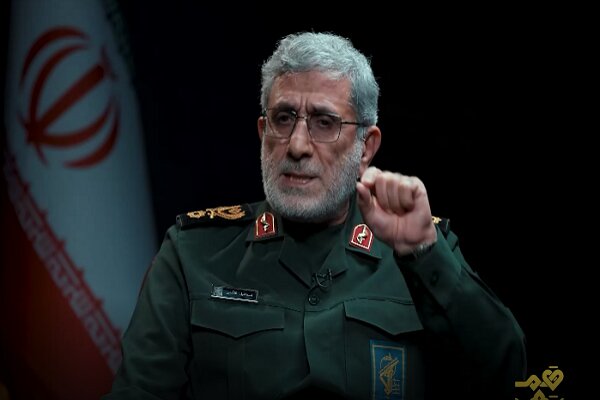
TEHRAN – A report circulating on certain social media accounts associated with the Israeli regime claiming the assassination of Brigadier General Esmail Qaani, commander of the Islamic Revolution Guards Corps (IRGC) Quds Force, has been flatly denied.
Sources who spoke to Tasnim news agency said these unsubstantiated claims are part of a repeated pattern by Israeli-linked networks aimed at spreading disinformation and carrying out psychological operations. Since the beginning of Operation Al-Aqsa Storm, the Israeli regime has repeatedly spread false rumors about an assassination attempt against General Qani.
One such account, allegedly associated with Mossad, is known as “Terrorism Alert,” and regularly posts a mix of false and true information online. The operation is widely seen as part of a Mossad psychological warfare operation rather than genuine news reporting. The account has previously published multiple false reports about the assassination.
In a recent interview, General Qaani himself dismissed such rumors, saying, “The Zionist regime is spreading reports about my assassination, so my friends are worried and trying to contact me so they (the Zionists) can determine my exact location.”
Brigadier General Esmail Qaani was first reported to have been killed on September 27, 2024, during an Israeli airstrike on a residential building in southern Beirut that claimed the life of Hezbollah Secretary-General Sayyad Hassan Nasrallah. The Revolutionary Guards acknowledged that one of its top commanders, Brigadier General Abbas Nirfurshan, was also martyred in the attack.
After the bodies of Israeli attack victims were recovered and identified, Western media launched a new wave of disinformation. They claimed Mr Khani was seriously injured in the attack but managed to survive. The fabrication was later reinforced by claims that the Quds Force commander returned to Tehran on October 4 on the plane of Iranian Foreign Minister Abbas Arakchi, who had made a short visit to Beirut.
When a senior Revolutionary Guards official finally addressed the rumors about Qani’s health and flatly denied his martyrdom or injury, Western media were forced to invent another lie. The fabricated article came from the UK-based news website Middle East Eye, which is reportedly funded by the Qatari government.
An Iraqi journalist known for his hostile stance toward the resistance reported on October 10 that “10 sources in Tehran, Beirut, and Baghdad” told MEE that Mr. Qani was “under surveillance” and “being interrogated” for his involvement in the “intelligence operations” that allowed Israel to assassinate Nasrallah. Other news outlets took the lie a step further, claiming that General Qani suffered a “heart attack” during interrogation.
But within just two weeks, commanders who were declared dead, wounded or arrested appeared in public. Mr. Qani attended General Nirfroshan’s funeral with his colleagues in the Revolutionary Guards and other Iranian officials, and appeared completely unharmed and relieved. He was captured on film praying silently and conversing with other participants, contradicting any claims previously reported by Western media.