
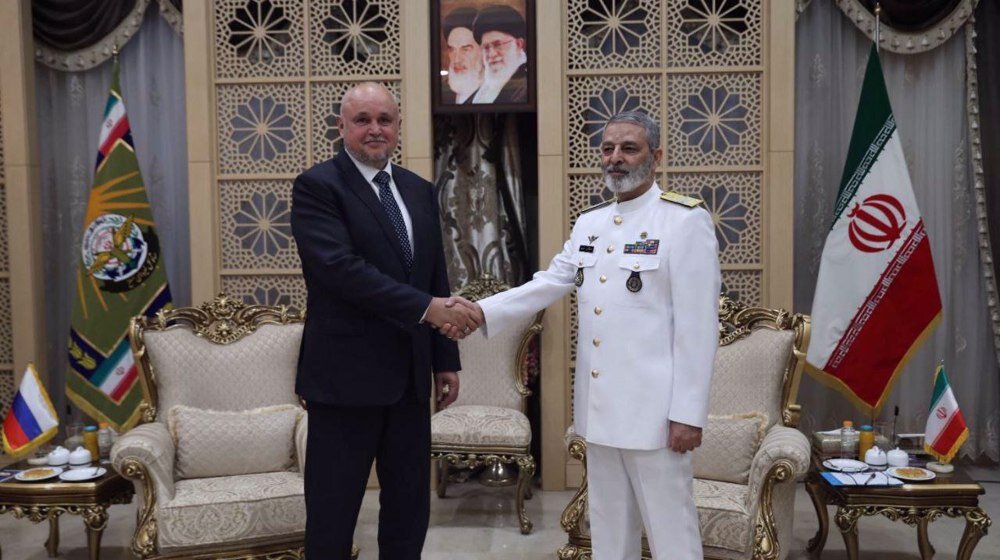
Tehran – Iran’s commander-in-chief praised Russia for its “very good” position at the United Nations and the International Atomic Energy Agency (IAEA) against Israel’s 12-day war against the Islamic Republic in June.
Major General Abdolrahim Musavi, chief of staff of the Iranian army, spoke at a meeting in Tehran with Russian Energy Minister Sergei Tsibilev on Thursday.
Musabi said he once again demonstrated that Iran was not the initiator of war to the world again, stressing that diplomacy remains a favorable means of resolving conflicts. “Iran considers diplomacy and negotiations to be the best solution to the problem,” he pointed out.
At the same time, the general recalled that Iranian enemies often exploited negotiations as a façade of deceptions. “The enemy used negotiations as the cover of betrayal and launched a imposed war against Iran,” he said.
Musabi emphasized that despite such overlap, Iran has shown that he has not hesitated to protect itself. “Iranian military has made a strong, solid, shattered response to the US and the Zionist regime,” he emphasized.
On June 13, Israel launched a blatant, unprovocative act of aggression against Iran, causing a 12-day war that killed at least 1,064 Iranians, including senior military commanders, nuclear scientists and civilians.
The conflict escalated further when the US intervened by bombing three Iranian nuclear facilities. This was accused by Tehran as a serious violation of international law.
Iran responded with force. The force launched a strike over strategic Israeli sites across the occupying territories, targeting Al Udeid Air Base in Qatar, the largest US military facility in West Asia. By June 24, Iran’s anti-manipulation had succeeded in halting the joint Israeli-American attack.
Beyond military issues, Musabi highlighted a wider opportunity for cooperation between Tehran and Moscow, particularly in the face of severe Western sanctions. “Iran and Russia have many capabilities to develop cooperation despite Western pressure,” he said, pointing to the resilience of the partnership between the two countries.
Energy Minister Tsivilev reflected these feelings and emphasized the need to deepen relationships between both the economy and the defense. He expressed his support for expanding the joint committee to raise the level of bilateral cooperation, highlighting Russia’s commitment to working closely with Iran in multiple sectors.
Iran-Russia cooperation indicates that a one-sided era is over: Pezeshkian
On Wednesday, Tsivilev also met with Iranian President Masoud Pezeshkian. During their talks, Pezeshkian emphasized that cooperation between independent states such as Iran and Russia could serve as a model for ending an era of unilateral domination in world affairs.
“A successful model of cooperation between independent countries, including Iran and Russia, will prove that the world’s one-sided era is over,” the president said. “We can lead our nation to development and progress without the need for one-sided strength.”
Pezeschkian emphasized Iran’s commitment to fully implementing previously signed contracts in the fields of transportation, energy and power generation. He called on both ministers and experts to double down on their efforts to ensure rapid progress.
“The Islamic Republic of Iran is seriously pursuing the implementation of agreements between the two countries. There is no obstacle to the way Tehran-Moscow cooperates,” he said.
The President praised the hope that regular, high-level visits and exchanges of delegations will further strengthen relations between the two “friendly and allied” countries.
Tsivilev gave a warm greeting from President Vladimir Putin to the President of Iran and expressed his satisfaction with the constructive outcome of the Joint Economic Committee of Iran and Russia. He emphasized that Moscow is ready to move forward without delay in implementing the bilateral agreement.
“Sans and external pressures cannot prevent trade and economic cooperation between Russia and Iran,” Tsivilev said, adding that the two countries have shown resilience in the face of Western restrictions.
Long considered close and strategic allies, Iran and Russia continue to expand cooperation across the economic, political, military and energy sectors despite sustained Western sanctions.