
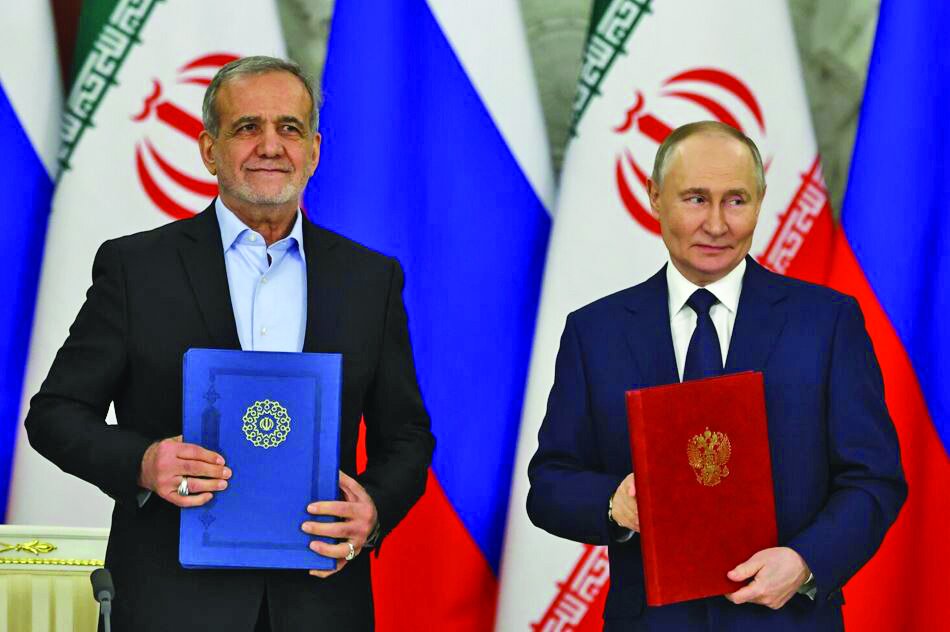
TEHRAN – Iran and Russia have entered a new phase in their long-standing relationship with the formal activation of the Treaty of Comprehensive Strategic Partnership between Tehran and Moscow. The 20-year agreement encompasses cooperation in defense, energy, technology and finance and is widely seen as a milestone in strengthening bilateral and regional relations.
As both countries face unprecedented Western sanctions, the treaty underscores their shared determination to build alternative political and economic frameworks, particularly through organizations such as BRICS and the Shanghai Cooperation Organization.
To better understand the implications of this strategic agreement, Tehran Times spoke to Dr. Rana Ravandi Fadai, a prominent Russian historian and senior fellow at the Institute of Oriental Studies of the Russian Academy of Sciences. Dr. Ravandi Fadai, a leading expert on Iran and Middle East issues, provides a nuanced analysis of how the treaty could redefine Iran’s geopolitical influence, shift the balance of power in Eurasia, and open new avenues for cooperation in energy and regional security.
Below is the full text of the interview.
How might this treaty affect Iran’s position in multilateral frameworks such as BRICS and the Shanghai Cooperation Organization?
I am convinced that this treaty is a real tool to overcome economic isolation. In fact, going back to the time of President Mahmoud Ahmadinejad, Iran gradually began to move in this direction, turning to Russia and the political alliances in which Russia played a key role, namely the SCO and BRICS. Iran joined these two organizations during the presidency of the late Ebrahim Raisi, who was clearly pro-Russian and actively worked to strengthen relations between Iran and Japan, including at the international level. This course was fully supported by Leader Ayatollah Seyyed Ali Khamenei.
This process accelerated rapidly under the late President Raisi and continues today under Massoud Pezeshkian, who recognizes that the West is still unwilling to change policy or make concessions to Iran. As a result, it was decided to deepen cooperation with Russia, China, and the BRICS bloc.
Pezeshkian recently said that BRICS will help Iran assert itself globally and play a more active role in world affairs. He also stressed that the organization should play an important role in preventing states such as Israel and the United Kingdom from committing acts of aggression against independent sovereign states.
Iran recently participated in the SCO summit held in China, and the president reiterated that the organization can contribute to creating a multipolar world. At the beginning of his term, Mr. Pezeshkian had certain illusions that the West would provide economic support. But with Western Europe, namely Germany, France, and the United Kingdom, effectively reinstating UN sanctions against Iran, the president lost any remaining hope that Western Europe or Europe would help.
Since then, he has decided that close cooperation with Russia and other BRICS members is the only viable path forward, and has even proposed the creation of mechanisms to circumvent sanctions. Most importantly, Iran can now rely on Russian support to position itself more confidently among such organizations.
To what extent is this agreement likely to change Iran’s diplomatic influence with the West, especially in the face of sanctions and international pressure?
Both Iran and Russia are subject to severe Western sanctions, but Iran is in an even more vulnerable position. The signing of this treaty will therefore allow Iran to assert its position more confidently before major Western powers. If the two countries succeed in establishing a mutual support system to counter sanctions, Russia and Iran’s positions vis-à-vis the West will be significantly strengthened.
What challenges might the two countries face in realizing the economic promise of this partnership?
First, both Russia and Iran are currently experiencing slowing economic growth, which in itself could have a negative impact on foreign economic cooperation. Second, close cooperation between Russia and Iran is contrary to the interests of the West and could result in new and additional sanctions being imposed on both countries. However, I believe that with enough political will, these obstacles can be overcome.
From your point of view, what changes does the Comprehensive Strategic Partnership Treaty bring to the strategic balance in Eurasia, especially in relations between Iran and Russia?
I believe that this agreement will weaken the influence of the West and Israel and shift the balance of power in Eurasia in favor of both Russia and Iran. However, it should be noted that Iran currently faces opposition in the region not only from Israel, but also from Syria’s Ahmad al-Sharat regime, which was previously one of Iran’s staunchest allies.
Therefore, strengthening Iran’s regional role will be a gradual process with serious challenges. But with the support of Russia and other allies of the Islamic Republic, it will surely happen.
Do you think this agreement will encourage other regional actors to pursue similar strategic partnerships?
Definitely. Many countries in the region have noted how quickly and effectively the Russian-Iranian partnership is developing, and this is motivating them to deepen their cooperation with each other. A recent example is the mutual defense agreement between Saudi Arabia and Pakistan, which is particularly important given Pakistan’s nuclear arsenal. Pakistan’s deterrence power now extends to Saudi Arabia, while Riyadh intends to pursue its own nuclear program with Pakistan’s assistance.
Given the importance of energy in both economies, what role will this treaty play in oil, gas and alternative energy cooperation?
I believe that this agreement will further promote cooperation between our countries in the oil and gas sector and in the alternative energy sector. Gazprom has already expressed interest in financing various projects within Iran’s oil and gas industry, including field development.
If the two countries coordinate their policies in the global energy market, it could have a significant impact on global oil, and especially gas, prices, tipping them in their favor given their vast resource reserves.