
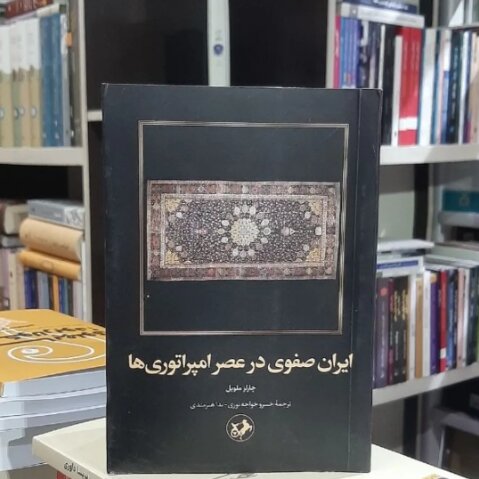
TEHRAN – The Persian translation of Charles Melville’s Safavid Persia in the Age of Empire has been released in bookstores across Iran.
The book was translated by Khosro Khaje Nouri and Neda Honalmandi and published by Amir Kabir Publishers in 727 pages, ISNA reported.
The original book for Volume 10 of the series, “Iranian Thought,” was published in 2021 by IB Tauris, a world leader in Middle East studies and recognized as a major presence in politics and international relations publishing.
There are 11 volumes in this series, 10 of which have already been published in Persian, and the last volume will be published soon.
During the 16th and 17th centuries, a new Safavid regime was established in Iran. The Safavids began a fundamental transformation of the religious landscape by reuniting the Persian lands under one rule and introducing Imami Shiaism as the official state faith, laying the foundations for Iran’s modern identity, among other ways.
In this book, leading scholars of Iranian history, culture, and politics examine the meaning of Iranian thought during the Safavid period by examining the contemporary experiences of both insiders and outsiders, and ask how contemporary scholarship defines the period.
Although sometimes seen as a period of decline from the high points of classical Persian literature and the visual arts of the previous century, the chapters in this book demonstrate that the Safavid period was a period of great literary and artistic activity in both secular and theological endeavors.
This book explores some of Iran’s literary and political interactions with its neighbors the Ottoman Empire, the Mughal Empire, and the Uzbekistan Empire, following the establishment of similar political states in West Asia, South Asia, and Central Asia around the same time.
Especially in the 17th century, as the amount and frequency of European merchants and diplomats visiting Safavid Persia increased, and as more Iranians recorded their own travel experiences to the surrounding Muslim lands, the Safavid period is the first in which the contours of Iran’s place in the expanding world can be recorded and explored, and insights into how Iranians viewed themselves and how others viewed Iranians.
Charles Melville is Emeritus Professor of Persian History at the University of Cambridge, UK, Director of the British Persian Research Institute, and Director of the Shahnama Project at Pembroke College, Cambridge.
He is the President of the Islamic Manuscript Society and Vice-President of the Academic Council of the Iranian Heritage Foundation. He has traveled extensively in Iran and Central Asia. His main research interests are the history and historiography of Iran from the Mongol to Safavid periods, and Persian manuscript culture.
He is the author and editor of numerous books and articles on Iranian history, including Every Inch a King, The Mongols’ Middle East, and Persian Historiography.
SS/SAB