
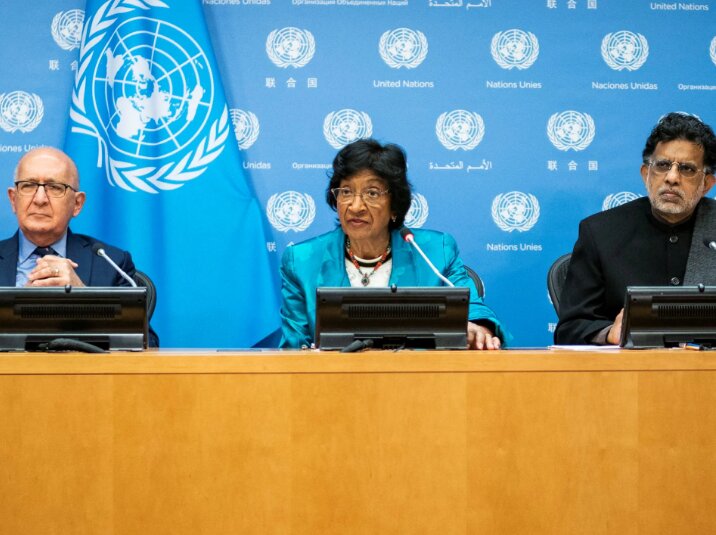
Tehran – The recent resignation of all members of the UN Commission on Inquisition on Occupied Palestinian Territories represents a difficult intersection of human rights accountability, geopolitical conflicts and organizational challenges within the UN system.
A closer look reveals growing political hostility, credibility issues, and a permanent external campaign to undermine and outlaw the work of the committee.
Personal reasons are hiding the politicized environment
On the surface, Pillay’s resignation at age 83 is not surprising given the difficult nature of working in a survey with the United Nations, citing health issues and commitments elsewhere.
Not to mention the implicit recognition of Kotari’s situation, Sidty’s rather hastily resignation shortly after her own retirement indicates the possibility of a coordinated resignation against any operational barrier and perceptions of external hostility. These factors are held in the context of an accelerated political environment that has a completely different impact on the committee’s ability to achieve designated objectives.
Commission’s important report and consequent repulsion
Since its establishment in 2021, the committee has produced periodic reports that are overwhelmingly critical of Israeli policies in the West Bank and Gaza. This explains a state of serious human rights abuse, including natural resources and disproportionate military conduct. These findings have generated intense backlash from Israel, the United States, and certain Jewish advocacy groups. In particular, he accused the committee of biased anti-Semitic trope after Kotari’s controversial remarks challenging Israel’s accession to the United Nations.
The anti-Semitism accusations raised pressure on the commission’s duties and internal cohesion, despite Pillay dismissing them as appropriation.
The US is increasing political pressure with sanctions
The resignation comes amid a broader Trump administration campaign targeting Israel’s international legal scrutiny. In particular, the United States has imposed sanctions against ICC prosecutor Karim Khan to pursue war crime investigations, including Israeli leaders, and has approved Palestinian UN Special Rapporteur Francesca Albanese for defending ICC prosecutors’ voices related to Israeli occupations and for defending ICC prosecutors’ voices and corporate responsibility.
These unprecedented sanctions are essentially a sharp reinforcement of US policies to protect Israel from international judicial processes by directly intimidating UN experts and hindering their work.
The overall situation reflects unacceptable interference that clashes with the independence and validity of the investigation, which should have been conducted under the auspices of the United Nations. The resignation committee was further constrained by diplomatic sclerosis as Israel refused to grant visas or cooperate with inquiries. This attitude creates an unacceptable professional environment for impartial research.
Therefore, collective resignation can be read not only as an individual choice but as a reflection of the systemic challenges posed by organized state-level resistance to international human rights mechanisms.
The future of UN surveillance depends on political will and protection
Looking forward to it, the invitation to the new appointment of the Human Rights Council prior to August 31 highlights the institutional resolve to continue oversight despite increased adversity. However, successor commissioners will need more powerful political support, protection from excessive impact, and mechanisms to ensure operational autonomy.
The resignation of members of the UN Fact-Investigation Committee represents a deeper crisis where age and personal considerations intersect with the fierce geopolitical contests over Israeli accountability.
Coordinated pressures from Israel and the US manifest themselves in diplomatic disorders and punitive sanctions, revealing attempts to curb international scrutiny in the Israeli-Palestinian conflict.
This episode raises urgent questions about the resilience of international human rights agencies when faced by Realpolitik and challenges the global community to reaffirm its commitment to protecting independent mechanisms of justice and accountability in highly sensitive zones of conflict.