
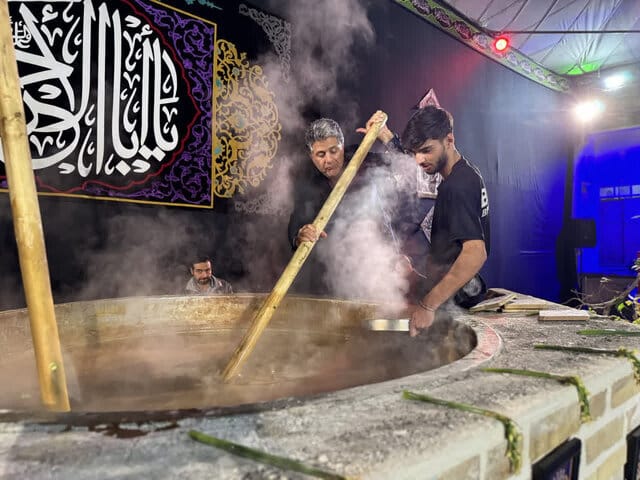
TEHRAN — As in previous years, the Samanu Pazhan ceremony was performed by the people of Sabeh city, Markazi province, on the day of commemoration of the martyrdom of Hazrat Fatem-e Zahra (SA).
Samanu is a traditional Iranian sweet paste made entirely from grinding sprouted wheat. This year, Moghadzadeh’s historic house in Sabeh will host the ceremony, ISNA reported.
The Samanu Pazhan ceremony is held in memory of Hazrat Fatem-e-Zahra (SA) and five members of the Prophet Muhammad’s household (the five members of Al-Aba refer to the Prophet of Islam himself, his beloved daughter Hazrat Fatemeh (SA), son-in-law Imam Ali (AS), and grandsons Imam Hassan (AS) and Imam Hussain (AS)).
The historic Moghadzadeh House, a Qajar residence with a pomegranate garden and a tiled veranda (iwan), welcomed hundreds of citizens on Wednesday night, rolling up their sleeves and boiling samanu pots to serve on neighboring tables, but the turning point in the ceremony was the arrival of a caravan of Honored Servant Razavi from the Holy Shrine of Imam Reza (AS).
Razavi’s servants who participated in the Samanu Pazhan ceremony blessed the Samanu pot with shrine blessings and murmured special prayers mixed with the tears of joy of those mourning Hazrat Fatemeh (AS).
The servants first went around the copper jar and loudly recited the Salawat Qase (special prayer) of Imam Reza (AS), then sprinkled the wheat sprouts with the temple’s pure rose water. Every time the samanu pot was stirred, blessings were sent to Prophet Muhammad (PBUH), and each time the samanu boiled, the words “Ya Fatemeh” were added. People were in tears.
Sabe Mayor Reza Mesbahi said Samanu Pazhan is not just a ritual. This is a practical lesson on empathy.
He added that the municipality played the role of facilitator of the Samanu Pazhan ceremony so that residents themselves could become stage directors.
He pointed out that everything from the development of the infrastructure to the preparation of the courtyard of the historic Moghadzadeh residence was done so that the citizens felt that the ceremony was their own.
Also, Saeed Karimi, chairman of Savee-e-Islam Municipal Council, noted the enthusiastic attendance of young people and said that this ceremony signifies that Samanu Pazhan from the martyrdom of Hazrat Fatemeh (AS) is a living tradition.
He announced the approval of a special budget for the Sabe native events calendar, adding that Samanu Pazang, Yalda Night (Shabeh Chere) and even rain-making ceremonies are all included in the council’s annual program, ensuring that the Sabe identity is passed on from generation to generation.
Irrespective of the religious aspects, religious ceremonies are an important part of the historical and cultural traditions of this land and a precious thing worth preserving as intangible heritage, and holding the Samanu Pazhan ceremony on the day of commemoration of Hazrat Fatem-e-Zahra (AS) at one of the historical monuments of Sabeh brought about the synergy of the identity elements of this city.
Samanu cooking traditions are deeply rooted in family tradition, with recipes passed down from grandparents to grandchildren. Remarkably, samanu produced in this region can be stored for up to two years without refrigeration, a testament to its unique quality and preservation techniques.
This ritual not only celebrates this local product, but also aligns with the spirit of Nowruz, the Iranian New Year, with Samanu being one of the seven items placed on the Haftsheen table, symbolizing rebirth and the arrival of spring.
KD