
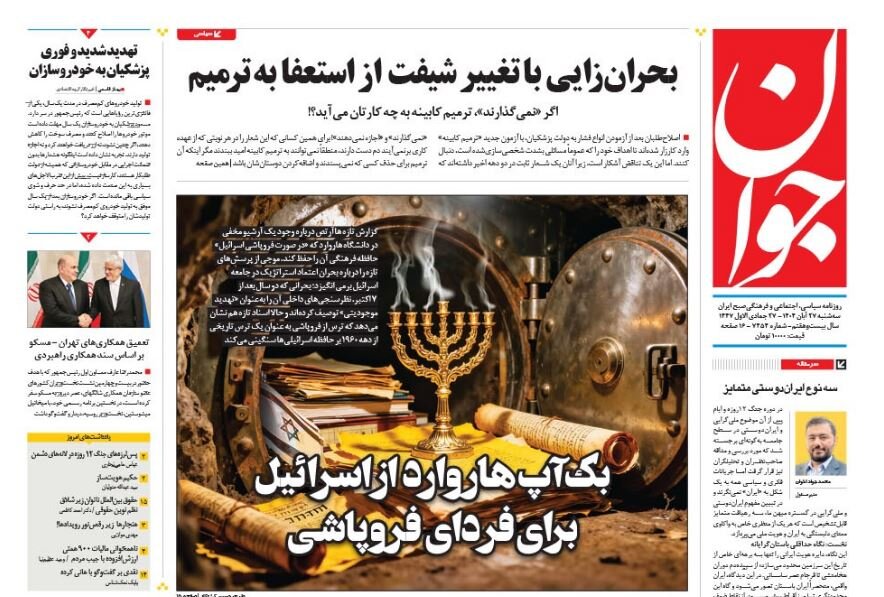
TEHRAN – In analysis, Mr. Jawan addressed the Shanghai Cooperation Organization’s Prime Ministers’ Meeting in Moscow.
The newspaper writes: The Islamic Republic of Iran’s accession to the SCO has given the organization a stronger identity and strengthened our position in the international arena based on national capabilities. This accession improved Iran’s global standing and created new opportunities for the nation. New capabilities are emerging within organizations such as the SCO and BRICS, which include Iran, Russia, and several other sanctioned countries. Therefore, it can be said that through synergy among these countries, Iran has a suitable opportunity to evade and neutralize sanctions. Joining large countries such as China and Russia presents a valuable opportunity to strengthen economic cooperation, resist Western pressure, and achieve convergence. A common argument we share today is the protection of independence. This common outlook allows us to expand our security cooperation and, in the economic field, rely on the capabilities of Iran, Russia and China, along with other SCO members, to decisively counter Western pressure.
Mr. Etelert: So far there is no news regarding negotiations with the United States.
Ebrahim Azizi, chairman of the Parliamentary Committee on National Security and Foreign Policy, verified rumors about possible negotiations between Iran and the United States in an interview with Mr. Etelert. The politician said that in the current situation, where international sanctions have been reinstated and we are paying heavy costs in the 12-day war, any narrative about Iran-US negotiations contradicts reality and amounts to bias. Indeed, until the United States expresses regret for siding with Israel in its war against the United States and abandons its overt campaign of Iranophobia, we will not see any movement from Iran to demonstrate understanding with the United States. There is no denying that our country’s economic problems create a difficult situation, but “running away from the difficulties” does not justify negotiations with the United States and other countries that pursue hostility toward Iran and spare no effort to harm our country. The Middle East is economically very rich. Therefore, not only Iran but also other Persian Gulf states can achieve their economic goals by working together without relying on the West. Additionally, having borders with 15 countries gives Iran unique capabilities. It is therefore sufficient to manage relations with neighboring countries in such a way that the carrying capacity of the border serves as a bridge to meet economic needs.
Hamshahari: Pressure and sanctions are ineffective
In his article, Hamshahari addressed Iran’s approach to overriding sanctions. “The threat of U.S. and European-led sanctions against Iran continues, but the Iranian government is working more proactively than before to counter its influence through multilateral diplomacy,” the newspaper said. One aspect of this approach is deepening strategic cooperation with Russia and China. The first vice president’s visit to China on Monday and the transport and urban development minister’s talks in Beijing are the latest manifestations of Iran’s anti-sanctions strategy. Meanwhile, Western threats and propaganda against Iran have continued in recent days. The US and European troika are applying new pressure and attempting to complete the puzzle of Iran’s encirclement by submitting a draft anti-Iranian resolution to the IAEA Board of Governors. However, recent developments increasingly prove that the “pressure and sanctions” narrative against the Islamic Republic is ineffective. In this context, Iran’s active diplomacy in the regional and international arenas provides a suitable basis for breaking the consensus around Western countries’ sanctions-oriented approach.
Iran: A new test of IAEA independence
In a commentary, an Iranian newspaper discussed this week’s IAEA board meeting and wrote: Following attacks by Israel and the United States on three of Iran’s main nuclear facilities, Tehran reached a technical framework agreement with the IAEA through Egyptian-mediated negotiations, under which it continued inspections at non-targeted facilities, including Tehran’s nuclear reactor and the Bushehr power plant. However, Iran suspended the deal after the United States and Europe moved to reinstate the expired UN Security Council resolution. From the perspective of Iranian officials, it is unreasonable to expect unilateral confidence-building while the other side seeks political pressure through outdated resolutions. Iran has consistently emphasized its commitment to its obligations under the Nuclear Non-Proliferation Treaty and continues technical cooperation with the IAEA within the accepted framework. Nevertheless, the IAEA calls for immediate increased cooperation, a demand that cannot be realistically realized unless political pressures are resolved. This week’s Council meeting will therefore be a new test of the UN agency’s independence and its resilience to political influence. Decisions made in the coming days could either pave the way for a return to diplomacy or deepen divisions and undermine the fragile trust that exists. Although Iran has clearly stated that it is ready for constructive cooperation, it is not in an environment where technological means can be turned into tools of political pressure.