
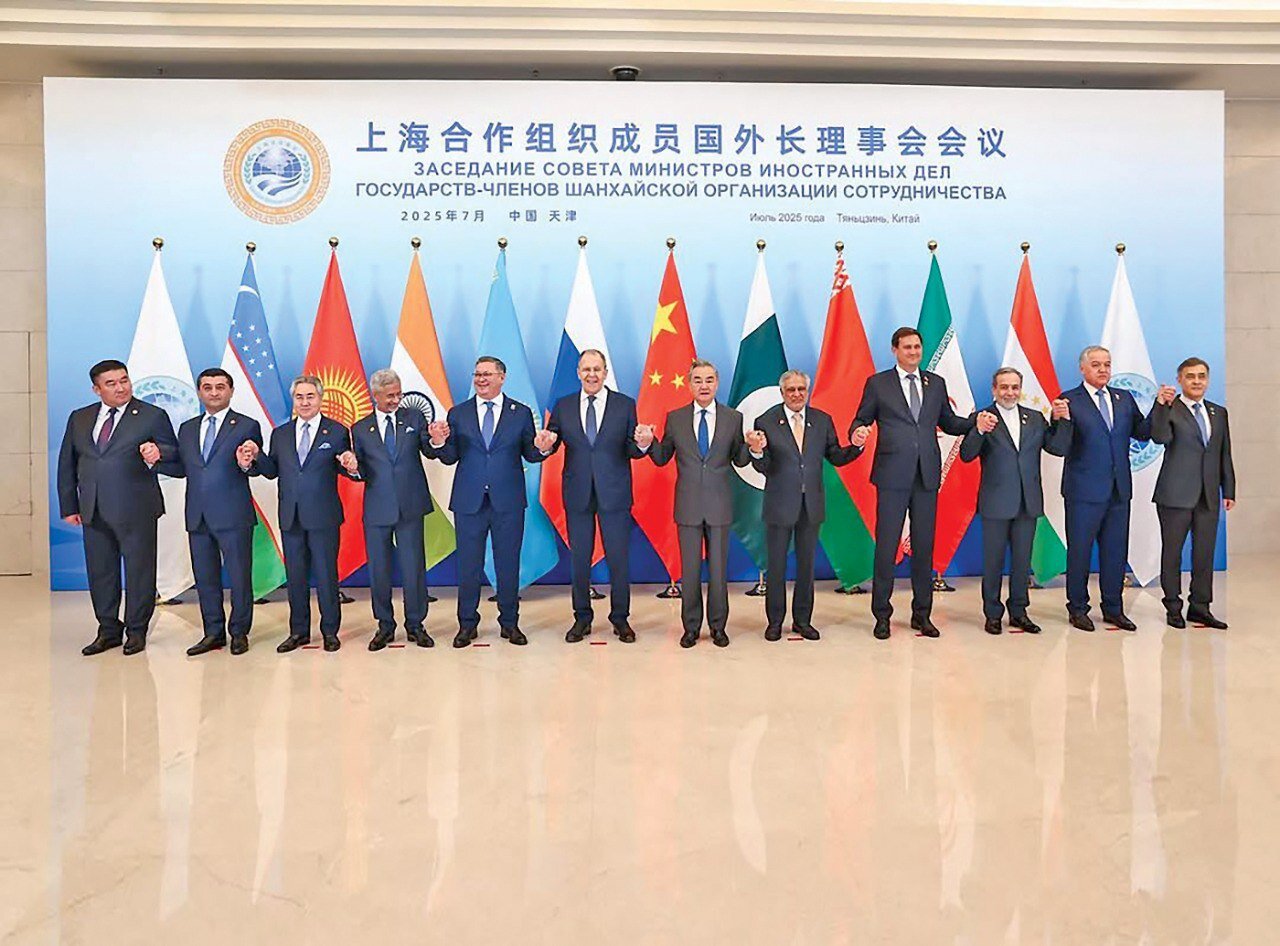
Tehran – Iranian Foreign Minister Abbas Aragut highlighted the importance of the Shanghai Cooperation Organization (SCO) as an important regional body and expressed his gratitude for Iran’s support in the wake of Israeli attacks.
“SCO is a very important regional organization and we respect that,” Araguchi said before the meeting at the Shanghai Cooperation Agency (SCO) Foreign Ministers’ Meeting on Tuesday. “Security issues in particular are an important topic being discussed within this framework. We are pleased that the SCO has stood up to Iran regarding the recent Israeli attacks.”
Araguchi also gave a powerful speech during the meeting, calling on member states to take a unified stand against Israeli-American attacks on Iran.
On June 13, Israel launched a blatant, unprovocative act of attack on Iran, assassinating many high-ranking military commanders, nuclear scientists and ordinary civilians.
More than a week later, the United States also took part in the war by bombing three Iranian nuclear sites with serious violations of the UN Charter, international law, and the Nuclear Non-Proliferation Treaty (NPT).
Araghchi emphasized that the SCO must speak in one voice as a recognized representative of the Global South, and that it must defend the core principles of the UN Charter, particularly the equality of sovereignty and the prohibition on the use of force.
Invoking the SCO’s governing decision, Aragut officially called on the Council of Heads of State to urgently review the situation and issue a resolution providing political support and necessary support to the Islamic Republic of Iran.
He warned that the assaults of the Israeli regime, directly supported by the United States, constituted a blatant violation of Article 2(4) of the UN Charter, causing serious damage to diplomacy, the rule of law and the nuclear non-proliferation regime.
“Our strikes against peaceful nuclear facilities are all severely violating the Nuclear Non-Proliferation Treaty, numerous IAEA resolutions and UN Security Council resolution 487 under IAEA safeguards,” he said. “There is no legal basis for justifying such an attack on peaceful nuclear sites based on political speculation.”
Araguchi has also criticized the international community’s failure to stop the massacre of the Palestinian people in recent years and end the Israeli occupation of nearby Arab lands. He said this latest attack on Iran was a direct result of the unidentified immunity that Israel enjoys, and was made possible primarily by the US and several European countries.
He outlined important proposals to protect member states’ sovereignty and strengthen the role of SCOs in tackling emerging threats.
These include the establishment of permanent mechanisms to monitor, document and coordinate responses to military attacks, sabotage, state-sponsored terrorism, and sovereignty violations within SCO members.
It was also proposed to create a dedicated centre to research and counter the unilateral sanctions tasked with developing supply chains, banking systems and operational strategies to protect the trade exchange of Member States.
Additionally, he called for the launch of a security assembly in the Shanghai region, which constitutes the defense and intelligence reporting agency, to cooperate and address terrorism, extremism, organized crime and cyber threats.
Finally, he urged deeper media and cultural cooperation between member states to counter the biased narratives promoted by cognitive wars and the power of hegemony media.
“With vast geopolitical, economic and human resources, SCO is uniquely set up as the fundamental pillar of the emerging multipolar world order,” Araguchi concluded. “We must firmly endure attempts to undermine unilateral sovereignty, which seeks to undermine unilateral sovereignty. Our future lies in cooperation, synergy and mutual trust.”
Iran and Russia FMS discuss regional security and cooperation
On the sidelines of the Shanghai Cooperation Agency (SCO) Foreign Ministers’ Meeting in Tianjin, China, the Iranian Foreign Minister met with Russian counterpart Sergei Lavrov.
The two discussed the bilateral states of Tehran-Moscow and exchanged views on regional development following recent US attacks on Israel and Iran. They also touched on issues raised at Araguchi’s recent visit to Moscow and at a previous meeting in Rio de Janeiro.
Araguchi highlighted the political pressures organized by the US and several European countries in the wake of these attacks, and reaffirmed Iran’s resolve to defend its legitimate rights to peaceful nuclear energy, including enriched activities, and to hold attackers accountable and protect them.
He further warned of the serious consequences of the UN Charter, international diplomacy and the principles of the nuclear non-proliferation regime.
Lavrov repeatedly denounced Russia’s illegal attacks on Iran’s peaceful nuclear facilities, highlighting ongoing bilateral and multilateral efforts to prevent further escalation. He also expressed Russia’s preparations to support Iran within an international forum, including the UN Security Council.
Iran, India FMS exchanges opinions on bilateral and regional development
Also, Foreign Minister Araguchi, bystanders of the SCO Summit, and India’s Sabrammamyamjaishankar, discussed the agenda in the field of meetings and mutual benefits.
They considered the growth of Tehran-New Delhi relations in light of recent US military actions against Israel and Iran, and exchanged perspectives on regional and international development, particularly in West Asia.
Pakistan and Iran reaffirm strong bilateral relations and regional security cooperation
Continuing his diplomatic engagement, Araguchi met with Pakistan’s Deputy Prime Minister and Foreign Minister Mohammed Ishak Dal.
The consultations focused on the steady development of bilateral cooperation and ongoing consultations between Tehran and Islamabad. Araguchi highlighted Iran’s commitment to expanding its brotherhood with Pakistan and promoting economic and trade relations.
He thanked Pakistan for his steadfast condemnation of his aggression against Iran and the solidarity manifested by the Pakistani government and its people.
Muhammad Ishaq Dal reaffirmed Pakistan’s support for Iran and expressed confidence in Iran’s resilience and continued progress. He also said that regular high-level dialogue between the two countries will encourage further deepening their relationship.
Both ministers have agreed to exchange opinions on regional and international issues that share concerns and maintain coordinated efforts at the Global Forum.
Iran and Uzbekistan are committed to strengthening bilateral relations and regional stability
On the sidelines of the SCO meeting, Aragut held a meeting with Uzbekistan Foreign Minister Bakhtiyo.
Araguchi condemned Israel’s military strike against Iran’s peaceful nuclear facility supported by the United States as a betrayal of diplomacy and international law. He lamented the lack of condemnation by the UN Security Council and the IAEA, but noted a wide range of global condemnations from over 120 countries and international organizations.
Saidov repeatedly stanced against Uzbekistan’s violation of Iran’s territorial integrity and expressed his sadness towards the victims’ families.
Both sides agreed to boost economic cooperation in Tehran-Tashkent through regular joint committees and strengthening trade facilitation, and pledged to continue mutual high-level visits and consultations on regional issues.
Iran and Kyrgyzstan highlight growing partnerships and regional cooperation
Araguchi also met with Kyrgyzstan Foreign Minister Zinbek Kribayev at the SCO Summit.
Pointing to the positive trajectory of bilateral relations, Aragut expressed his hope that recent agreements and cooperation within the framework of the Eurasian Economic Union will further strengthen relations, particularly in the economic and trade sectors.
Kulibayev expressed sadness to the Iranian victims of the recent attacks, describing Iran as Kyrgyzstan’s best friend. He welcomed a higher level of visit and invited Aragut to Bishkek.