
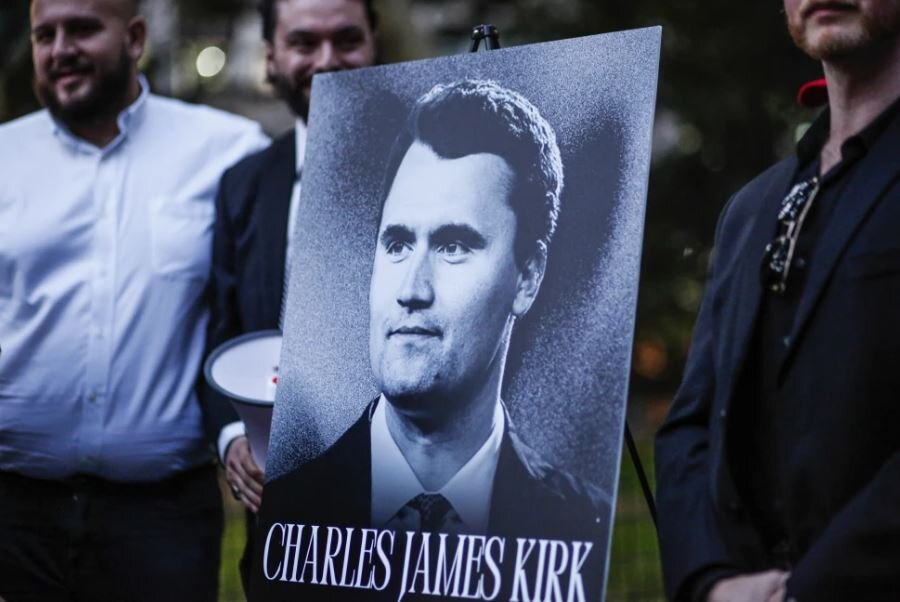
MADRID – The death of Charles Kirk and the way it was received in the public and media fields allow for a deep political analysis of how rights to mourning and commemoration are regulated in the modern world.
Kirk is a highly polarizing extremist and highly polarized figure whose rhetoric and behavior are prominent due to direct attacks on immigrants, women and minorities, but even liberal media who do not share his ideology were much more aware of his death. This phenomenon provides a starting point for understanding how symbolic and political hierarchies deserve to be mourned and systematically stripped of their rights.
The essential problem lies in the fact that Kirk belongs to certain social and political groups and is recognized for his memorial legitimacy thanks to the visibility he occupy within the Western political system. His death is inserted into a story that acknowledges his contradictions and extremism, while defending his humanity, his right to memory, and his public protest against his assassination. This public justification extends even to actors critical of his ideology who understand that condemning his murder constitutes a defense of democratic values and freedom of expression.
However, this comprehensive and legal logic of mourning has not been applied fairly to other groups. In particular, Israeli Iranian victims attacked during the 12-day war, and Palestinians killed in Gaza’s genocide faced media and political perceptions that were systematically restricted or rejected. These lives are subject to systemic and massive violence, but the right to public mourning and political memorial is denied. For Palestinians, media visibility is only integrated if the scale of the violence and the number of victims make it impossible for complete silence.
However, this forced existence does not guarantee full humanization or equal recognition. Rather, under normal circumstances, these lives remained invisible and were stripped of the subject’s status worthy of international mourning, which reflects the exception imposed by the brutality of the event.
Meanwhile, Iranian casualties of recent wars remain within the political and media scope. Their names rarely appear in official stories, and the grief that comes with their death is erased or expelled from global collective memory. This exclusion makes their deaths “unmorn.” They do not occupy the iconic space of shared humanity. It is not the purpose of legitimate mourning policies or universal demands for justice or compensation.
Therefore, the hierarchy of mourning has a deep political significance. Recognition or exclusion from the right to lament acts as a device of power in which the humanity of a particular body is regulated and others are dehumanized. Death is no longer just a biological fact, and becomes a political issue that teaches how power relations and exclusion work on a global scale.
Within this framework, Kirk can assassinate him, but he cannot be abandoned as a man worthy of mourning. His extremist and contradictory figure has been symbolically reconstructed, so his death evokes collective sentiment and public protest. In contrast, when Palestinians or Iranians die, the global system reaffirms their state as a marginal and sub-organisation, denies emotional and political space.
The visibility of the media, especially among Palestinians killed in Gaza during recent genocide, has been a complicated phenomenon. Only the unprecedented scale of violence and the ever-increasing victims were able to open up space for view. However, the presence of this media does not necessarily lead to a universal right to mourning and dignified memory. In many cases, exposure is fragmented, politicized and conditioned by global strategic interests. In many cases, these death stories are reduced to numbers or presented as isolated episodes of violence, stripping away the body of the human dimension and the possibility of complete empathy.
Kirk’s case exemplifies the political argbitrariness in perceived choice of mourning. It is not a problem that his ideas are rejected or condemned, and his death is subject to visibility and public debate. Thus, the politics of death and grief not only justify individual loss, but also reveals the social and political status of the body dying within a racialized, hierarchical global order.
The right to lament is therefore a regulated right through power to determine who is worthy of being recorded in public memory and who is relegated to forgetting. Possible mourning is associated with discourses of citizenship, belonging, race, religion, and geopolitics. Justice mourning not only recognizes losses, but also justifies lost life and recreates political and symbolic hierarchies within the global human community.
Kirk’s death thus becomes a public event of mobilization in the context of his privileged and recognized positioning winning. In contrast, the deaths of Iranian and Palestinian victims are very visible during mass crime and genocide, reaffirming symbolic alienation that exists outside the framework of recognition and empathy.
This observation is key to imagining the truly universal and just politics of death and mourning. Questioning these classes means asserting the right to mourning that does not discriminate based on identity or geopolitical location. It means defending the dignity of all bodies and political respect for all losses, transforming collective memory into an inclusive and fair space.
Finally, a political debate about who can mourn and who must question the roots of race, political and economic exclusion operating in global necropolitics. Memory and mourning are not merely sentimental exercises, but constitute a space in which legal forms of life and death are contested, and, in turn, the possibility of sharing justice and human potential in a world marked by violence and inequality.
To expand the analysis, we need to consider how these hierarchies of mourning intersect with the media narrative and the construction of what is called the “symbol values of life.” Kirk’s public perception arises not from his intrinsic humanity, but from his placement within a system of values that prioritize certain bodies over other bodies. In other words, the right to mourning is clarified around a network of global, racial, and political power that determines which losses are important and which are negligible.
Furthermore, comparisons with other political deaths throughout history show that this practice is not new. The patterns repeat from assassination of political leaders in colonial contexts to attacks on minorities in modern conflict. Some bodies turn into symbols of global moral rage, but others remain invisible. This shows that death and mourning are ultimately instruments of governance and social regulation that reflect the allocation of symbolic values according to structural inequality and standards of power and belonging.
In the case of Palestinians and Iranian victims it highlights the need to rethink the concept of universality in political and human rights. Shared humanity is not conditioned by cultural, political, or racial proximity, nor can it be subordinated to Western media logic. To achieve a truly universal politics of mourning, it is essential to recognize and stand up to the structures that determine which bodies deserve to mourn and which are systematically marginalized.
In this sense, Kirk’s death and his treatment of media provide an important mirror to examine the arbitrar nature of the mechanisms that justify mourning. The enlargement of his memory and centrality of his death to the public agenda demonstrates how empathy and anger are selectively assigned to replicate the hierarchy of political and human values. The politics of mourning becomes an ontological field of conflict. It determines not only who deserves to lament, but also lives fully recognized as human beings within the existing global order.