
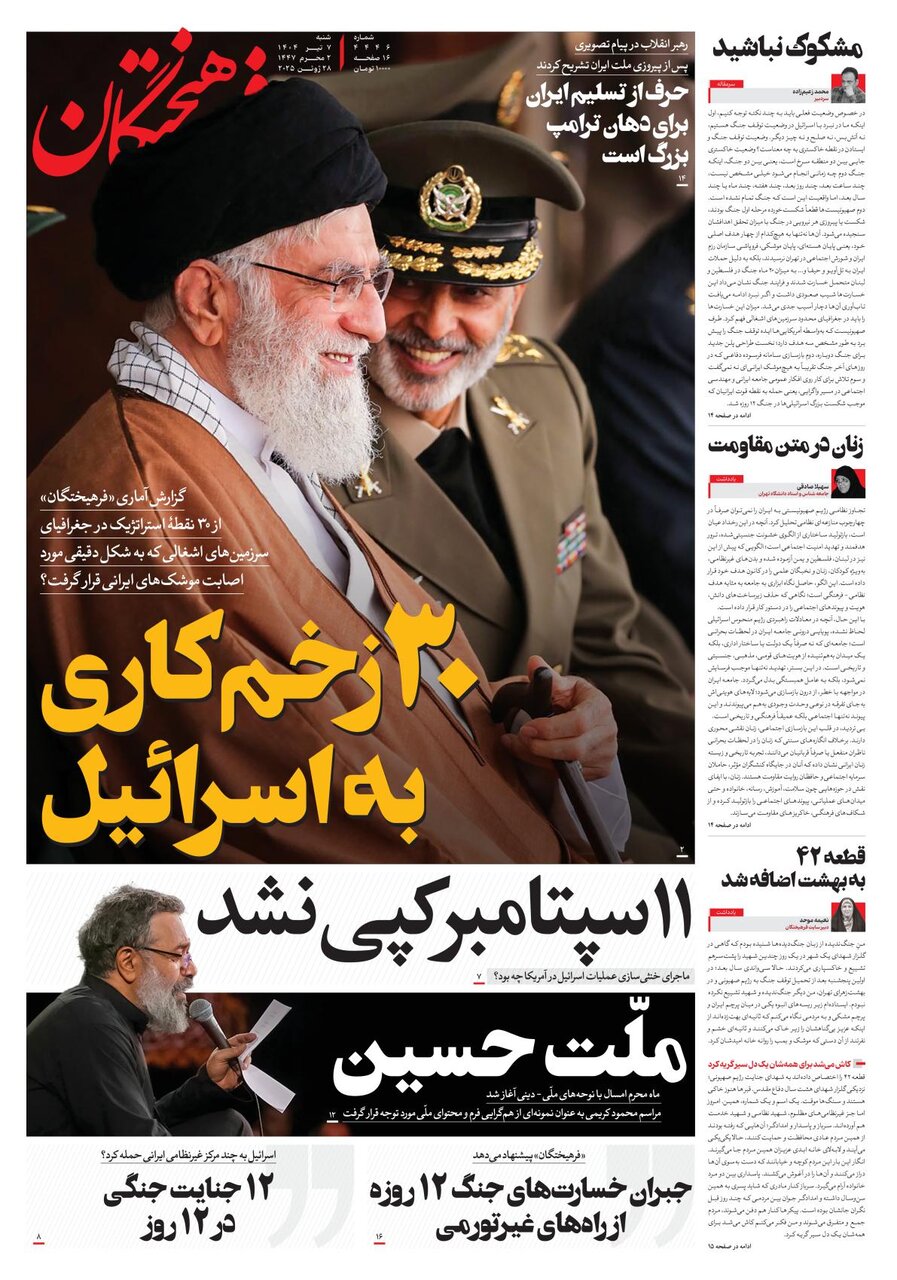
In the Tehran-article, Farhikhtegan analyzed the Tehran Times monopoly report, claiming that the Zionist regime had planned a destructive explosion on the US soil intended to be misaligned to Iran.
According to this article, the suspicious false flag operation has created evidence and sought to provide an excuse for a full-scale US war against the country, involving Iran. The plan aims to manipulate American public opinion and justify military attacks, but it was revealed through intelligence received from friendly countries. Knowing the plan, Iran reportedly sent warnings to American officials, leading to disruption in the plan. While the United States played a very active role in Israel’s 12-day war with Iran, the operation was designed to completely draw Washington into the conflict by recreating the shock and political consequences of the September 11 attack.
sobh-e-no: Iran must be on guard as Israel does not respect the ceasefire
In the analysis, SOBH-E-NO highlighted the history of Israel’s violation agreement and lack of commitment to a ceasefire and that Iran remains fully prepared for the violation of the ceasefire that came into effect on June 25th. It writes as follows: The ceasefire agreement appears to have created hope for a temporary halt to the attack. Iran’s Islamic Republic must continue to maintain its vigilance at the highest level. Dealing with betrayal and reattacks by the Zionist regime requires full defensive and operational preparation, along with strengthening the defensive and intellectual systems. At the same time, the country’s diplomatic devices must convey global public opinion about the unreliable nature of Israel, reflecting repeated violations of the regime’s international rules. Under the current circumstances, trusting the Zionist regime’s commitment to a ceasefire without deterrence and complete preparation is nothing but naive. This regime has repeatedly shown that it is not compliant with any international rules or regulations. Therefore, maintaining preparation and attention is the only way to protect a country’s national security.
Donya-e-eqtesad: Intelligent Silence
In his memo, Donya Ektesad wrote to Iran’s intellectual silence to the west: The recently agreed ceasefire between Iran and Israel in Washington’s mediation is not from moral concerns or peace, but to prevent tensions in the energy market and widespread global competition in the United States. America’s military involvement in recent wars has been limited and calculated. Trump has adopted a vague position. In response to the recent conflict, he said: “Iran and Israel are violating the agreement and I am not satisfied with either of them.” This artificial neutrality reflects exactly the same cost-oriented view of the region. Therefore, Iran should not hurry to prove that it is dangerous, as neither Washington has the incentive to continue sanctions, and therefore, as Tel Aviv has not consciously or unintentionally maintains an image of a threat. The best response at this point is intellectual silence. In politics, you don’t always have to speak for yourself. Sometimes it’s enough to wait for the other person to speak your language without knowing it, making you doubt others.
Iran: “Strategic Loneliness” History Choice or Destiny? !
Theorists of “strategic loneliness” believe that Iran will never become part of the trajectory of the great coalition of the world’s great powers, not because of political mistakes, but because of the specific characteristics of the country, such as Persian, Shiite religion, and its specific geographical location. From their viewpoint, the region’s great powers do not consider Iran as part of its strategic team. As a result, Iran is forced to follow the path of authority from within by strengthening its internal power and increasing its general legitimacy. Contrary to the general perception of strategic loneliness, Iranian analysts view it as an opportunity for independent action in the region. They believe that Iran’s historical experiences are full of betrayal of great powers, from Russia and the UK to today’s America and China. According to this view, Iran can never rely on others. Because others always make and break agreements to their preferences. Iran’s strategic loneliness is the result of its political system, its general discourse, and the intentional orientation of the Islamic Republic in its foreign policy. This perspective views this phenomenon as a political and debate component rather than inherent.