
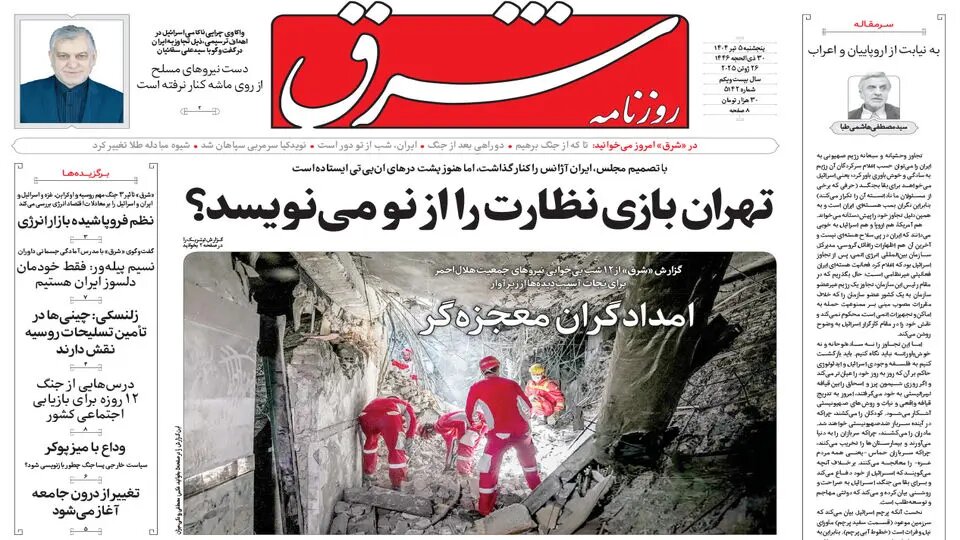
Tehran – In a memo, Sharg addresses the current situation in the Middle East, writing: Following the unprecedented US attack on Iran’s nuclear facilities, the world is facing a wave of contradictory analysis, narratives and reactions.
This operation not only changed the Middle East security equations, but also marked the beginning of a new chapter in the battle for the global media narrative. Meanwhile, media close to Democrats have repeated their usual patterns and sacrificed political orientation for existing realities. With the end of the 12-day war and the declaration of a ceasefire, the Middle East has entered a new chapter. However, the scars of this event and the repeated fears of conflict continue to cast a shadow over the region. Rebuilding Iran’s nuclear facilities at best requires billions of dollars in investment for years, and the country will undoubtedly redefine its nuclear and regional policies. Finally, the US massive attack on Iran’s nuclear facilities is a turning point in the Middle East geopolitical and security equations, an event that their effects will cast a shadow on regional and global development for the next few years.
Etemad: Strong Iran
In his analysis, Etemad discussed the failure of the Western program, saying: The West foolishly thought that Iran’s nuclear industry, a product of Iran’s inherent knowledge, could be destroyed by military attacks, but the West faced defeat in its final option against Iran. The West wanted to try their last chance to defeat Iran before officially accepting Iran’s power again. In other words, their last chance was that before dealing with Iran, the West decided to mobilize all its capabilities, including military force, to overthrow Iran’s control system and prevent it from becoming nuclear power. But, strangely and surprisingly, everything turned out to be the other way around. Modern history and historical experience demonstrate that Western political classes consistently act against the East. The West repeatedly deceived and adopted comprehensive pressure to eliminate Eastern competitors.
Kayhan: The failure of the American project
In his commentary, Kaihan analyzed the US failed projects against Iran. The US and its allies have repeatedly tested maximum pressure strategies against Iran, from sanctions to nuclear scientists and cyberattacks. However, these policies not only ended with failure, but also led to increased self-sufficiency, increased resistance and the development of Iran’s deterrent capabilities. And contrary to the expectations of the invaders, the attack on Iran did not cause internal anxiety or public riots. On the contrary, many segments of society viewed foreign invasions as a threat to state sovereignty, regardless of their political or ideological affiliation. This has led to the formation of unity and solidarity against a common enemy. In addition to military attacks, by highlighting the son of the abdicated king of the Pahlavi regime, Western and Israeli propaganda machines sought to nominate him as an option for the Islamic Republic. However, the Iranians rejected the project.
Arman-e-Emrooz: Golden Economic Opportunity in the Shadow of Peace
In the article, Arman-E-Emrooz examined the outlook for financial markets in Iran and the Middle East. Economist Morteza Afgha said Iran and the Middle East financial markets were severely affected after the announcement of a ceasefire between Iran and Israel. Global and regional market outlook has had a concrete impact on the market, creating a continuous, vulnerable political and economic ceasefire. The “political ceasefire” provided a temporary opportunity to reduce tensions and relative market revival. The current political ceasefire is the starting point for the relative stability of the oil market, foreign currency, gold and capital markets. But economic, structural and governance reforms are prerequisites for overcoming the crisis, along with lifting sanctions and establishing constructive relations with the world. Without these reforms, the ceasefire would not last. The country is also far from the path of economic development.