
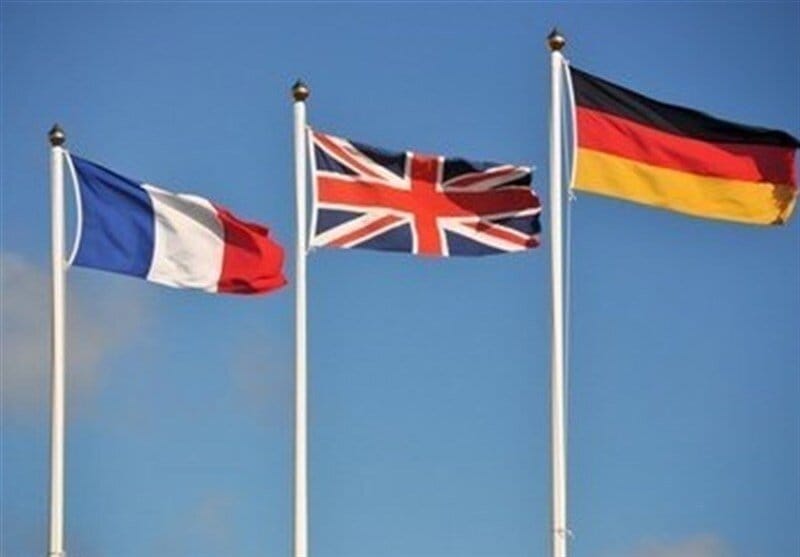
TEHRAN – Iranian media have strongly criticized the “shameless arrogance” of the European Troika, comprising Britain, Germany and France, as they renewed calls for Iran to provide more “transparency” over its nuclear program while continuing to ignore its commitments under the now-expired 2015 nuclear agreement (JCPOA).
Germany’s Foreign Ministry said in a post on X that Foreign Minister Johan Wadepoul met with British Foreign Minister Yvette Cooper and French Foreign Minister Jean-Noël Barrault on the sidelines of the G7 summit.
The German Foreign Ministry claimed that during the meeting, “the three ministers emphasized that even after the snapback mechanism is reactivated, Iran must continue to ensure true transparency of its nuclear program.” He added that the discussion also addressed the situation in West Asia and ways to strengthen military and financial support to Ukraine.
Iranian media criticized this statement as another demonstration of European duplicity. The Troika has demanded “transparency” from the Iranian government, but the Troika itself has never kept the promises it made under the JCPOA. Since the United States unilaterally withdrew from the agreement in 2018, European countries have not taken any practical steps to neutralize or lift the illegal and unilateral sanctions imposed on the Islamic Republic, Tasnism wrote.
Instead, London, Berlin, and Paris are increasingly aligning themselves with U.S. policy, undermining the spirit and substance of the agreements they once claimed to uphold. Fars News Agency claimed that their calls for “accountability” and “restraint” have become empty slogans masking their own political submission to Washington.
The so-called snapback mechanism, a provision within the JCPOA that allows any party to unilaterally reinstate UN sanctions if Iran claims non-compliance, was formally activated by the European Troika in late August. This marked a dramatic escalation of Western pressure on Iran.
On September 19, the UN Security Council voted against permanently lifting pre-JCPOA sanctions against Iran. Just eight days later, the Security Council also rejected a resolution proposed by Russia and China, signatories of the JCPOA along with Iran, calling for a delay in the measures. The next day, E3 announced that all UN sanctions against Iran had been formally reimposed.
The decision effectively dismantled one of the last remaining pillars of the 2015 agreement. It also once again exposed Europe’s lack of strategic autonomy and its willingness to follow American instructions even at the cost of international law and diplomatic credibility.
Over the past 15 years, Iran has endured a series of coercive measures, including financial restrictions, oil embargoes and technology bans, aimed at paralyzing its economy and isolating its people. However, these pressures produced the opposite result.
Rather than weakening the country, sanctions accelerated Iran’s efforts toward self-reliance and innovation. The country has made remarkable advances in aerospace engineering, biotechnology, pharmaceuticals, and nuclear science, and these advances were achieved precisely because foreign pressures left us with no choice but to develop domestically.
The JCPOA has been largely non-functional since 2018. Europe has failed to provide the promised economic relief that was at the heart of the deal, following the U.S.’s illegal withdrawal and the reimposition of widespread sanctions. After nearly 18 months of fruitless waiting, Iran has begun to gradually reduce its nuclear stockpile in response to Western inaction. This is a move that is fully consistent with Articles 26 and 36 of the JCPOA.
The remaining signatories to the agreement, Russia and China, have repeatedly stated that the paralysis of the JCPOA is a result of Western countries’ non-compliance. Both countries are calling on Europe and the United States to return to real diplomacy rather than coercion.
Adding to the tensions were US and Israeli airstrikes in June that targeted Iranian nuclear facilities, the very facilities protected under the framework of the JCPOA. The attack was condemned around the world as an act of blatant aggression. US President Donald Trump later boasted that the airstrikes had “destroyed” Iran’s nuclear infrastructure, a statement that Tehran said amounted to an open admission of war crimes.
Analysts in Tehran argue that Europe’s latest statements are a continuation of this broader Western strategy of using diplomatic pressure and selective rhetoric to justify economic warfare and military threats.