
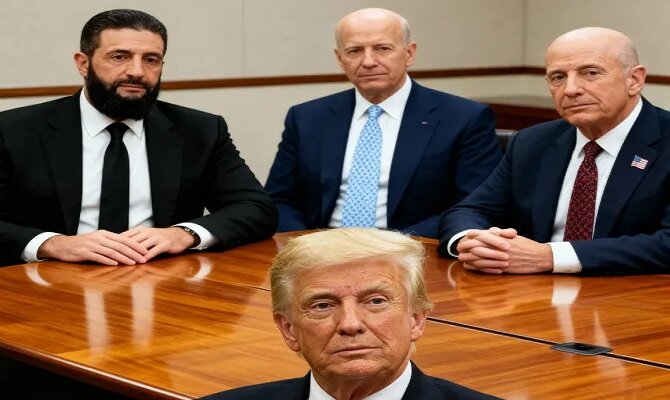
When a route like the one in Syria is used, the message is layered and indirect in nature, designed to hint at yet plausibly refute strategic intent.
Its core message appears to relate to the sanctity of Russia’s strategic interests in Syria, which form the basis of its Middle East policy. By using Syrian intermediaries, President Putin could strengthen Russia’s military entrenchment and ability to complicate US objectives, thereby testing President Trump’s stated desire to withdraw from “endless wars” and offer regional stability in return.
The speculative inclusion of nuclear threats would represent a dramatic escalation, consistent with Russia’s “escalate-de-escalate” principle and repeated rhetoric regarding Russia’s arsenal. Such a signal would not be a direct threat, but rather a calculated reminder of Russia’s ultimate deterrent power, aimed at shaping the limits of U.S. support for Ukraine by setting implicit red lines that could lead to a broader, uncontrollable conflict.
At the same time, the most likely statement will be a stern warning against continuing shipments of advanced weapons to Ukraine. The timing of such a message through back channels will be critical if it is preceded by a public change in President Trump’s position. That would represent an attempt to capitalize on a marked trend of sympathy within the Trump administration toward Russian security concerns.
Following this hypothetical exchange, President Trump’s public statements regarding the suspension of additional aid could be interpreted as a direct, although unverifiable, link. This would signal the success of a pressure campaign aimed at effectively using diplomacy to achieve military objectives on the battlefield and exploiting existing political divisions within the United States over funding to Ukraine.
Moreover, the use of Sharif as a messenger itself is an important signal. It exposes Putin’s networks of influence and power that directly conflict with U.S. interests, and highlights Russia’s ability to exert influence and engage in politics through channels outside the diplomatic world, which is completely dominated by the West.
From an analytical point of view, this sequence of events must be treated as ranging between hypothesis and fact. Caution should be taken as concrete evidence is lacking. Correlation does not imply causation. President Trump’s longstanding skepticism about U.S. involvement in foreign affairs and aid provision provides a sufficient alternative explanation for his policy statements, regardless of external pressure.
Statistically, the flow of US aid is huge, with Congress approving more than $100 billion in aid to Ukraine since the invasion. An abrupt halt or significant reduction after such a secret meeting would be a salient data point indicating the success of Russia’s coercive strategy and fundamentally change the dynamics of the war.
Tom Barak claims Al Shara supports US anti-terrorism alliance
The irony is profound. Tom Barak, forever disgraced by his alleged links to the Epstein scandal, now claims to be dictating anti-terrorism policy to sovereign nations. His credibility has already been eviscerated by personal legal and ethical entanglements, making his geopolitical pronouncements not only questionable but fundamentally disingenuous. This was a grave error in diplomatic judgment and one that elevated compromised individuals to positions of strategic influence.
Mr. Barak’s strategy hinges on the paradoxical rehabilitation of former ISIS official Ahmed al-Sharah, returning him to a key ally. This is a dangerously short-sighted policy that prioritizes short-term tactical gains over long-term regional stability. Al-Shara’s own record is one of abject failure. His forces have proven unable to protect Syria’s borders from the very foreign extremist forces he once helped import from Central Asia and the Caucasus, a fact that completely undermines his usefulness.
The envoy’s threat is a clear attempt to engineer a new sectarian conflict, specifically targeting Shiite forces such as Hezbollah and Iran. This represents an ironic return to a failed strategy that has historically fueled rather than stabilized the region. By framing these established regional actors only through a terrorist lens, this policy deliberately ignores their significant public support and political entrenchment, which is a serious analytical error.
This miscalculation is serious. Barak’s rhetoric reveals a serious underestimation of Hezbollah’s military capabilities, built over decades of conflict. With an estimated 150,000 rockets and missiles and battlefield experience against both the Israeli military and extremist groups like ISIS, Hezbollah represents a resilient non-state force, not a simple militia that can be easily dismissed or defeated by converted jihadists.
Ultimately, Mr. Barak’s approach is less a coherent strategy and more a volatile provocation. Leveraging unreliable assets like al-Shara to confront a battle-hardened force like Hezbollah while ignoring Iran’s extensive regional networks will only exacerbate the situation rather than solve it. This policy appears designed not to combat terrorism but to recklessly provoke broader regional conflict for which its architects are clearly unprepared.
In conclusion, although the specific scenario is hypothetical, it is a valuable model for understanding modern coercive diplomacy. The hidden message would be aimed at exploiting the division, reminding us of its consequences, and ultimately manipulating U.S. policy to secure Russia’s strategic interests in Ukraine and solidify its position as a rising world power.
Author: Dr. Ahmed Mustafa
Reprinted from: https://intellecto.wordpress.com