
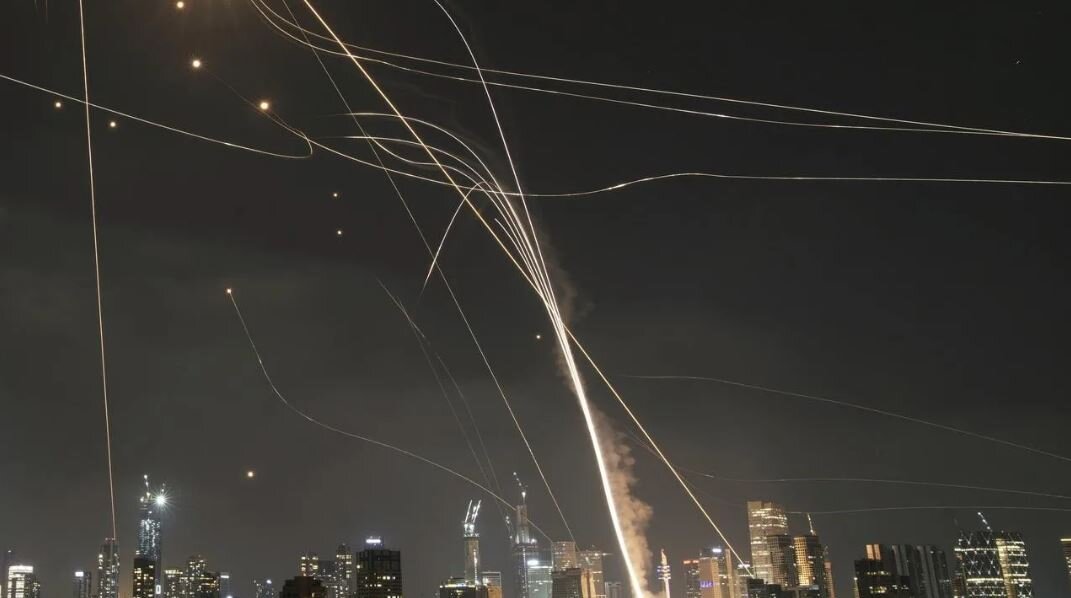
TEHRAN – In the middle of the night on June 13, 2025, Iran shook regional dynamics by launching Operation True Promise III in response to a direct Israeli attack.
The operation coincided with a message airing on Islamic Revolution leader Alitra Seyed Ali Khamenei, and struck the centre of Israel’s military and security centres with 22 missile attacks and 10 drone strikes over 12 days. But in addition to real damage and heavy blows, another scene appeared. Perhaps it is more important than the battlefield itself, the battlefield of the story.
From the first few hours, there was a total contrast between earthly reality and the headlines of mainstream Western media. Newspapers like the Financial Times and New York Times reported that “most missiles were intercepted” and that “the damage was minor.” Meanwhile, images circulating on social media and field reports show that Tel Aviv and Haifa were engulfed in flames and smoke, buildings collapsed and critical infrastructure paralyzed. This gap was not merely a contradiction in detail, but a sign of a greater phenomenon. Story management through software censorship.
Israel sought to hide the true scope of damage by banning images and accurate statistics and threatening local media. The ban has continued so far as it faced legal consequences for even Israeli journalists to share photos and videos. What was conveyed to the world was a real-life manipulation version aimed at maintaining domestic morale, preventing diplomatic pressure, and hiding the failures of multi-layered defense systems like the iron dome.
Media experts call this approach “soft censorship.” Soft censorship does not mean not only removing news entirely, but rewriting reality within a controlled framework. Israel and its western allies have attempted an obvious defeat over Iran’s hypersonic Fate missiles, ballistic Sedil and caddle missiles, as well as Arash 2 and Shahed 136 drones, in a “defensive victory.” In this rewrite, the truth became a victim and the headline was transformed into a psychological tool.
Meanwhile, independent reports and some local sources highlighted unprecedented damage to key centres including Israel’s infrastructure and defense headquarters, Kiriya’s military intelligence complex, Nevatim and Tel Nof Airbase, Mossad Headquarters, Mossad Oil Reflinery, Kiryat Gurion’s industrial zone, and Kiryat Gurion’s industrial zone. One of the main target sites was the Wiseman Institute in southern Tel Aviv. It is a scientific research centre operating in advanced technology, biological sciences and military research, and is recognized as one of the pillars of Israel’s technology and innovation. The destruction of the centre not only jeopardized Israel’s research and technology capabilities, but also demonstrated Iran’s ability to accurately target sensitive civil centres. It sent a clear message about local deterrence: the ability to accurately respond to threats at the heart of enemy science and technology centres is part of a deterrence tool that Israel was not prepared for.
International reactions were also worth noting. In its first statement, the US labelled Iran as a “unstable actor” but limited its response to verbal support. Washington was well aware that acknowledging the full extent of damage meant acknowledging the vulnerability of allies in key regional regions. The European Union called for restraint, but could not clearly address the real scale of casualties and damages. Only some non-mainstream media in Latin America, Africa and Asia highlighted the narrative gaps by publishing field images. This duality of silence and position was in itself part of the narrative war. This is a story that prefers to leave the image of “invincible Israel” intact.
However, military analysts were not so constrained by such considerations. Some Russian analysts and retired Western officials have acknowledged that the infiltration of Iranian missiles into Tel Aviv represents Israel’s “strategic defeat.” They emphasized that the effectiveness of iron domes against hypersonic missiles and mass attacks is severely limited. In their view, the operation demonstrated that Israel’s military superiority was no longer guaranteed and that the concept of deterrence in the region entered a new stage.
The human dimension of conflict was also distorted by the story. In Iran, more than 1,000 people have been killed, including 160 women and children, and nearly 5,000 injured. Israel argued that these were all “legitimate targets” and that most of the victims were ordinary civilians. On the other side, Israel admitted to only 28 deaths and more than 3,000 injured, while other sources reported more than 800 casualties. This contradiction further emphasized that Israel’s censorship is aimed at rewriting its global image, not just domestic control.
The economic consequences of the operation were also censored. The strike on the Haifa refinery disrupted fuel production and rising prices. The Kiryat Gat production halt affected the collaboration between the microprocessor industry and international technology. Ben Gurion Airport was closed for hours, affecting trade and tourism. But mainstream media reduced all this to “minor damage.”
The future of local deterrence is defined in light of the war in this story. If Israel continues to deny defeat and rely on censorship and distortion, it effectively weakens its deterrence. Public opinion both domestically and regionally will sooner or later realize the gap between reality and the story. In other words, concealment may have short-term psychological effects, but over time it erodes legitimacy and public trust.
Through Operation True Promise III, Iran has demonstrated that it not only has strong response capabilities on the battlefield, but is also prepared for soft battles. Images of Tel Aviv’s flames, though censored, remain in collective global memory. The video, which bypassed censorship, had an impact equivalent to over 1,000 official reports. This is exactly where the official story failed. Reality finds a way to surface, even if buried.
Finally, Operation True Promise III was not just a military conflict, but a historic moment that uncovered the gap between truth and story. Israel and its allies tried to turn defeat into victory through censorship and distortion, but the image and evidence told us a different story. There were important lessons in operation. In other words, in the age of multi-layered media and social networks, defeat can no longer be hidden behind headlines.