
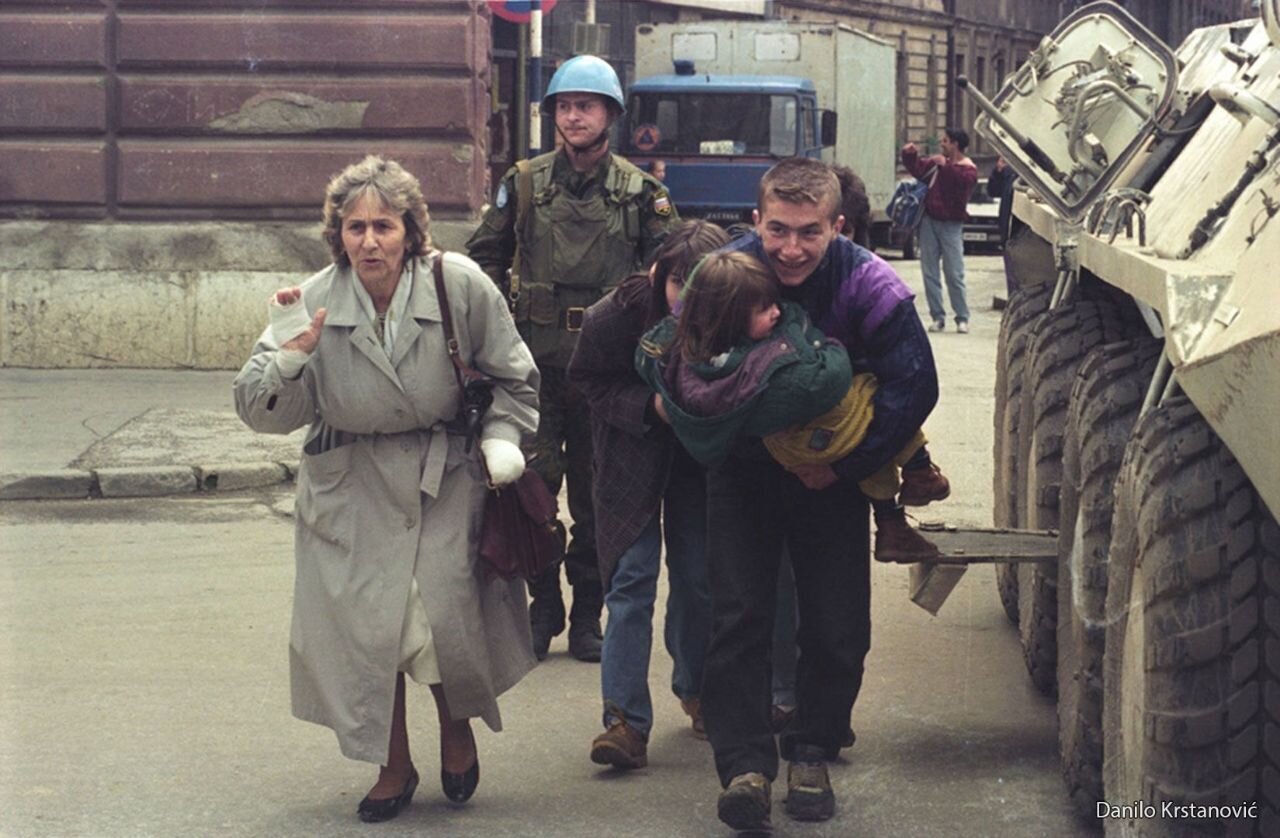
SARAJEVO – It was all a matter of time and place. Were you there when a sniper shot you on the street while you were fetching water? The taps were dry and the entire Olympic city of Sarajevo, the capital of Bosnia and Herzegovina, had to draw water into bottles and canisters at several springs and water tanks. And he would shoot.
It was all a matter of time and place.
Were you there when a sniper shot you while trying to buy bread? There were no stores open and bread could only be bought in a few places. Were you there in the freezing winter when a sniper pulled the trigger while you were collecting wood in the park to keep yourself warm in a makeshift stove? The children attended a makeshift school in the basement. You were attending college with a false sense of normalcy at a time when everything was abnormal.
Bullets and grenades hit homes, and I didn’t know if I would wake up alive after going to bed. Many people were killed in this way, and others called them lucky, because death discovered them while they were asleep.
It was all a matter of time and place.
Do you find yourself in the crosshairs when you go to see a movie at the theater, a concert, a book promotion or the newly launched Sarajevo Film Festival?
Walking through the fire to the university
Yes, it was. In the absence of public transport, between 1992 and 1995 Sarajevo’s young and old walked for miles through the besieged city, knowing full well that their lives were in danger and that they could be hit by bullets or torn apart by grenades.
And all in order to maintain the spiritual resistance of the city that was being destroyed, it was unique in the fact that on May 17, 1992, in the first year of the war in Bosnia and Herzegovina, in the midst of the siege, it opened a new theater, the Sarajevo War Theater (SARTR). SARTR still draws audiences more than 30 years later.
For me, it was very personal. At the age of 18, I served on the front lines as a soldier in the Armed Forces of the Republic of Bosnia and Herzegovina, defending the city, country and dignity, and without any fear took notes for my first novel among my peers, after which I entered the Faculty of Political Science at the University of Sarajevo, from which I later graduated.
Despite sniper fire and Serb artillery, tank, and mortar shells, thousands of students walked to their faculties for lectures and exams literally thirsty and hungry in a city without electricity, gas, or basic necessities.
Through my journalistic writings and book writing, I had the opportunity to meet many foreigners who were always interested in the war years.
They will be stunned to see the details I remember: the “flowers on the asphalt” left by mortar shell explosions, the splintered building facades, the windows shattered by the blast and covered with humanitarian plastic sheets.
Scars like memories that remain in even the smallest detail.
I was going to tell them that my father had died in the war, but instead I wanted to tell them about the fashion show I once watched from the front row at the Kamerni Theatre, about the music that was composed at the time, about the packed auditorium of the Bosnian Cultural Center during the wartime showing of Pulp Fiction, where the audience burst into laughter at the sight of liters of fake blood, and then went home after stepping on real blood.

“Beware of snipers” sign in Sarajevo / Danilo Krstanovic
Watch out, sniper!
On the way home, there were big warnings on every corner that read, “Watch out, Sniper!” Barricades and makeshift blankets were placed at intersections to block the sniper’s view of passing civilians, but Sarajevo is not a small city. It was located in a valley surrounded by hills, from which the Serb soldiers had a perfect vantage point overlooking the streets, buildings, entrances, and everything else.
Between the theater and my apartment was the infamous “Sniper Alley.” Exposed strips, as we called them, because even the fastest dashes don’t guarantee survival.
It was all a matter of time and place. Were you there when the sniper opened fire?
I remember when a sniper’s bullet passed just inches from my head.
Panic, fear?
no.
Today, probably. Back then, that wasn’t the case at all. It becomes a part of everyday life and humans adapt, recognizing that they have no other choice.
There could have been another way, just like in Gaza today. However, this is not the world we live in, ruled by ruthless leaders who have no mercy, humanity, or justice.
It was all a matter of time and place. And just when you think it can’t get any worse, you find out it absolutely can.
I was already writing for Oslobozenje, the oldest daily newspaper in Bosnia and Herzegovina. The paper was founded in 1943 and was declared the world’s best newspaper in 1992. At the time, the paper ran a front-page headline, “Sniper Safari in Sarajevo,” revealing how wealthy foreigners were paying the Serbian army to come and shoot civilians from their positions.
It was April 1995, the final year of the war, which ended with the unjust Dayton Peace Agreement, the effects of which we are still living with, but at least the killing had stopped and hope had begun, and that hope still survives.

Sprinting across open, exposed ground every day / Danilo Krstanovic
sniper tourist
At the time, to be honest, it made no difference to me who I was filming whether it was a xenophobic person who hates Muslims and everyone left in the city, or a pathological foreigner fulfilling a sick fantasy.
Perhaps that’s why people stopped thinking about it, but it all came to the fore again three years ago when Slovenian director Milan Zupanic’s documentary Sarajevo Safari was screened at the AJB DOC Film Festival in the Balkans, where I worked at Al Jazeera before its recent closure. He had been researching the subject for years, and that’s when things started to unravel.
It’s all a matter of time and place.
Today, in the same place but in a different time, journalists are once again playing the most honorable role, just as they were during the war, exposing and reporting on concentration camps, massacres, and utter barbarism. Italian journalist and author Ezio Gavazzeni filed a criminal complaint in a Milan court after years of investigation into war tourists who allegedly came on organized trips and shot at civilians, children, women, and the elderly in Sarajevo.
A story from more than 30 years ago, in which no one was arrested or held accountable, has now been revealed to the world. Following his accusation, prosecutor Alessandro Gobbis launched an official investigation in a Milan court, giving hope to those whose loved ones were killed by the sniper that some form of justice might finally see the light of day. According to reports, the specific names have been released but are still being kept secret due to the investigation.
Last night, I spoke by phone with Shevko Hodzic, a veteran journalist from Osloboženě. He recorded the presence of sniper tourists in his personal wartime diary and later books. He told me that this proves how depraved humanity can be.
sick price list
Let’s imagine. You are from a democratic Europe, in this case Italy, but other nationalities have been mentioned and even US Republican Congresswoman Anna Paulina Luna has called for an investigation in the US, all so that you can shoot people like big game animals from a safe distance, purely for disgusting entertainment.
It was a hunt. For humans.
Such operations required extensive coordination. The plane reportedly departed from Trieste to Belgrade and was then transported by helicopter or car to the front lines around Sarajevo. Of course, the authorities of the Serbian and Bosnian entity Republika Srpska deny this, but in any case no one trusts them because they glorify wartime president Radovan Karadzic and convicted war criminals such as General Ratko Mladic, convicted in The Hague of the Srebrenica genocide and other serious crimes.
So even if there is a conviction in the Italian case, no one expects moral catharsis here. But perhaps somewhere in the world people will finally understand the horror of such evil and prevent similar crimes in the future.
I happen to know Edin Subasic, a former war intelligence officer in the Bosnia and Herzegovina army. He was one of the first to receive information about the sniper tourists from a captured Serb volunteer in 1993. The soldier had been talking to Italian war tourists who had come to shoot in the city a few days earlier.
It was shocking, but the real shock came after. Subasic learned of the existence of a sick price list in which Serbian fighters shooting Sarajevans were reportedly paid hundreds of thousands of German marks, with the highest price being offered for the murder of a child. He kept the details secret for investigative reasons, but he did tell me one new thing.
In Podrinje, eastern Bosnia, near the Serbian border, there is video evidence that a tourist sniper very likely shot a civilian dead as medics removed big-game hunting ammunition from the body of a wounded civilian, which could lead to a new documentary film.
It was all a matter of time and place.
During the siege, 1,601 children were killed in Sarajevo, many by snipers. A total of 11,541 civilian lives were lost due to sniper fire and artillery fire. The siege lasted 1,425 days, the longest in modern history, and 50,000 tons of artillery was fired from Serb-held positions, averaging 329 shells per day.
be careful
Memory only has meaning if it makes us better people. With that hope in mind, I wrote my debut wartime novel, “Take Care.” Its title was the way Sarajevans greeted each other during the siege. This is the story of young people of all nationalities who left their university halls to protect their city, and it is a true story of friendship and love that endures under the constant smell of gunpowder.
There are no sniper tourists in the novel. why? The answer is simple. Even though I was once in the crosshairs of a sniper, I am ashamed of such misdeeds. As I said, I prefer to talk about plays, movies, books, concerts…End
(Edin Krehic is an award-winning author and journalist from Bosnia and Herzegovina. He has published five novels over the past 30 years, written film scripts, and reported from many countries. He lives in Sarajevo.)