
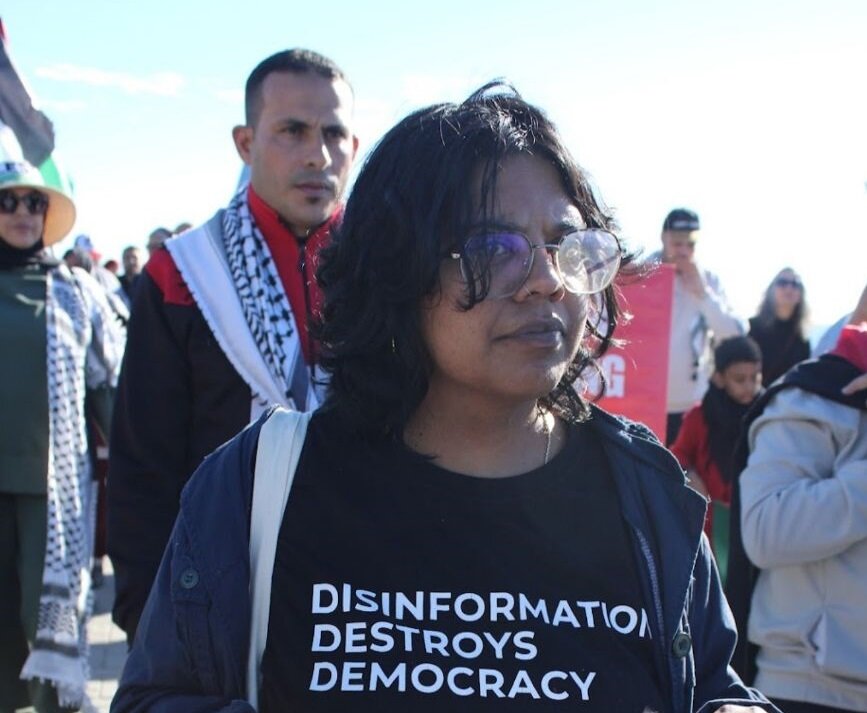
Tehran – For South African journalist Denny Subramani, the struggle for freedom of the Palestinian press is deeply personal. Sitting at her desk earlier this year, she was overwhelmed by the steady flow of devastating news. A journalist after the murder of a journalist in Gaza.
Anger turns into action
“I was mad,” she recalls. “By January 2024, more than 170 journalists had been killed. Today, that number is well over 270. It’s not just a tragedy, it’s a massacre.
The silence forced her to act. One night, at 10pm, she was frustrated by frustration, and drafted a statement in denunciation of Israel’s attacks and calling for solidarity with Palestinian journalists. Soon afterwards, she and her colleagues launched journalists against Apartheid (JAA), an initiative that organized a national vigil at Cape Town, Durban, Johannesburg at the School of Excellence Journalism in South Africa, and at the University of Rhodes.
“We wanted to be clear. South African journalists aren’t silent,” explains Subramany. “If the editorial agency doesn’t act, we do that.”
She adds: “I’m wondering about this. The Press Council has not made a statement, but it is intended to work with the editorial body. You can see it on that page. At the bottom, it speaks of interventions in big technology. But its vision is for journalism beyond South Africa.
Lessons from South Africa’s apartheid past
Subramany’s activism is inseparable from the history of her country. Born in 1987, she grew up in the last year of apartheid and witnessed a vulnerable transition to democracy. The background, she says, has shaped her sensitivity to injustice and censorship.
She recalls one story in particular. Her report on Sharpville, the town of Gauten, where police shot and killed protesters during the anti-pass protests in the 1960s. Official records listed 69 casualties, but survivors told her that the actual death toll was much higher.
“The experience taught me something important,” she recalls. “In the situation of oppression and genocide, we really don’t know how many lives are lost. Records are manipulated and voices are erased. The same can be said today.
For Sablamany, the similarities between South African apartheid and occupied Palestine cannot be denied. She argues that both are systems of militarized control, racism and institutional silencing of objections. “Even if Israel stops bombing today, Palestinians will still face decades of reconstruction. Look at South Africa: 30 years after democracy, we are still recovering.”
Media silence and western prejudice
If Israeli airstrike atrocities anger Subramani, the complacency of the media facility will infuriate her even more.
“There are journalism schools, editors forums and press conferences in South Africa, but none of them spoke when journalists were being slaughtered in Gaza,” she says. “That vacuum has made us realize we need an independent voice.”
Incidentally, the Sharpville massacre was a key moment that led to the creation of the South African Press Council, highlighting its historical roots in the struggle for accountability.
She also criticizes the Western-dominated global media landscape, which she describes as “middle class, eurocentric and reluctant to stand up against its prejudice.”
In the recent debate, South Africa’s public broadcasters have stopped freelance anchors who actively questioned respected anti-apartheid figures to describe Israel’s actions as the Holocaust. “It was harassment, not journalism,” says Subramany. “But the fact that such incidents occur shows the pressure journalists face when speaking honestly about Palestine.”
She argues the result is a deliberate elimination of the Palestinian voice. “Israel guarantees that foreign journalists cannot enter Gaza. It kills remaining local journalists. And instead of protesting, Western outlets censor themselves. It’s a crisis of global press freedom.”
The story of an Israeli “terrorist journalist”
According to Subramany, one of the most disturbing tactics is the everyday branding “terrorists” of Israeli Palestinian journalists.
“You can’t label people terrorists and kill them without evidence,” she insists. “Killing a journalist is a war crime. How do you justify 272 war crimes? You can’t.”
She argues that the strategy is designed to create media power outages. “We are civilians. We are media. By killing us and denying access, we guarantee that no one can report the truth. That’s the point.”
The role and failure of international organizations
Asked about the role of organizations such as the United Nations and the Commission to Protect Journalists, Subramany is skeptical.
“The agency can only do that much,” she says. “But the UN has failed. If we are witnessing genocide, why are the Security Council still vetoed? Why are we allowing strong states to block accountability?”
She notes the irony that South Africa, once a victim of apartheid, is now leading accusations in the International Court of Justice for Israeli crimes. “It shows how far we have come, but it shows how weak global institutions are. Justice is always selective unless veto is abolished.”
“Media Massacre” as a deliberate strategy
Subramany and her colleagues have coined what is happening in Gaza: harsh phrases for the media genocide.
“This is not a secondary damage,” she emphasizes. “This is a target campaign that wipes out the profession. Israel knows exactly what it is doing, and we want them to know what we know.”
She warns that the impact is beyond Palestine. “If the murder of journalists is normalized, reporters are not safe anywhere. Western journalists who are silent must understand. This can happen to you too.”
“Every candle was illuminated, every slogan was screaming, every article was published. It’s all telling Palestinian journalists you’re not alone.”
Solidarity from South Africa
Despite institutional silence, grassroots solidarity in South Africa was strong. The JAA organized vigils, screenings and joint protests with the Palestinian Solidarity Commission.
At a meeting in Cape Town, Subramani and her colleagues led the march, primarily in pro-Israel neighborhoods. “It was a huge moment for us,” she says. “It’s the space that we stand surrounded by our people and say we refuse to be threatened.”
At Mary Fitzgerald Square in Johannesburg in January 2024, their vigils were supposed to be “covering” the event, but attracted journalists who ended up taking part in the move. “Even those who couldn’t protest directly were writing about it and broadcasting it. They confirmed that the story was told.”
For Sabramhani, these acts of collective rebellion are invaluable. “Every candle was illuminated, every slogan was screaming, every article was published. It’s all telling Palestinian journalists you’re not alone.”
Risks, challenges, and different South African contexts
Unlike her European and American colleagues, Subramany says that South African journalists have less risk to support Palestine.
“The attitude of our country is clear. We took Israel to the ICJ. We have a long history of solidarity,” she explains. “That doesn’t mean there’s no pressure, but I’ve never heard of people who were punished for making a statement.”
Still, the challenges remain. The South African media industry is in a crisis with little support for newsroom shrinking, volatile digital platforms and investigative journalism. “The industry is losing people. It undermines our ability to tell stories,” she warns.
Speak the truth, with words
For Subramany, the obligations of journalists everywhere are simple, but non-negotiable. I’ll tell you the truth.
“We are not allowed to lie. Every word is important. If we call something with the wrong name, it distorts reality. So genocide, genocide, genocide, apartheid. Name the perpetrator. That’s what we do.”
She acknowledges that such integrity may be at the expense of it. “If your newsroom doesn’t believe the truth, you’ll face repulsion. But you have to ask: is it really journalism?”
“They must know that they’re not alone.”
At the end of our conversation, Subramani returns to those at the heart of this struggle: Palestinian journalists in Gaza.
“I don’t know if our statement will reach them or what they will see about our protest,” she admits. “But if that’s the case, I want them to know this. They’ll never be alone. South African journalists are always with them.”
Her words reflect the spirit of global solidarity that once sustained South Africa’s own liberation struggle. Today, as Israel wages war in the media, solidarity is more urgent than ever.
* * * Journalists against Apartheid (JAA) are currently organized by journalists across the country. The core organising teams are Josephine Crokner, Resa Pazaar, Shakira Tebas, Samina Anwarey, Aziz Yonis and Denny Subramani.