
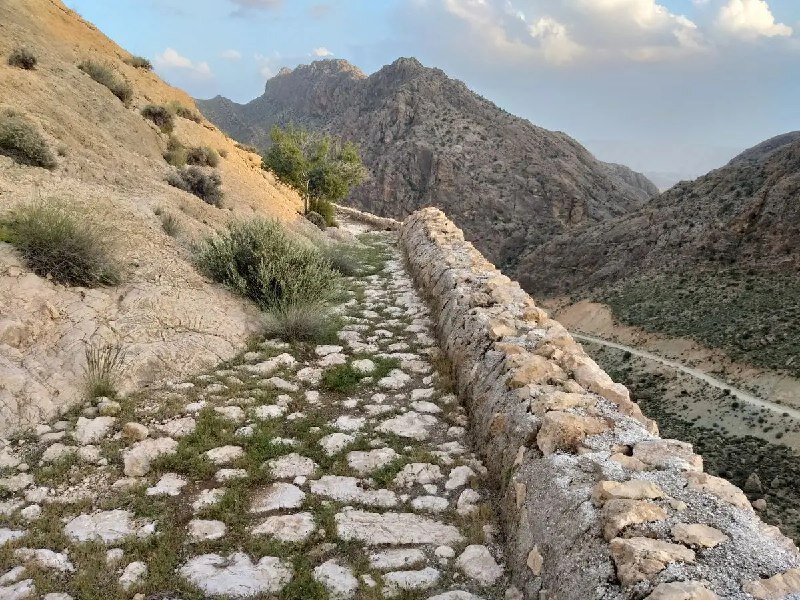
Tehran – Storm showed another part of Fahraj Spice Road. The Spice Road was one of Iran’s first ancient routes to exchange spices for different parts of the world. It was connected to the Silk Road. Some of it was exposed in the late 1990s due to a severe storm.
Irna writes that some archaeologists have attributed the history of this paved road to the Achemenid period.
The importance of the emergence of the Faraj Spice Road attracted Professor Sharia Adoru, a well-known Iranian archaeologist, to the area.
During his visit to the ancient site of Faraj, he declared that Faraj was Iran’s oldest archaeological campus, and that many ancient crafts have been observed in the city, including artifacts from the Paleostemic and Paleostemic periods.
Hamid Vahidede, caretaker of Carman’s Farradi Cultural Heritage Department, said that due to the intense storm, a new part of the Spice Road has been observed near the Mir Nadeli Tower, dating back 1,000 years.
Faraj in Karman province has 358 historic monuments and ancient sites, adding that Spice Road is the most important historic site of Faraj.
He said over the years many experts and archaeologists have been searching for Iran’s Spice Road, and the heavy storm of Farradi announced the route. In the first phase, when the storm exposed a portion of this road, Spice Road was registered as a national heritage site and its archaeological research began.
Vahidzadeh added that funds will be allocated for the recovery and placement of the tourist routes for this work.
He explained that Nadelli Tower is the only desert lantern registered nationwide in Iran.
Farradi Spice Road emerged from under the desert sand in the late 1990s due to a severe storm, and is now 40 kilometres have been identified. Last month, another part of the ancient spice road of Farradi appeared again from under the ground due to a storm.
According to Vahidzadeh, 70% of the county’s historic monuments, including ancient sites and historical monuments, emerge from under the sands of the desert, and are identified only because of intense storms.
Farradi County is a newly established and its population is not enough to allow the area to become a city, so there is little funds allocated to it, he said. “Despite having over 300 historic monuments, the cultural heritage sector receives less than 10 billion reals ($11,111), which is an amount that we don’t know if it will focus on the tourism sector or restore the historic monument.
Vahidzadeh announced: “The only thing that helped Fahraj’s historic monument was the efforts of the Carman Cultural Heritage Department, which registered the identified historical monuments of this county nationwide at the expense of the department itself.
After the release of news about Finding on Spice Road, pointing to the arrival of foreign tourists to Fahraj, he said that the Italians were the first foreigners to come to Fahraj to visit this ancient site. One of them was a merchant who traveled to Fahraj to visit Spice Road, he added.
Spice Road is an ancient Iranian road highway connected to the Silk Road, and visiting the ancient routes is extremely important for foreign tourists who have come to Farage, they announced that Spice Road is more important than the Silk Road and its architectural structure is also very different from the Silk Road.
The only difference between Iranian Spice Road and Silk Road is the provision of roadside parking for safe passage of riders and carriages who have traveled this narrow paved road. Furthermore, these parking or rest areas are located exactly every 250 meters, indicating great interest in the structure of the ancient spice road. This difference does not exist on the Silk Road route.
KD