
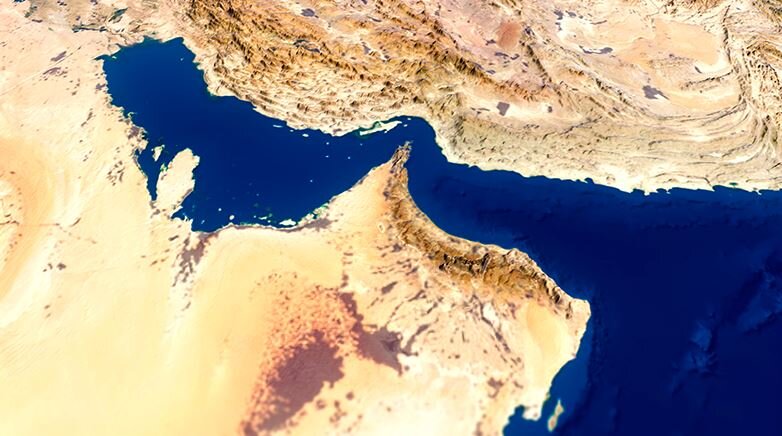
Tehran – For decades, the Strait of Hormuz has been one of the most sensitive geopolitical chokepoints in the world. Connecting the Persian Gulf to the Sea of Oman, this narrow waterway extends to international waters not only serves as a major artery of global energy flows, but also as a flashpoint for regional and international security dynamics.
According to the U.S. Energy Information Agency (EIA), more than 20 million barrels of crude oil pass through the straits every day, making up about a fifth of the world’s oil trade. It is also an important conduit for the shipping of liquefied natural gas (LNG), further increasing its strategic importance.
However, the importance of Hormus transcends the flow of oil. As tensions grow between Iran and the parallel powers of the West, combined with continued Israeli military accumulation, particularly in Syria, Lebanon, and Iranian territory itself, Terrans have consistently warned that the act of attack is not unmanned. One strategic option frequently cited in both formal and informal channels is Iran’s ability to disrupt or halt maritime traffic through the Strait of Hormuz as part of a calibrated deterrence or retaliation reaction.
Contrary to some portrayals in Western media, Iran is neither a fragile state nor a loosely organized militia actor. It is a sovereign nation of over 89 million people with vast territorial spread, institutional resilience after more than 40 years of revolution, and an increasingly sophisticated indigenous defense industry. According to Stockholm International Peace Institute (SIPRI), Iran owns one of the region’s most robust missile programs, with an operating range of over 2,000 kilometers. The Islamic Revolutionary Guard Corps (IRGC) navy has developed asymmetric naval capabilities, including fast attack crafts, sea lightning and coastal missile systems, allowing Iran to challenge the maritime advantage of the Persian Gulf.
Iran’s military doctrine focuses on the concept of “active defense.” This is a commitment to avoid launching wars while maintaining the ability to respond quickly, multi-layered and proportionately to attacks. This principle is rooted in historical experience, particularly in the Iran and Iraq Wars (1980-1988), where Iran repelled full-scale invasions with minimal international support, and ultimately maintained territorial integrity despite large-scale casualties and economic hardships.
The Iranian threat destroying traffic through the Strait of Hormuz should not be dismissed as an absurd brink. In the strategic literature, the use of geopolitical chokepoints as leverage is a recognised and often exploited deterrence tool. Tehran has repeatedly stated that it respects international commitments as long as sovereignty and rights under international law are respected. However, in the face of direct military attacks by the US, Israel or other actors, Iran can resort to asymmetric measures in which Hormuz remains a central node to shift the strategic equation.
From a legal standpoint, the right to limit or suspend the passage of innocent through the territory is granted under the United Nations Sea Law (UNCLOS) Convention. Article 25 of the treaty allows coastal states to regulate transportation for security reasons, but Article 51 of the UN Charter expressly confirms the right to self-defense in the case of armed attacks. Therefore, Iran’s measures to pass through Hormuz in response to foreign forces could be interpreted as a legal act of collective self-defense, rather than a violation of international norms.
Importantly, Iran does not require large-scale motor actions to disrupt transport through the straits. Even hints of hostility and limited skirmishes nearby can cause premiums to surge, redisplay freight traffic and cause oil prices to rise. For example, according to a World Bank rating, global oil prices have skyrocketed by more than 10% following the 2019 attack on two oil tankers near the strait.
Traffic disruptions through the Strait of Hormuz will have an immediate impact on major energy importers. Countries such as China, India, South Korea and Japan rely heavily on crude oil passing through the straits. Even oil exporters such as Saudi Arabia, the United Arab Emirates and Kuwait will suffer significant losses as marine exports rely primarily on access through Hormuz. The ripple effects reach global transport lines, insurance providers and international financial markets, each of which are extremely vulnerable to upstream disruptions.
Beyond economics, the closure or militarization of the Strait of Hormuz will underscore existing regional alliances. The US currently maintains military bases in Qatar, Bahrain, Kuwait and the UAE. In the event of a major escalation, domestic political pressures in these host countries could rise to reassess their alignment. At the very least, they demand a more neutral attitude. A full-scale US military intervention to force the reopening of the straits will significantly increase the risk of conflict across the region.
It is also worth noting that Iran has proposed regional cooperation initiatives aimed at reducing tensions and fostering collective security. Most notably, the efforts (hope) of the peace of Hormuz, introduced by Tehran as a security framework for the Persian Gulf based on non-attack, mutual respect, and the exclusion of foreign military forces. However, as Israeli sabotages, targeted assassinations, and secret attacks on Iran’s interests continue to decline, these overtures have often been on the sidelines due to implicit Western support or silence.
In this context, Iran’s deterrence message includes the credible threat of closing or destroying Hormuz – is driven not by adventurism but by a calculated perception of its strategic leverage. The Islamic Republic is not a illicit actor. It is a structured state with institutional depth, general support, and an evolving deterrence stance designed to increase the costs of attacks. The enemy should not assume that targeted airstrikes, secret operations, or economic wars will be unanswered. Direct attacks on Iranian territory through Israeli proxy attacks and obvious US campaigns risk the Strait of Hormuz being one of the most consequential theatres, causing a variety of asymmetric reactions.
In conclusion, the international community must realize that security is not one-way. Regardless of power, if you violate the sovereignty of another person, you cannot expect immunity from the consequences. The Strait of Hormuz is not only an important channel for the global energy market, but also a symbol of Iran’s strategic depth. If Iran’s territorial integrity or political sovereignty is attacked, its effects echo far beyond its boundaries.