
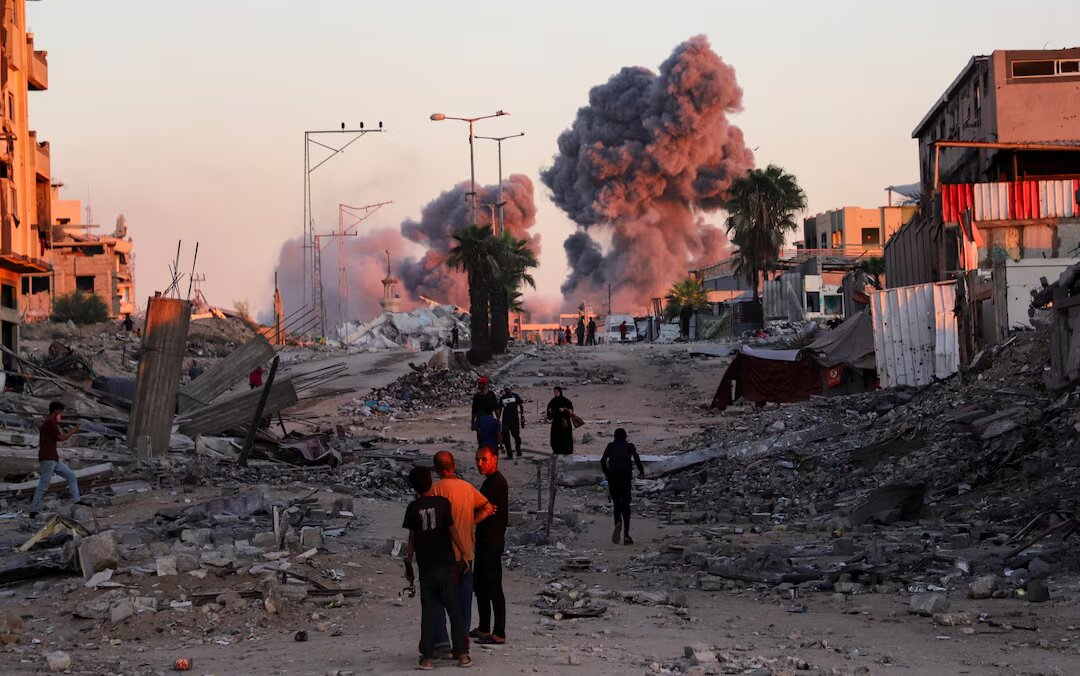
MADRID – In the days since the announcement of an “indefinite ceasefire” with Hamas, the promised ceasefire has never been truly implemented by Israel.
Rather than actually cease operations, the Israeli military continued its regime of violations, including shelling, drone patrols, deployment of tanks near civilian areas, and surveillance, effectively ensuring that the violence continued unabated. The Gaza Strip, including Beit Lahir and Shujaiyah, has been hit by repeated strikes, targeting housing, makeshift schools and emergency clinics.
The failure of this ceasefire is not a coincidence or a temporary overreach. It is part of a political logic deeply embedded in Israel’s strategic principles. Since the ceasefire went into effect in early October, Gaza media outlets have recorded at least 80 violations by Israel, resulting in the deaths of 100 Palestinians and the wounding of 230, including shelling, deliberate targeting of civilians, shootings, and arrests across Gaza’s governorates. These actions, which utilized tanks deployed near residential areas, drones with live-fire capabilities, and electronic surveillance technology, highlight that the ceasefire is functioning more as a tactical tool to maintain control and continued pressure on the Gaza population than as a true cessation of hostilities.
Figures such as current U.S. Vice President J.D. Vance and U.S. Special Envoy for the Middle East Steve Witkoff insist that the ceasefire is valid and tout it as a diplomatic breakthrough, but these claims fall apart even with minimal oversight. The truth is that the ceasefire was never truly implemented. The shelling continues, the blockade remains suffocating, and Gaza’s humanitarian crisis is deepening.
Such statements, wrapped in glossy rhetoric of peace, stability, and compassion, expose the deep hypocrisy underlying President Trump’s so-called peace plan. Far from reflecting progress, this narrative functions as political theater. It is a convenient façade intended to project control and moral leadership while diverting attention from the ongoing atrocities. Rather than a peace mechanism, the “ceasefire” functions more as a public relations tool to maintain geopolitical points at the expense of Palestinian lives.
Gaza: an enclave under a phantom ceasefire
Israel’s policy towards Gaza is based on permanent crisis management. Israel manages collapse rather than seeking solutions. Since the 2014 war, and the 2007 blockade before that, Gaza has been in a continuous state of exception, with normality defined as only minimal survival. A so-called ceasefire serves as an administrative moratorium on structural conflicts. A ceasefire would allow Israel to regroup its forces, test its surveillance systems, redefine its energy boundaries and tighten its economic blockade under the guise of complying with humanitarian agreements.
During this period, residents of Gaza experience a phantom truce. Drones continue to hover overhead, selective incursions continue, and access to essential goods, construction materials, and fuel remains restricted. Israeli authorities use the language of security to justify policies that actually control demographics and territory. In this sense, a “ceasefire” becomes a form of administrative warfare, less obvious but no less destructive.
This dynamic serves a clear purpose. It is to neutralize Palestinian political sovereignty, dissolve resistance into mere humanitarian management, and reduce politics itself to management of suffering. The collapse of each armistice is not a failure of the system, but its central mechanism. Gaza, like southern Lebanon before it, today serves as a testing ground for military technocracy that blends collective punishment, surveillance, and economic strangulation to maintain complete control without the political costs of formal occupation.
Mirror of Lebanon: A model of colonial occupation
The model applied in Gaza did not emerge in a vacuum. The plan is based on Israel’s experience in southern Lebanon, where the occupation did not end with a formal withdrawal in 2000, but instead turned into a regime of constant harassment. Since then, Israel maintains near-continuous airspace and intelligence operations over Lebanese territory, violating its airspace through reconnaissance flights, preemptive bombing, and sabotage operations.
The so-called “permanent ceasefire” on the Lebanese front required, and still requires, Hezbollah’s complete withdrawal from behind the Litani River, while Israel enjoys complete military freedom south of the Litani River. This asymmetry destroys any effective sovereignty over Lebanese land and turns the very concept of peace into a colonial tool. In this equation, an armistice does not mean the end of a war, but the institutionalization of a ceasefire under the rules established by the occupying power.
In that sense, Lebanon and Gaza are two manifestations of the same logic: an unequal peace that demands obedience and the abandonment of the right to resistance as the price of survival.
Gaza, Lebanon, Iran: interconnected fronts of a single logic
This governing principle is not limited to the geography of Palestine, but extends throughout the broader regional structure. The axis linking Gaza, southern Lebanon, and Iran reveals a coherent strategy to prevent the emergence of an actor capable of exercising real deterrence or military autonomy against Israel.
After a short but violent 12-day war, Israel sought to impose on Tehran a framework similar to that applied in Gaza, a “shared security” model in which Israel, as the sole participant, retained the initiative and monopoly over legitimate force.
This regional order, disguised as counterterrorism cooperation and security balance, is built on a structural hierarchy of Israel’s military superiority guaranteed by Western support and the subordination of all other countries. Hamas, Hezbollah, and Iran, despite deep political differences, embody diverse expressions of a single rejection. It is a rejection of an order in which sovereignty exists only through external permission.
The Semantics of a Ceasefire: The Normalization of Asymmetrical Violence
On the international stage, Israel has succeeded in imposing a semantics of violence that presents violence as inevitable. The term “ceasefire” has been stripped of its political content and reduced to a diplomatic tool for managing the humanitarian impact of the occupation without questioning its structural causes.
Every time a new attack erupts, international organizations repeat the familiar formula: “Restore calm,” “Avert humanitarian catastrophe,” and “Allow aid to come in.” But stillness is not peace. It is simply a normalization of siege. This humanitarian narrative shifts the discussion from politics (sovereignty, self-determination, justice) to the technical management of suffering. The report counts flour sacks and electricity hours, but not borders, land, or freedom.
A ceasefire therefore becomes a working discourse for the existing order, an obvious solution to preserving the status quo. While violence is managed, measured, and presented as a natural phenomenon in the region, the very concept of Palestinian sovereignty dissolves to the margins of humanitarian reports.
Palestinian resistance: symbolic and political logic
In this context, Hamas’s response goes beyond ideology and military strategy and acquires a political and symbolic dimension that goes beyond the battlefield. Its weapons have limited range and accuracy, cannot match Israel’s military capabilities, and are intended to challenge the narrative of Israel’s invincibility. Each rocket that pierces Israeli airspace is also a political statement, representing the existence of a people who refuse to disappear as political actors.
This resistance is fragmented and often instrumental, serving as a reminder that enclaves cannot be unilaterally pacified. Israel can destroy buildings, tunnels, and weapons depots, but it cannot eradicate the acts of resistance that give meaning to Palestinian identity. In this act, there is a continuity of sovereignty that survives even if it collapses.
Israeli reckoning: fragmentation and control
In recent years, Israel’s war on Gaza has evolved into a technological laboratory of unprecedented control. What was once visible territorial occupation has turned into algorithmic domination. Israel has perfected a surveillance ecosystem based on artificial intelligence, facial recognition, and mass data analysis to transform an entire population into a set of predictive patterns. Technology is no longer just for protection. It became the central weapon of perpetual warfare, managing life and death with mathematical precision.
Within this framework, a ceasefire does not mark a humanitarian pause, but rather a technical step. Meanwhile, Israel’s military establishment adjusts its systems, improves its algorithms, expands its biometric database, and tests new tools of social control. Each cycle of violence becomes a more efficient iteration of technology, refined and exportable under the label “smart security.” The occupation has become digital. There is physical surveillance, with boots turned into drones, walls turned into sensors, and an electronic panopticon that regulates every movement of Palestinians. Gaza is both a battlefield and a testing ground.
This untold violence is further exacerbated by financial controls on humanitarian aid. Funds allocated to Gaza’s reconstruction will be screened, conditioned, or blocked altogether, ensuring that any reconstruction efforts are conditional on Israeli approval. Gaza thus becomes a forever unfinished and interrupted territory, a place where life is rebuilt only to be destroyed again.
Iran and regional perspectives
From Tehran, the collapse of the Gaza ceasefire is seen not as an isolated event but as part of a broader conflict between two notions of sovereignty. For Iran, Palestinian resistance serves as an essential deterrent, preventing Israel from consolidating its absolute regional hegemony under Western protection.
Iran’s support is political rather than military, and stems from the strategic judgment that Israel’s security structure will not be stable as long as Gaza resists. In its resistance, Iran sees a continuation of its own struggle to maintain its sovereignty, unaligned with Washington or Tel Aviv. In this way, the Gaza conflict becomes a chapter in a broader struggle over the rights of states and peoples to determine their own destinies outside the structures of global domination.
Erosion of international law and its marginal role
The prolonged violence exposed the ineffectiveness of international law. Institutions intended to ensure proportionality in the use of force and protect civilians have been reduced to symbolic denunciations. Israel is redefining the concept of “self-defense” to justify large-scale attacks, while the international community responds with lukewarm statements and calls for restraint.
This deterioration is not only legal but also moral, and the selective application of international norms undermines confidence in the multilateral system. Gaza thus exposes the crisis of legitimacy in the modern world order, where force is ignored and impunity is commonplace.
Looking to the future: sovereignty and resistance
The collapse of the Gaza ceasefire cannot be understood as an isolated event, but as a symptom of a broader paradigm. In the emerging regional order, sovereignty is no longer measured by diplomatic recognition but by the effective ability to resist and deter. Palestine stands as the ethical and political limit of the international system. Although they are a people without a nation, they are not without a will. Although it does not have a regular army, it nevertheless has a symbolic resistance that shakes up the imposed narrative of peace.
Every time a ceasefire fails, we see that peace without equality is impossible. Israel’s ceasefire functions as a conceptual device designed to maintain war under the guise of peace. This formula has been exported and adapted to other sectors, from Lebanon to Syria, where control of violence is replaced by political solutions.
Against this background, Palestinian resistance, in all its forms, persists as an assertion of ultimate dignity. Resistance does not simply mean opposing the occupier. It is about asserting the right to exist, to decide, and to imagine a future beyond the force-imposed order and complicit silence of the world.