
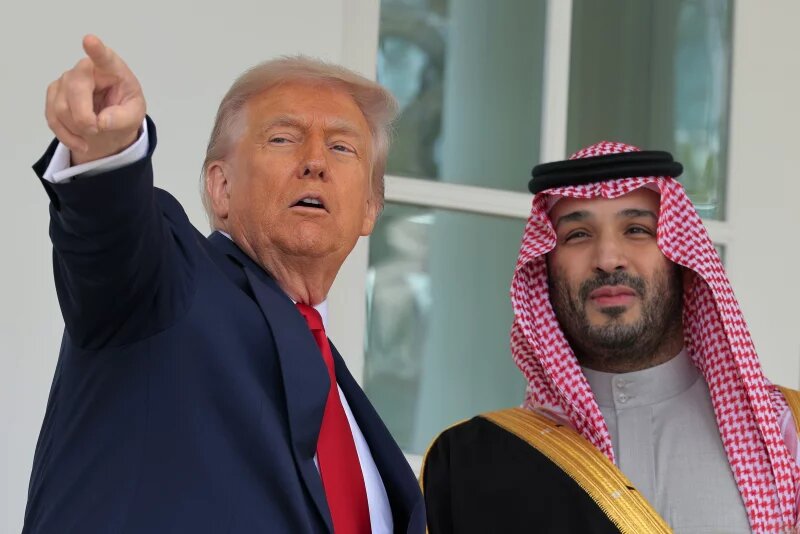
TEHRAN – Tuesday’s meeting between U.S. President Donald Trump and Saudi Arabia’s Crown Prince Mohammed bin Salman at the White House was more about strategy than ceremony.
From defense cooperation to economic investments, each announcement was structured to deepen Saudi dependence on Washington, maintain Israel’s military superiority, and advance a framework for regional normalization.
Taken together, these results reveal how U.S. policy weaves security, economics, and diplomacy into a single architecture, smoothing the path to Riyadh-Tel Aviv normalization while strengthening U.S. influence.
Abraham Accords
Prince Mohammed signaled Saudi Arabia’s readiness to join the Abraham Accords, but reiterated that normalization with Israel must be coupled with a credible path to a Palestinian state. This conditional approach reflects Riyadh’s adherence to the Arab Peace Initiative, which links Israeli recognition to Palestinian sovereignty. For Israel, Saudi participation in the Abraham Accords would represent a major diplomatic breakthrough, reducing regional isolation and incorporating economic and security cooperation. This condition ensures that normalization is framed as part of a broader peace process rather than a unilateral concession, thereby balancing regional legitimacy and strategic interests.
defense agreement
President Trump’s announcement granting Saudi Arabia “major non-NATO ally” status formalized Riyadh’s position in the U.S. security establishment. The accompanying defense agreement strengthens an 80-year partnership and commits Saudi Arabia to sharing the burden of regional deterrence. The deal benefits the United States by anchoring Saudi defense modernization into U.S. institutions, training, and doctrine, creating a long-term dependency. For Israel, the agreement would ensure that Saudi capabilities are integrated within a U.S.-controlled framework, reducing the risk of independent disengagement and strengthening a common deterrence posture against regional threats.
F35 sales
The decision to authorize the sale of F-35 jets to Saudi Arabia represents a departure from traditional US policy of preserving Israel’s “qualitative military superiority” through downgraded exports. But in reality, the deal does not undermine Israel’s primacy. Washington ensures that Saudi capabilities remain aligned by controlling the timing of deliveries, the level of technology provided, and the training pipeline. Israel’s advantages are maintained through unique access to customized software libraries, indigenous integration, and permanent upgrade flows. Although there has been speculation that Saudi Arabia’s acquisition of state-of-the-art jets could undermine Israel’s superiority, the reality is that American surveillance has not undermined Israel’s air superiority. More importantly, the deal itself creates conditions for closer ties and possible normalization between Saudi Arabia and Israel.
investing in saudi
Saudi Arabia’s announcement of up to $1 trillion in investments in the US focuses on technology, AI and rare materials, creating deep economic interdependence.
For Washington, this influx of capital will support jobs and innovation, while for Riyadh it will ensure access to cutting-edge technology under U.S. regulatory oversight. Israel stands to benefit indirectly, as normalization paves the way for trilateral cooperation in emerging industries and incorporates economic ties alongside security agreements.
Gaza resolution
The outcome of the conference is consistent with the logic of President Trump’s recently approved Gaza resolution, which prioritizes U.S. control, external oversight, and conditional progress toward establishing a Palestinian state. Saudi buy-in provides Arab legitimacy and resources to support implementation, while US control over advanced capabilities ensures that Israeli security concerns are addressed. The resolution places the United States at the center of governance of the Gaza Strip and states that development will be in line with Israel’s security needs. Although this refers to a possible path to a Palestinian state, Israel’s opposition makes this prospect largely symbolic and risks pushing the concept of a state further into the background. In fact, the resolution functions less as a roadmap to sovereignty than as a mechanism to consolidate U.S. influence and strengthen Israel’s security position.
The meeting between President Trump and President Bin Salman illustrates how defense, foreign affairs, and the economy are interwoven to contribute to a broader strategy. Saudi Arabia will increase its dependence on US systems, Israel’s military superiority will remain secure under US oversight, and the Gaza resolution will gain regional support through Saudi involvement.