
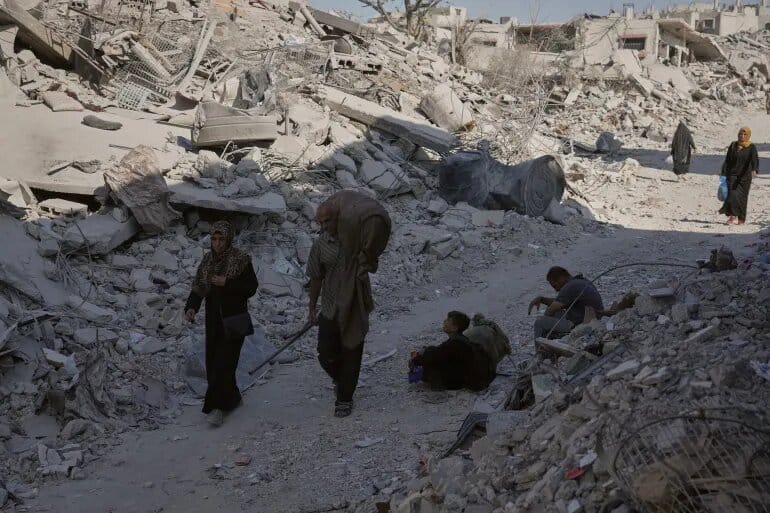
The immediate consequences of the London-Gaza war include massive destruction and human losses at all levels. This is in addition to the inability of the Israeli occupation entity and the US behind it to eliminate the axis of resistance.
The failure to create a new Middle East reduced that possibility. However, indirect outcomes include the degree of recovery readiness. It appears that the Resistance may have suffered heavy losses in terms of defense and deterrence. On the surface, the party appears defeated.
The enemy appears to be successful, as they wreak havoc on a large scale superior in firepower and intelligence, but their victory is hollow. It has lost an essential element of its existence. In the case of the Israeli entity, the outcome is defeat if external support begins to dwindle or proves to be in tatters. In other words, the entity has lost external support, a core element of its existence.
As for the resistance, even if its capabilities are weakened, its weapons stockpiles reduced, its organizational structures weakened, or its personnel reduced, it can be compensated for in stronger and more resilient ways.
If the external regional and international environment turns in its favor, the resistance has gained an advantage. If the internal supportive environment becomes one that embraces the causes of resistance, then when the conditions are right, what has been destroyed can be rebuilt with strength and effectiveness.
Direct results can appear as victories, but they can also constitute elements of defeat. Although the indirect result may seem like defeat, it contains elements of resurgence and a stronger return. In reality, tools may be compensated while the international situation and surrounding environment also change. For example, if a company fails to achieve the expansion it has set as a goal, the problem leads to its own downsizing.
In that case, if the remaining three years of the Trump administration pass without any results, the next administration may change course and recalculate in order to secure its own interests. The Israeli occupation entity may not be a key factor in the new regime’s interests. In fact, it may even be detrimental to their interests. Similarly, the influence of European public opinion on leadership could be influenced and changed in future elections, leading to organizational ostracism. This creates pressure for reconciliation.
Previous US administrations had adopted a two-state concept. President Trump’s two administrations have adopted the concept of “prosperity,” which means addressing the region on the basis of people, rather than nation-states or homelands, in the interests of regional expansion and security. This is a result of the recognition that, given the widespread public rejection in the region, there are factors that overwhelmingly make it impossible for this entity to continue on its current map. Therefore, we look at trends and talk about the need to find solutions that are broader than the current Gaza problem, to find more comprehensive solutions to the causes.
The Abraham Accords mean bringing the region closer to the Israeli occupation entity at the administrative level. However, this became unattainable as the war failed to eliminate the resistance. The basis for building the American project through the Abraham Accords was the elimination of resistance movements in the region. If the war were to stop at this point without eliminating the Resistance leadership or disarming the Resistance, which seems unlikely, this would mean that the seeds and roots of the Resistance in Palestine would remain alive and vibrant, even if the Resistance did not withdraw completely from the Gaza Strip, which seems unlikely. This shows that the project has completely failed at its narrowest, simplest, yet deepest and most essential point: Palestine.
If the war were to stop now, the settlement project on which the company’s survival depends would not be able to continue without outside support and would likely be completely curtailed. Ironically, the slogan “Palestine from the rivers to the sea”, which was rarely heard in the Arab region, is once again being chanted by demonstrations and protesters around the world.