
TEHRAN — India’s renewed commitment to Afghanistan’s Taliban regime reflects a pragmatic shift in putting interests ahead of previous ideological reservations.
The rapprochement between India and the Taliban comes amid an ongoing conflict between Afghanistan and Pakistan, amid deadly border skirmishes following the October 9 explosion in Kabul, which Afghanistan’s foreign ministry blamed on Pakistan. Islamabad accuses the Taliban in Kabul of harboring the Tehreek-e-Taliban Pakistan (TTP) group, often referred to as the Pakistani Taliban. TTP has emerged as one of the biggest national security threats in Pakistan.
India has restored full diplomatic relations with Afghanistan and upgraded its technical mission in Kabul to an embassy, Indian External Affairs Minister S. Jaishankar announced in October. The announcement followed Afghanistan’s Foreign Minister Mowlavi Amir Khan Muttaqi’s six-day visit to India.
Mr. Mutaki’s visit followed the restoration of air links between the two countries, and Mr. Jaishankar welcomed Mr. Mutaki’s invitation to join Indian companies in exploring Afghanistan’s mineral deposits and promoting trade.
The Indian embassy in Kabul was downgraded four years ago amid fighting between the Taliban and Ashraf Ghani’s government. The Taliban plans to send two diplomats to New Delhi this month.
Pakistan and Afghanistan signed a ceasefire agreement in Doha, followed by four rounds of talks in Istanbul aimed at cementing the ceasefire for long-term peace. While some of these consultations have had limited success, overall they have struggled to produce durable and workable solutions.
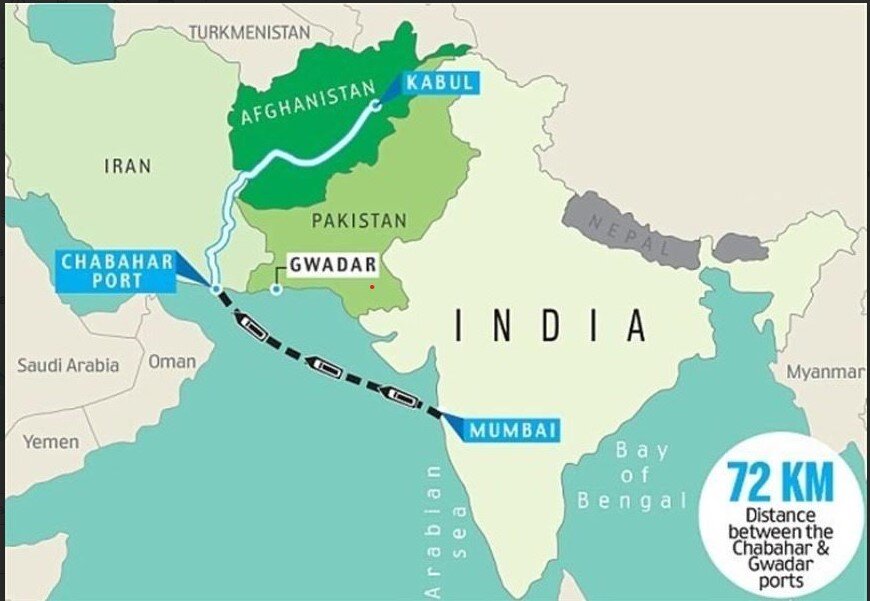
The 2,600-kilometer border between the two countries remains unstable and largely closed as peace negotiations continue. Now landlocked, Afghanistan is increasingly focusing on trade routes through Iran, especially the port of Chabahar, for trade with India and Central Asia.
In May 2024, the Iranian Ports and Maritime Authority and the private company India Ports Global Ltd. (IPGL) signed a 10-year agreement that includes an investment of $120 million to develop and operate the Shahid Beheshti Terminal.
Meanwhile, Nooruddin Aziz, Afghanistan’s deputy minister of commerce and industry, called for stronger cooperation and joint investment with Iran. He made the remarks at the Iran-Afghanistan Joint Economic Committee meeting held in Hilmand city, Sistan-Baluchestan province on Saturday.
Azizi said the Chabahar-Mirak rail and highway project is underway to strengthen infrastructure.
exemption from sanctions
On October 30, India’s Ministry of External Affairs announced that the United States had granted India a six-month extension of sanctions relief for operations at Iran’s Chabahar port. The waiver, issued under the provisions of the Iran Freedom and Non-Proliferation Act (IFCA), allows India to continue developing and using the port without being subject to secondary US sanctions. Strategically, this exemption remains important for India to maintain access to Afghanistan through another corridor rather than through Pakistan.
It is worth mentioning that in 2019, India successfully obtained sanctions relief for Iranian oil and both countries agreed to make payments to each other through their own currencies. The United States reimposed sanctions on Iran in November 2018, during the first term of President Donald Trump, when the United States withdrew from the landmark nuclear deal between Iran and seven other countries.
According to reports, India has resumed importing crude oil from Iran. India imported $111 million worth of Iranian crude oil in June, according to data from the Ministry of Commerce and Industry. In addition to crude oil, India imported $94 million worth of Iranian oil products between January and July this year.
bombing of pakistan and india
Two bombings, one day apart, shook the capitals of India and Pakistan within 24 hours. At least 10 people were killed and more than 30 injured in a car explosion in New Delhi on Monday night (November 10). The car burst into flames near the city’s historic 17th-century Red Fort (Lal Qila), a symbol of India’s independence and a popular area for tourists.
A suicide bomber detonated himself next to a police car in Islamabad on Tuesday afternoon, killing at least 12 people and injuring at least 27 others. Pakistan has also accused Afghanistan of involvement, but TTP denies responsibility. According to the Associated Press, the leader of the Jamaat-ul-Ahrar group, an offshoot of the TTP, claimed responsibility for the attack.
Russia on Wednesday strongly condemned “terrorist attacks” in Pakistan and India and called for greater international cooperation in the fight against extremism.
Russian Foreign Ministry spokeswoman Maria Zakharova said the Russian government “condemns in the strongest terms” the bombing, adding: “Russia always insists on an uncompromising fight against terrorism.”
Pakistan’s Interior Minister Mohsin Naqvi claimed the attack was “carried out by Indian-backed elements and proxies of the Afghan Taliban.” India denies involvement.
“We are at war,” Pakistan’s Defense Minister Khawaja Muhammad Asif said in a post on X, which criticized Afghanistan’s Taliban government without mentioning India by name.
India-Afghanistan trade
Trade between the two countries had steadily expanded until the Taliban returned in August 2021. According to India’s Ministry of Commerce, bilateral trade exceeded $1.5 billion in 2019-20, with India’s exports reaching $997 million and imports around $530 million.
From 2015 to 2020, India’s exports to Afghanistan increased by nearly 89%, while imports expanded by 72%, supported by India’s preferential trade agreement and Afghanistan’s duty-free access to dry fruits, saffron and medicinal herbs.
The Taliban’s occupation of Afghanistan in 2021 caused a sharp decline in bilateral trade. Immediately after the Taliban takeover, India excluded Afghanistan from the India-Iran-Uzbekistan agreement on the use of Chabahar port. Meanwhile, the Taliban has expressed interest in joining the China-Pakistan Economic Corridor (CPEC).
Beijing’s main goal remains to expand CPEC to Afghanistan, which connects Central, South and West Asia under the Belt and Road Initiative (BRI). However, Kabul has not yet committed to joining CPEC. The main reason for Afghanistan’s reluctance is its deteriorating relationship with Pakistan.
Kabul criticized Pakistan’s policy shift as a violation of the Afghanistan-Pakistan Transit Trade Agreement (APTTA), a bilateral trade framework signed in 2010 aimed at providing landlocked Afghanistan with access to global markets through Pakistan’s seaports. Negotiations for the latest version of APTTA have been ongoing since 2021, but progress has stalled due to deteriorating relations between the two countries.
Despite the lack of progress, the Taliban are attempting to diversify their means of travel beyond Pakistan. In March 2024, the Taliban announced plans to invest approximately $35 million in the Chabahar port.
In September 2025, a high-level Iranian delegation led by Minister of Industry, Mining and Trade Seyed Mohammad Atabak visited Afghanistan to promote connectivity by expanding the use of Chabahar in Afghanistan. The two countries also discussed increasing the cargo capacity of the Qafherat railway in order to create an intermodal transport route from the railway to the port serving Chabahar.
The 225 km long Qahherat Railway includes 78 km in Iran and 147 km in Afghanistan. Hafez Sadatnejat, project manager of Qaf Herat, said it was essential to complete the project as soon as possible. The project began in 2007, but delays are believed to be due to regional instability and the transition to Afghanistan in 2021.
The project, which took 18 years to complete, connects Herat to Iran’s railway network via Qaf in Khorasan Razavi province. The rail line is considered a key link in a broader transcontinental corridor linking China, Kyrgyzstan, Tajikistan, Afghanistan, Iran, and ultimately the Persian Gulf and Europe.
Coming back to India’s approach towards the Taliban, India is gradually shifting from pure humanitarian assistance to a focus on trade and transport, with Chabahar playing a key role in connectivity.