
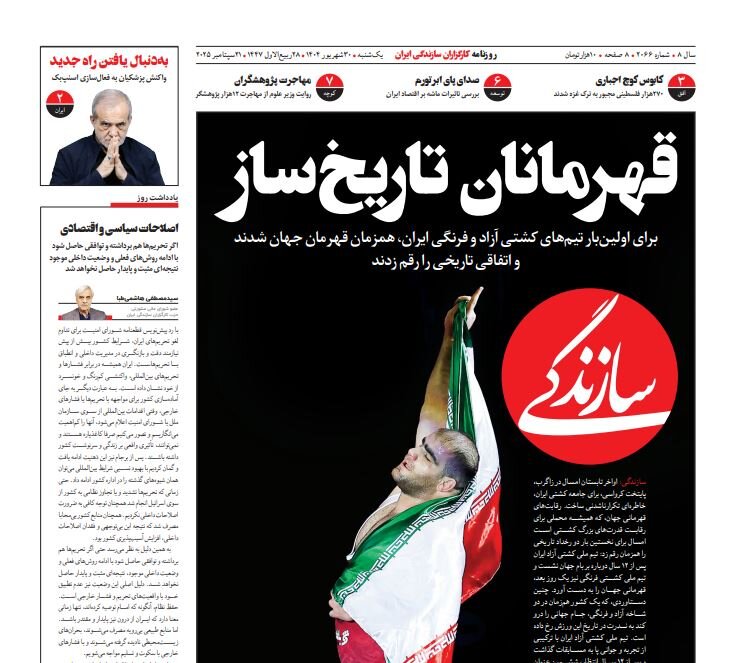
Tehran -Sazandegi proposed the strategies that Iran should take to combat the activation of snapback sanctions, writing:
This moment is one of the most sensitive periods in the country’s history, with timely and bold decisions that can drive away the evils of snapbacks, alleviate international pressures, and maintain Iran’s national security and economic interests. The next point is broad and aggressive diplomatic movements. Today, Iran needs to strengthen its relationships with influential countries at the global and regional level by using all its energy. The current situation in the country requires a combination of aggressive diplomacy, courageous decision-making and internal cohesion to prevent the risk of snapback activation, sanctions and international pressures with minimal and greatest effectiveness. Direct interactions with influential foreign officials are also the turning point in achieving these goals.
Ham Mihan: Improve Iran’s status by participating in a global campaign to recognize the Palestinian state
Ham Mihan wrote about a global campaign to recognize the Palestinian province, and the annual UN General Assembly meeting is underway. He said, without a doubt, that the formation of a Palestinian state would improve the living conditions of the people under occupation in an unfair way. The Palestinian state recognizes the Palestinian people with the right to membership in international organizations and the right to self-defense against invaders. And in the long run, it can help Palestinians gain more rights. By participating in a global wave of support for the recognition of the Palestinian state, Iran can first improve its position within the framework of an international mechanism to resolve the Palestinian issue, and as an active player, enter into the international discussions and negotiations taking place regarding the fate of the Palestinians. Today, Iran’s seats in the Palestinian negotiations for the future are empty. Iran is advocating for the rights of Palestinians, but it has not participated in the diplomatic process to help them. The presence of Iran in the diplomatic process that helps to alleviate the suffering of the Palestinian people is the wrong impression to cause and disappoint Palestinian people or resistance groups.
Vatan-e-Emrooz: Strategic Autonomy and Future Outlook
Vatan-e-Emrooz wrote: A review of modern case studies shows that despite being politically independent, many countries lack true strategic autonomy. They may manipulate tactically, but at key strategic moments, they are forced to compromise their national interests or align with the agenda of the great powers. In contrast, Iran offers another example, showing that it can achieve some degree of strategic autonomy, but it must bear certain costs. The world has shifted from an era of unilateral American domination to a multipolar order. In this new environment, only countries with authentic strategic autonomy can shape the rules of emerging systems. The rest will be forced to operate under conditions set by others, even if those conditions are against your national interest. Therefore, strategic autonomy must be maintained by relying on domestic capabilities and national resolve. Otherwise, decades ahead, we risk being a passive audience, with Iran’s national interests and security being sacrificed by the whims of regional and global power.
Arman-e Melli: quitting NPT or halting cooperation with the IAEA will benefit Israel and the US
Arman-e Melli seeks the views of Mohammad Hossein Beheshtipour, a senior international relations expert. Some within Iran are proposing to halt cooperation with the IAEA in response to the activation of Western snapback sanctions against Iran at UN Security Council on Friday. Beheshtipour said: When pressure on Iran is growing in the US and Europe, withdrawal from the NPT is not a solution, but a cost and dangerous path to strip Iran of its legitimate rights and create a new global consensus for the country. The best strategy for Iran is to remain within the framework of international law, exploiting the mechanisms of the IAEA to prove the peaceful nature of its activities and rely on domestic capabilities to withstand pressure.
The wise policy is not about emotional responses but about choosing courses that preserve Iran’s rights and pave the way for effective diplomacy while mitigating the threat. One chronic weakness in Iran’s foreign policy is trapped in the militant perspective. Specialized policy means accepting positive actions in any country and openly criticizing their negative actions, not limited to partisan frameworks.
In international sectors, national interests must be the norm. It’s not a temporary cooperation or ideological perspective. The slogan of withdrawing from the NPT may appeal to some and convey a sense of power and independence, but foreign policy is not at the stage of emotional display. Another point is to criticize Iran’s undeniable rights that raise certain actions of the IAEA, particularly politicization and allegations of spying by some inspectors. But the strategic mistake is to portray the institution, not the US and its maximum pressure policy, as the main perpetrator. The IAEA is the sole authority to monitor peaceful nuclear activities under international regulations. If Iran stops working with the agency, it will bring exactly what Washington and Tel Aviv have been seeking for years: forming a global consensus for Tehran.