
In recent months, the Republic of Sudan has faced a delicate and complex situation. Internal conflict and a widespread humanitarian crisis have placed this important African country in one of the most difficult periods in its modern history. Given Sudan’s strategic location in the Horn of Africa and the Red Sea coast, the country’s development has special importance not only for the Sudanese people but also for regional stability.
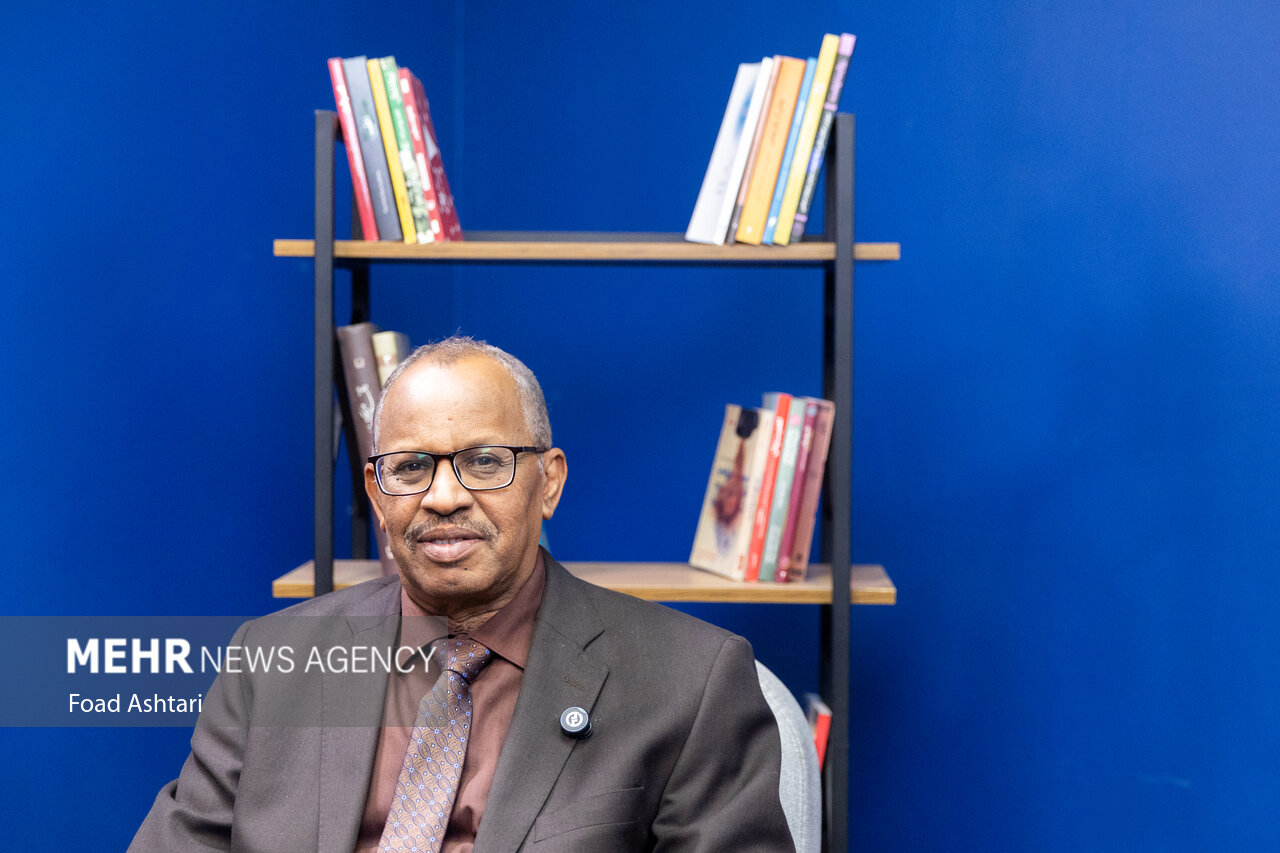
Mehr News Agency interviewed Mr. Abdulaziz Hassan Saleh Taha, Ambassador of the Republic of Sudan to Tehran, in which he spoke about various aspects such as recent developments, Sudan’s future prospects, and relations between Tehran and Khartoum.
In this interview, he criticized the silence of international organizations and Western countries in the face of these crimes and announced that evidence of the UAE’s financial and military support for these organizations had been submitted to the UN Security Council.
In which areas are the main centers of conflict between the Sudanese Armed Forces and Rapid Support Forces currently concentrated and what are the strategic objectives behind these clashes?
As you know, this invasion against Sudan began on April 15, 2023. Terrorist rebels who rose against the country’s legitimate authority not only assassinated Sudanese figures, but also sought to target the identity, culture, values, and morals of the Sudanese people. Through their inhuman acts, they committed crimes that amounted to “war crimes,” “crimes against humanity,” and “genocide.”
These forces destroyed cultural centers, museums, universities, schools, mosques and other religious sites, and even killed innocent worshipers. The church was not spared from this destruction either.
In the face of this systematic attack, the people of Sudan, along with their armed forces, armed forces and supporting forces, stood up with tenacity, courage and sacrifice. Over the course of two years of war, they were able to drive rebel and terrorist groups, who came with the aid of foreign mercenaries and support from certain countries (which provided funds and equipment to kill Sudanese citizens), from the Sudanese capital Khartoum and several cities in various states.
Most recently, on October 26, after a two-year siege on the city of Al-Fashir, these terrorist forces entered the city and committed all kinds of crimes and massacres, witnessed by the whole world, including the Islamic Republic of Iran and its independent media, which reported these atrocities.
Unfortunately, these crimes in Al Fashir and Bara (North Kordofan province) have been met with silence from the international community, regional and international organizations. In Sudan, the government and people are calling on the world and independent media to condemn the countries that label these rebel and terrorist groups as terrorists and support them with money, weapons and mercenaries.
What factors led to political disagreements between the military and rapid support forces escalating into all-out war?
In fact, what happened in Sudan was not a political conflict between the military and this rebel group. Nor is it simply a personal conflict between the military commander who heads Sudan’s Sovereign Council and the terrorist group’s leader. Rather, it is an act of aggression, a planned coup attempt against a country’s legitimate government, and an attempt to seize power with external support from a specific country.
When the Sudanese military thwarted this plan, the conflict became an all-out war not only against the legitimate government, but against the Sudanese state itself. In most wars, fighting occurs between two armies, but in Sudan the main targets were defenseless civilians. Assassinations, shelling of residential areas, destruction of infrastructure and public services (hospitals, water supplies, power plants, etc.), forced displacement of civilians, seizure of homes and banks (including central banks), and widespread looting of people’s property, from cars and money to school and university equipment, are all part of this war.
Religious institutions are not immune from these crimes, and women and girls continue to suffer abuse at the hands of these criminals. Therefore, this is not simply a conflict between “military forces and rapid support forces.” It is the work of rebel and terrorist organizations that are bringing in mercenaries from several continents and countries to change Sudan’s demographics.
You yourself have probably seen the videos released in recent weeks showing how these people murder defenseless innocent people. This war is not simply a war between the regular forces of a sovereign state and rebel forces. It is a war waged by factions that unfortunately have support from certain foreign countries, both regionally and internationally.
A report has surfaced claiming that the United Arab Emirates provided military and logistical support to the Rapid Support Force (RSF). What evidence exists regarding this and what is Khartoum’s official response?
The Sudanese government has submitted official documents and evidence to the United Nations Security Council and the United Nations Secretariat showing that the United Arab Emirates government has provided financial and military support to these rebel and terrorist groups. This includes participating in financing the purchase of weapons and recruitment of mercenaries.
These reports have also been confirmed by the findings and surveys of certain United Nations committees, some Western countries, and reliable American and European media. All of this evidence has been formally presented by the Sudanese Permanent Mission to the United Nations in New York, and there is no doubt as to its authenticity.
After the normalization of diplomatic relations between Iran and Sudan, what concrete steps have the two countries taken to strengthen cooperation in the political, economic and humanitarian fields, and how has Sudan prioritized these areas?
Relations with the Islamic Republic of Iran are close and positive and have been for many years. The two countries have many things in common. Both are Islamic states and members of the Organization of Islamic Cooperation, the Non-Aligned Movement, and the United Nations. Of course, these ties were severed for eight years from 2016 to 2024, but they were restored last year (2024), with Sudan reopening its embassy in Tehran and Iran reopening its embassy in the port city of Port Sudan.
Relations with the Islamic Republic of Iran are friendly and deep-rooted. During this short period, positive steps have been taken to develop diplomatic, economic and trade relations. Both parties and their governments reaffirmed their commitment to cooperation in various areas including economy, trade, technology and agriculture.
However, given that it has only been a year since the resumption of diplomatic relations, and that the war began in 2023 while diplomatic relations were still suspended, there is essentially no opportunity for any form of military assistance from Iran to Sudan. I therefore emphasize that the relations between Sudan and Iran, like Sudan’s relations with other countries, are normal and based on mutual respect and national sovereignty.
Given that Sudan borders the Red Sea, what role will competing regional and global powers play in the continuation of the conflict?
Sudan is located on the Red Sea and has approximately 850 kilometers of coastline. This area is a very important commercial and economic route. As an independent country, Sudan cooperates with other Red Sea coastal states to ensure maritime security and maintains full control of its territorial waters.
Of course, major powers and even some regional countries have interests and ambitions in this maritime corridor. However, Sudan does not allow national sovereignty to become an instrument for implementing foreign policies.
MNA/6653714