
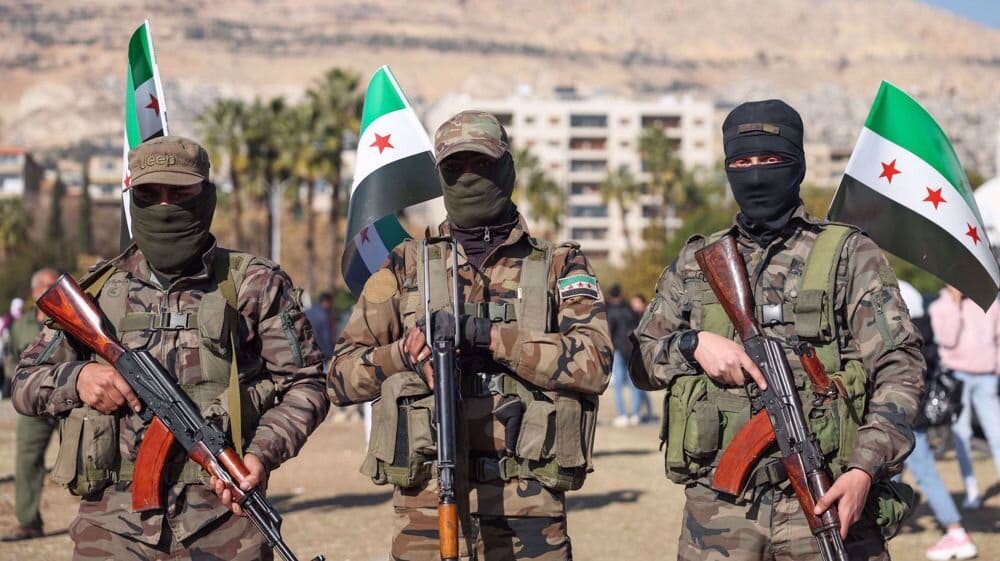
According to sources cited by Cradle, foreign militants affiliated with HTS were transferred from the Harem area of Idlib province to the city of al-Qusayr near the Syria-Lebanon border in recent days.
The move reportedly coincided with the transfer of heavy military equipment, including armored vehicles and other hardware.
“At the same time, forces belonging to the Ministry of Defense of the Syrian Interim Government moved into Lebanese territory, specifically in the Wadi al-Tarajat area of Ras al-Mara, along the Syrian-Lebanese border on the outskirts of Damascus, in an attempt to secure positions,” the source said, referring to the barren area where no Lebanese troops are stationed.
These reports emerged as Abu Mohammed al-Jolani, formerly of al-Qaeda and Daesh, arrived in Washington on Sunday, shortly after Washington announced Syria’s participation in the US occupation coalition in Arab countries.
HTS forces remain deeply infiltrated by extremist elements. Many of the current commanders and officers are known to be former members of al-Qaeda and Daesh factions.
The reported buildup of HTS-related forces near Lebanon coincides with renewed threats from the United States that such militias could be deployed against Hezbollah.
On Friday, US special envoy Tom Barrack said the extremist-led regime in Damascus would “actively support” the US and Tel Aviv in confronting Lebanon’s Hezbollah.
Analysts have warned that U.S. policy and collaboration with extremist-leaning Syrian groups like HTS risk reigniting cross-border violence and undermining the security achieved by Hezbollah and the Lebanese National Army after expelling Daesh and al-Qaeda elements from Lebanon’s eastern border in 2017.
Jolani said in an interview with the Washington Post that “good” progress had been made in direct negotiations toward a deal with Israel, boasting of weakening the Axis of Resistance on Tel Aviv’s behalf.
“Israel has always said it is concerned about Syria because it fears the threat of Iranian militias and Hezbollah. We are the ones who drove those forces out of Syria,” he said.
“The United States is with us in these negotiations, and a significant number of international parties support our position in this regard. Today, we learned that Mr. Trump also supports our position. We will push towards a resolution of this issue as quickly as possible,” he added.
Jolani also met with U.S.-based Syrian Rabbi Yosef Hamra.
According to Hebrew reports, key parts of the agreement are likely to include intelligence sharing between HTS and Israel and cooperation against the Axis of Resistance, particularly Iran and Hezbollah, which helped the previous regime retake large swaths of Syria from al-Qaeda and Deash.
Earlier this year, Israel carried out heavy attacks in Damascus and other parts of southern Syria in the name of defending the Druze minority from Yolani militants.
It continues to invade and occupy territory, expanding the occupation it established after the fall of former Syrian president Bashar al-Assad last year.
But Jolani and other HTS officials have repeatedly suggested they are not a threat to Tel Aviv.
Analysts have questioned why al-Jolani has not sent troops against Israel, which continues to attack and occupy parts of Syria almost daily.
The HTS-led regime will reportedly hand over the occupied Golan Heights to Israel as part of an impending normalization deal with the illegal group.
Since coming to power, HTS has committed widespread war crimes and brutal repression, particularly against minority communities such as the Alawites, who have faced targeted violence as Syria experiences a wave of sectarian and regional unrest under the group’s control.
Jolani was a former lieutenant to late Daesh leader Abu Bakr al-Baghdadi and later became head of al-Qaeda’s official branch in Syria, Jabhat al-Nusra.
Jabhat al-Nusra was eventually renamed Hayat Tahrir al-Sham (HTS) and took control of Syria in December 2024.
In the early days of the US-backed war against Syria, which began in 2011, there was evidence of collaboration between Israel and Jabhat al-Nusra.
RHM/