
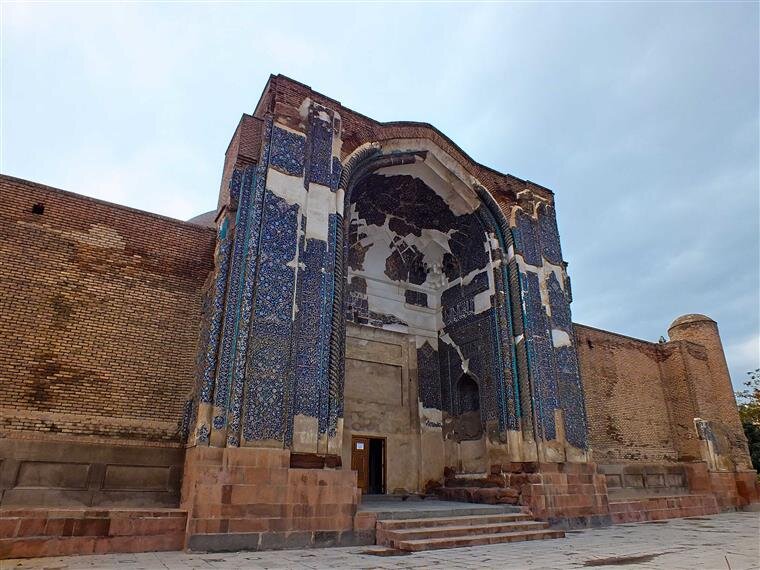
TEHRAN – Tabriz’s centuries-old Blue Mosque will undergo emergency restoration with minimal intervention to prevent further loss of its original tilework, local officials said.
Vahid Nabadad, East Azarbaijan’s deputy director for cultural heritage, said on Wednesday that decades of moisture accumulation had caused damage to the monument’s decorative layers and tiling, prompting experts to take urgent stabilization measures.
He mentioned valuable efforts, saying that funds were allocated for emergency restoration in early 2023, followed by a natural drying process starting in 2024, followed by the strengthening and protection of the mosque’s remaining decorations.
Navadad explained that many preservation efforts in the 1970s used acrylic coatings, which trapped moisture behind the decorative layer and caused significant damage to the tiles and mortar underneath. In some areas, damage has progressed to such an extent that adequate repairs are no longer possible, he said.
Nabadad said the current restoration team is working on the principle of preservation with minimal intervention. He said the team focused on comprehensive documentation and photogrammetry before taking physical action.
He added that current efforts include documentation with more than 3,000 photographs, stabilization of the structure and preservation of existing elements, and so far no reconstruction work has been carried out.
Navadad said that because the decorative layer was in a fragile state and there was a risk of further tile loss, the team decided to use local consolidation methods to stabilize all remaining tiles in place. This approach prevented further damage and maintained the monument’s integrity, he said.
Mr. Nabadad also reported that during the documentation process, several inscriptions and texts were identified that were previously unnoticed. These discoveries could reshape the historical understanding of the mosque’s founders, designers and craftsmen, he said. The results will be published as specialized articles for researchers and the media.
He stressed that the State Heritage Department remains committed to the protection of the monument and that the ongoing restoration follows international principles of reversibility, minimal intervention and comprehensive documentation.
Completed in the mid-15th century, Tabriz’s Blue Mosque (better known as Masjed-e-Qabd) was one of the most glorious buildings of its time. Once built, artists spent another 25 years covering every surface with blue majolica tiles and the intricate calligraphy that gave it its name.
The mosque is named and admired for its unique tile decoration, traces of which can still be seen on the building’s dilapidated walls. Both the interior and exterior surfaces were once covered with various tile revetments. Remnants of tile mosaics, underglazed and overglazed tiles, and glossy tiles testify to the richness of the decoration. The cobalt blue ground color is used extensively, and the gold and white arabesque pattern is expressed in delicate colors. The dome was a deep blue color with gold patterns stenciled on it.
morning