
BEIRUT—In modern warfare, combat is no longer fought only on the military front. Critical infrastructure, the backbone of everyday life, has become a deliberate target of strategies aimed at breaking the will of the Lebanese people and undermining their resilience.
This has one clear and direct purpose. The idea is to drag Lebanon into hasty negotiations with Israel and pave the way for normalization at a later date.
By eroding the foundations of daily life and intensifying livelihood crises, Israel seeks to turn economic pressure into political pressure in the hope of destabilizing the social fabric and forcing the parties to accept closed-door negotiations that strip the people of their resistance to legitimacy.
Clearly, the ongoing attacks are not just military actions, but strategic pressure measures aimed at sending a clear message that there is no separation between the resistance and the societies that host it.
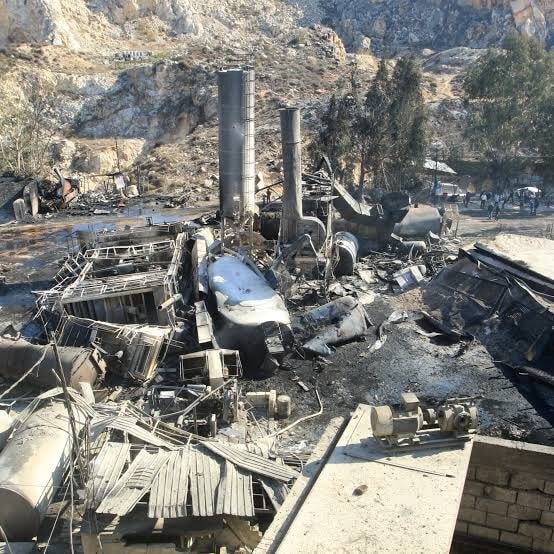
South Lebanon Water Works announced that a recent Israeli attack destroyed a strategic fuel depot where 500,000 liters of diesel were stored.
This supply depot was not a military installation, but a service facility that provided electricity to the villages and towns of the South and powered the generators on which local water stations depended. Destroying it would effectively deprive tens of thousands of households of water and disrupt hospitals, bakeries and public institutions.
The targeting didn’t stop there. Fighter jets attacked a quarry and concrete kiln in the town of Ansar, causing casualties and significant property damage. The damaged kilns provided construction materials and cement for reconstruction projects in the south and served dozens of municipalities and public institutions.
With this bombing, Israel did not attack its technological facilities, but rather its will to rebuild itself. Nevertheless, the kiln owners’ association declared that “despite the threats, reconstruction will continue” and stressed that it will not allow the Israeli occupation regime to impose “a life of rubble” on its people.
Although these attacks are not unprecedented in the regime’s record, they signal a dangerous shift in the nature of Israeli warfare, combining ground attacks with economic and psychological pressure.
Destruction of infrastructure halts agricultural and industrial production, reduces employment opportunities, deepens poverty, and forcibly opens the way to migration and displacement.
The ultimate goal of removing the population from the South and turning it into a region unable to support life was thus achieved. This is a silent war that continues long after the fighting is over.
In the capital Beirut, the scene is equally absurd. Volunteers from the Farah Al Ata Association continued to rebuild Al Mamoun Street, which was destroyed in an Israeli airstrike in September 2024, but were surprised by the suspension of the project based on the decision of security forces, citing minor violations regarding the tile and glass facades.
This contradiction reflects the dual nature of the Lebanese state. During wartime, they are completely absent, and when the people are at the core of their responsibilities, the administration is strict.
Meanwhile, a report by the Food and Agriculture Organization of the United Nations (FAO) reveals the scale of the disaster resulting from Israel’s targeting of agricultural land and production infrastructure.
More than 2 million livestock and poultry were lost, vast tracts of farmland and forest were burned, and an estimated $263 million emergency recovery plan was required.
The plan includes steps to repair farmland and infrastructure and help farmers get back to work, but funding remains inadequate and the government’s efforts are fragmented.
Furthermore, Morris Tidball-Bintz, the United Nations Special Rapporteur on extrajudicial, summary or arbitrary executions, said that given the lack of evidence of military use of bombing targets, these acts could amount to war crimes: International humanitarian law is clear: no civilian installation may be targeted unless it serves a direct military purpose, and unwarranted harm to civilians is a serious violation.
Analysis of these facts reveals that targeting infrastructure is part of the resistance’s strategy to put pressure on its natural environment. When water and electricity are cut off and roads and factories are destroyed, Fudoshin becomes a daily burden for people.
By this the enemy seeks to sow dissatisfaction and despair into the souls of Southerners, and to make resistance a burden rather than a shield. But this formula didn’t work in 1996 or 2006, and it won’t work today.
This is because, after the war, society, which had reconstructed its environment through self-help efforts and strengthened its organization and unity, began to recognize that reconstruction was also an act of resistance.
So despite the bombardment, we’re seeing civic action expand, local organizations filling gaps in the state, and local governments adjusting to provide services even with limited resources.
When communities rise from the rubble, they rebuild what has been destroyed, turn devastation into an opportunity for review and development, and prove that no invasion, no matter how violent, can extinguish life.