
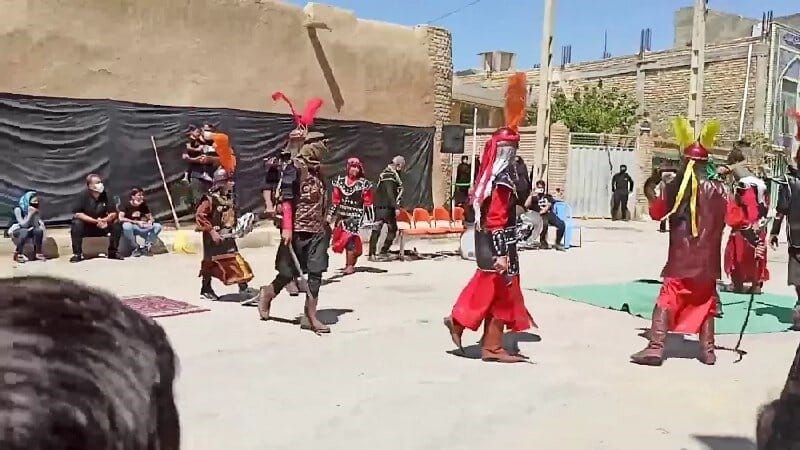
Tehran – The second culturally artistic Tajie lamentation ceremony in the village of Keirabad in Semnan district, Semnan province, announced the state’s tourism director.
Samaneh Soltanipour added that the event will be held in the form of creating works in various areas of handicrafts, Isna reported.
She said anyone interested in attending the event can send their work until August 14th.
Soltanipour added that August 17th is the deadline for original works and final reviews by the Secretariat of the Symposium on the City of Semnan, the Village of Kheyrabad, Kheyrabad Handicraft House and the Stories of Love’s Passion for the Final Review of the Works.
According to the Public Relations Department of Semnan Cultural Heritage, Tourism and Handicrafts, she said the work at the event will be reviewed by Professor Seid Mahmoud Eftekhari, Dr. Maedi Emray and Dr. Esan Ahman.
She reminded her that the closing ceremony of this mourning event will be held on August 20th at the Handycraft House in Kaylabad Village.
Meanwhile, the head of Donggan’s Cultural Heritage, Tourism and Handicrafts Bureau announced that the traditional Tajie ritual will be held on Safah’s evening.
Mojtaba Akbarpour said that in Tajiye’s ritual performances for the martial teachings of Hazrat Ali Akbar (AS), Hazrat Abbas (AS), and Imamhussein (AS), Tajiye’s mourning ceremony was held in the public space of Donggan on the night of Safah, with a enthusiastic acceptance of the noble people of Damgan.
He added that the traditional and artistic ritual is a key step towards the revival and introduction of Tajie’s precious art, which has been registered as an Iranian spiritual heritage on the UNESCO World Heritage List and has a special place in the Damgan ritual culture.
Referring to the enthusiastic attendance of people at the ceremony, he said that the extraordinary acceptance of people at the ceremony in mourning shows their deep love for Ahlul Bayt (AS), and this broad attendee will double his responsibility to plan more carefully in the coming years and carry out this ritual more grandly.
Akbarpour considers interaction and empathy with various Tajie performance groups in Donggan County as one of the important achievements of this mourning ceremony, saying this valuable cooperation plays an effective role in introducing Tajie to the younger generations and promoting the Tajie ritual style of Donggan’s Tajie among those interested in this noble art.
Referring to the factors behind the event, he said that mourning ceremony and traditional Tajie rituals were held in Dongang by Dongang Tajie Centre, with support and cooperation from Dongang city and Islamic council, as well as the Semnan cultural heritage, tourism and handicraft departments.
Iranian Tajie designates a genre of traditional religious theatre that essentially commemorates Imam Hossein’s martialism (as) and the passion of Ahlbeit (members of the Islamic prophet family). In this theatrical genre, the lyrics reading, which is almost always in poetry, takes precedence over director and action.
Tajie, listed on the UNESCO list of Intangible Cultural Heritage in 2010, is a kind of drama about the brave war and martialism of the grandson of Prophet Muhammad (Pbuh), and the other events that occurred in Ashura are the king mart, whose hair was removed by Imam Hussein (AS) and his 72 companions, and other events that occurred in Ashura. Tazieh’s performance began in the Safavid era (1501-1736) and flourished in the Qajar era (1794-1925).
Tajie presents religious events, historical and mythical stories, and folk tales. Each performance has four components: poetry, music, song and movement.
KD