
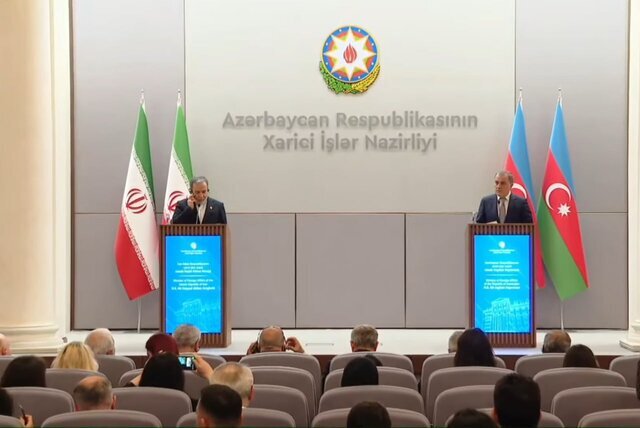
TEHRAN – Iranian Foreign Minister Abbas Araghchi said his visit to Baku came at an “extremely timely” time to reevaluate relations between the two neighboring countries, stressing that Tehran and Baku should not allow outside actors to destroy or redirect their partnership.
Araghchi made the remarks Monday at a joint press conference with Azerbaijan’s Foreign Minister Jeyhun Bayramov.
Araghchi said he had invited Bayramov to visit Tehran and said the two countries had agreed to expand dialogue, consultations and diplomatic exchanges aimed at restoring “unproblematic” relations and strengthening cooperation across the board.
The minister said that Iran is looking forward to welcoming Azerbaijani President Ilham Aliyev and Foreign Minister Bayramov to Tehran. He added that the meeting addressed a wide range of regional issues, including what he described as Israeli aggression against regional countries.
Araghchi said that the meeting also touched on the latest developments in the Caucasus region and the 3+3 cooperation mechanism. Both sides reiterated the need for regional peace and stability and opposition to any foreign interference. They also agreed to promote trilateral meetings with other regional partners.
Foreign Minister Aragushi said that the 3+3 framework is an effective tool to expand cooperation and that Iran is determined to expand relations with Azerbaijan in all fields. “We must not allow outsiders to undermine or misdirect this relationship,” he said.
The minister noted that in accordance with Azerbaijan’s proposal, the next 3+3 meeting will be held in Baku, and then in Yerevan. He welcomed the positive trend in relations between Baku and Yerevan and the broader peace process.
Referring to questions about regional security, Aragushi said Iran and Azerbaijan share similar concerns and believe regional security is the responsibility of regional states. “Any foreign interference is destructive,” he said, adding that Tehran and Baku would continue to work closely together.
Mr. Araghchi cited the continued cooperation between Iran, Azerbaijan and Russia, and reported significant progress on the Rasht-Astara railway. Funding has been secured and preparatory work is more than half completed. Construction is scheduled to begin next year.
Regarding peace proposals for Gaza and the region, Alaghushi said Iran supports all efforts to stop the killing of Palestinians, allow humanitarian aid to Gaza, and end the occupation of the Palestinian territory. “No plan must undermine the Palestinian people’s right to self-determination and sovereignty over their land,” he said.
Azerbaijan is ready to do everything in its power to strengthen relations with Iran: Aliyev
In separate talks on Sunday, Azerbaijani President Ilham Aliyev told the visiting Iranian foreign minister that Baku was ready to use all its capabilities to deepen ties with Tehran. Mr. Aliyev said that Mr. Araghchi’s visit was “historic and extremely important” in promoting mutual understanding, and expressed satisfaction at the steady improvement in bilateral relations.
Araghchi received greetings from Iranian President Masoud Pezeshkian, who reaffirmed Tehran’s determination to expand cooperation in all areas of common interest. He stressed the importance of continued diplomatic engagement, saying continued consultations help prevent misunderstandings and facilitate the management of bilateral issues.
During his visit, Araghchi also discussed regional development with senior Azerbaijani officials, including Bayramov.
Ahead of the visit, Iranian Foreign Ministry Spokesperson Esmail Baghai emphasized the cultural, religious and historical ties that connect the two countries. He said diplomatic exchanges such as Araghchi’s visit contribute to regional stability and strengthen cooperation in the Caucasus.
Araghchi’s visit comes about three months after the United States brokered an agreement between Azerbaijan and Armenia. The agreement prompted warnings from Tehran about Washington’s interventionist intentions in the region. Iran welcomes peace efforts in the region, but says it is closely monitoring developments to protect stability and has repeatedly warned against foreign interference.
Reflecting on his trip, Araghchi wrote that he came to Baku with “a message of peace, friendship and the firm determination of the Iranian government and people to open a bright new chapter in bilateral relations.” He said the visit was not a normal diplomatic mission but a reaffirmation of the “historic kinship” between the two countries.
He pointed out that the regional environment is conducive to expanding purposeful economic cooperation in areas such as transport, energy, trade, investment and people-to-people exchanges. Such cooperation will bring greater prosperity to both countries, he said.