
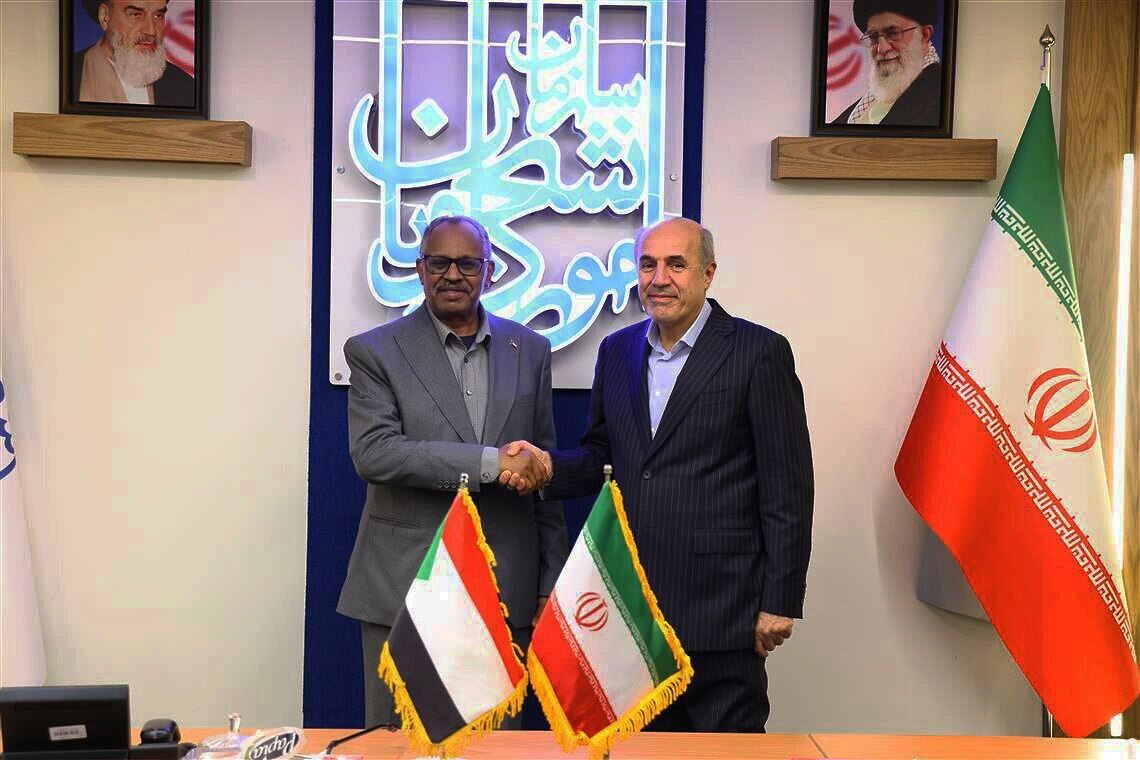
TEHRAN – Student Affairs Secretary Saeed Habiba and Sudanese Ambassador to Tehran Abdulaziz Hassan Saleh Taha explored ways to strengthen scientific cooperation between the two countries.
At the talks held in Tehran on Tuesday, Saleh Taha highlighted the two countries’ cultural commonalities and historical ties, adding that Sudan looks forward to expanding ties with Iran.
The official mentioned Iran’s role in Sudan’s scientific and technological development and expressed hope that more Sudanese students will have the opportunity to study in Iran. “These students are Iran’s cultural and scientific ambassadors in Sudan,” he added.
Khalid Ibrahim Al-Sheikh, Sudan’s deputy ambassador to Iran, said that Sudanese students are satisfied with the educational situation, services and life in Iran.
The official further said that Sudan is proud of the progress of its students, especially in the medical field, and hopes that more students will enroll in Iranian universities.
Mr. Habiba highlighted the high ranking of Iranian universities in the world and explained the country’s achievements in various fields, mainly biotechnology, electronics and modern technology.
The official also announced that the two countries stand ready to strengthen scientific cooperation by accepting privately financed Sudanese students, granting them scholarships and granting them sabbatical leave.
Currently, 23 Sudanese students are majoring in 12 universities in Iran. Of these, 22 percent are women.
Promoting scientific cooperation
In October 2024, Javad Mohammadi, director of Iran’s National Institute of Genetic Engineering and Biotechnology (NIGEB), met with Taha to discuss ways to expand scientific ties.
Saleh Taha, who visited NIGEB, said that Iran’s progress in the fields of biotechnology and genetics is amazing. “Iran’s Institute of Genetic Engineering and Biotechnology can be a perfect scientific model for establishing universities and research institutes in Sudan,” the official stressed.
Sudan aims to strengthen cooperation (with Iran) in the treatment of diseases such as cancer and infectious diseases, as well as exchange of professors and students. Saleh Taha further stated that the country is open to learning from your valuable experience in the international scientific field.
Mohammadi said that in line with the Islamic Republic of Iran’s policy of strengthening international cooperation in the field of science diplomacy, the institute welcomes scientific cooperation and exchanges with other countries, especially Islamic countries.
He stressed that NIGEB is affiliated with the International Center for Genetic Engineering and Biotechnology (ICGEB).
In the event of a pandemic or various diseases in African countries, the institute can work with Sudan and other African countries to develop disease detection tools and disease control methods, officials said.
Mohammadi added that the implementation of joint scientific projects and the exchange of professors and students in genetics and biotechnology sciences are also potential ways to foster cooperation.
MT/MG